The weight of a vessel is a very interesting aspect in the first place. Unlike all other physical objects, when we talk about the weight or mass of a vessel or any floating object in general, we usually allude to displacement.
This displacement, as we know, is nothing but the mass of the floating structure itself and is also equal to the mass of the water the vessel displaces to remain afloat, as per Archimedes’ principle. This quantity is also sometimes expressed in terms of volumetric displacement, which denotes the volume of the water displaced by the weight, which weighs the same as the weight of the vessel.
Cargo Ship
The displacement can be further divided as:
Lightweight
Deadweight
The lightweight is essentially the inherent weight of the vessel itself, including the structural weight of the ship, plus the weight of systems, machinery, equipment, cablings, piping, ducting, wiring, outfitting, and so on. Deadweight is the weight the vessel can carry: cargo, consumables, fuel, freshwater, ballast, people (passengers or crew), provisions, and other effects. Hence, a vessel without all the items in deadweight is basically in a lightship condition.
Though displacement is the common designation of any vessel, the size of a vessel is more specifically denoted depending on the type of ship for all practical purposes. When we speak about cargo and common types of commercial vessels like passenger ships, they can be referred to in more than one way, and that’s often confounding.
For instance, a passenger ship is usually referred to by the maximum number of passengers it can carry instead of the displacement. A 1000-pax ferry, for example, can hold up to a maximum of 1000 people. Deadweight tonnage is another very common term that refers to the maximum carrying capacity of the vessel in terms of weight, which is nothing but the deadweight measure of the vessel.
We have learnt in our previous articles about other standardised measures like Gross Tonnage (GT) and Net tonnage (NT).
To recapitulate, GT is based on the total usable internal space of a vessel, whereas NT is based on the space within the GT that is commercially revenue generating, that is based on spaces designated for cargo or freight or consumers (passenger ships).
They widely differ from the deadweight tonnage as they encompass the total carriable weight of the vessel, including other expendables of deadweight like fuel, lubes, ballast, water, consumables, etc.
Cargo ships that are laden with cargo are usually addressed on the basis of their purpose and utility.
Bulk Carriers and similar vessels
These vessels, mainly designated for transporting dry cargo in bulk format, are referred to in terms of their deadweight tonnage or, more commonly, the DWT tonnage. Hence, when we say that a bulk carrier is 100,000 DWT certified, it essentially means that the given vessel can hold up to a maximum of 100,000 metric tonnes of cargo in its holds.
Bulk Carriers
As we know from several of our previous articles, bulk carriers range extensively in size from 500 tonnes to as much as a whopping 300000 tonnes. The Pacific Flourish is the largest bulk carrier in the present, with a maximum carrying capacity of almost 400000 tonnes!
The wider category of bulk carriers is the General-Purpose Carriers, which can carry more varied types of cargo but usually dry only. Similarly, other miscellaneous special sub-types of bulk carrier vessels include ore carriers, coal carriers, timber carriers, etc., and they are referred to in terms of their deadweight tonnage only. Apart from DWT, GT and NT are commonly used for dry cargo vessels.
Tankers and similar vessels carrying liquid cargo
Tanker Ship
Like bulkers, tankers are also referred to in terms of their deadweight tonnage expressed as DWT or tonnes, along with GT and NT. Crude oil carriers, gas carriers, chemical tankers, etc., all fall under this category. These are based on the maximum amount of liquid cargo the vessel can carry. Like bulkers, liquid cargo ships can also vary widely in size, ranging from as low as 500 DWT to as large as over 400000 DWT.
Containerships
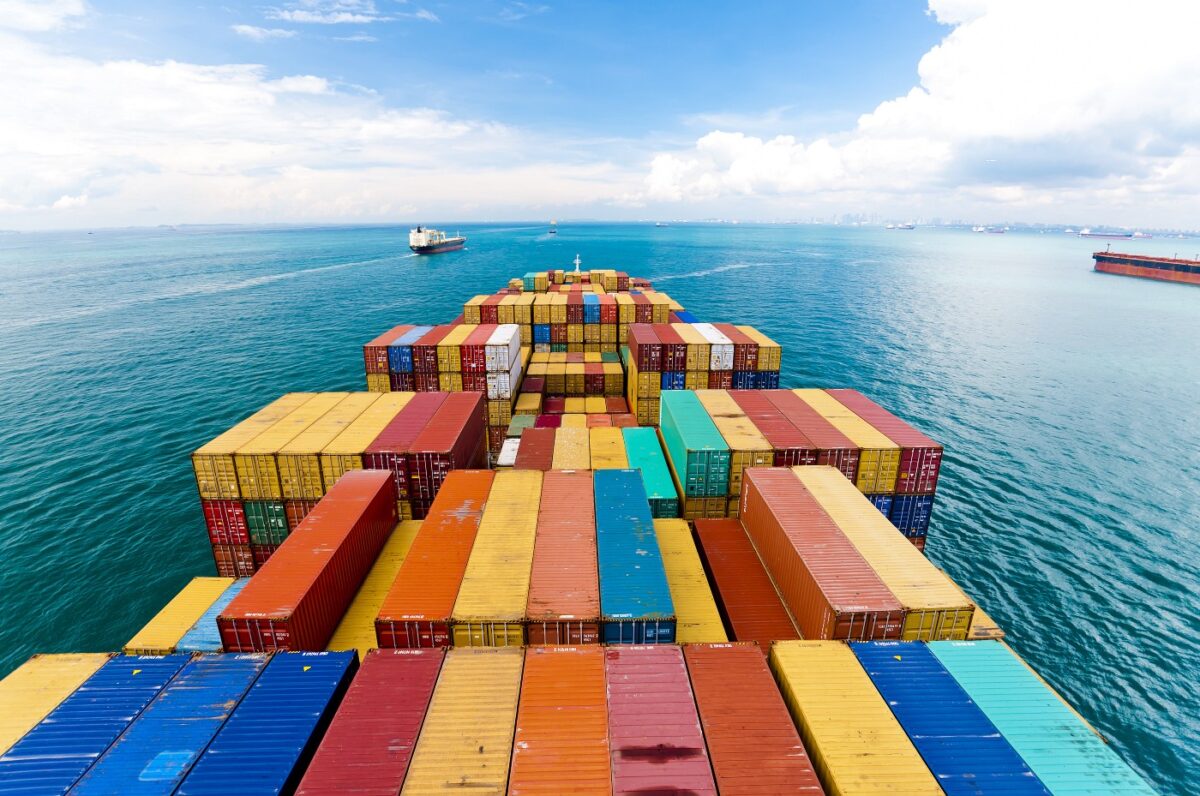
They are one of the most common types of commercial cargo vessels where packaged cargo is in the form of standard containers. More than the overall displacement tonnage, they are mostly identified in terms of the maximum number of containers they can carry.
Containerships
Remember the TEU units that we had discussed many times? Containerships are mainly designated in terms of TEUs. Hence, a 10000 TEU containership essentially means that the vessel can carry a maximum of 10000 1-TEU standard-size containers on board. Conversely, they also mean they can carry 5000 2-TEU or a combination of 5000 1-TEU + 2500 2-TEU containers.
Other types of vessels like Ro-Ro and Ro-Pax
Other types of commercial vessels can be described in different ways. Ro-Ro vessels that are mainly used to ship wheeled cargo like cars are defined in some special units like lane metres. By convention, 1 lane metre equals a deck area equivalent to 2 square metres.
Ro-Ro
Based on the vehicle sizes and the available lane metres, the total carrying capacity of a Ro-Ro can be deduced. Ro-pax vessels that are combinations carriers of vehicles, as well as passengers, can be defined as a combined measure of the lane metres and the number of pax-es it can carry.
Sometimes, these kinds of vessels are also defined simply as the number of vehicles they can carry. Other than these, they are referred to in terms of GT or NT as well.