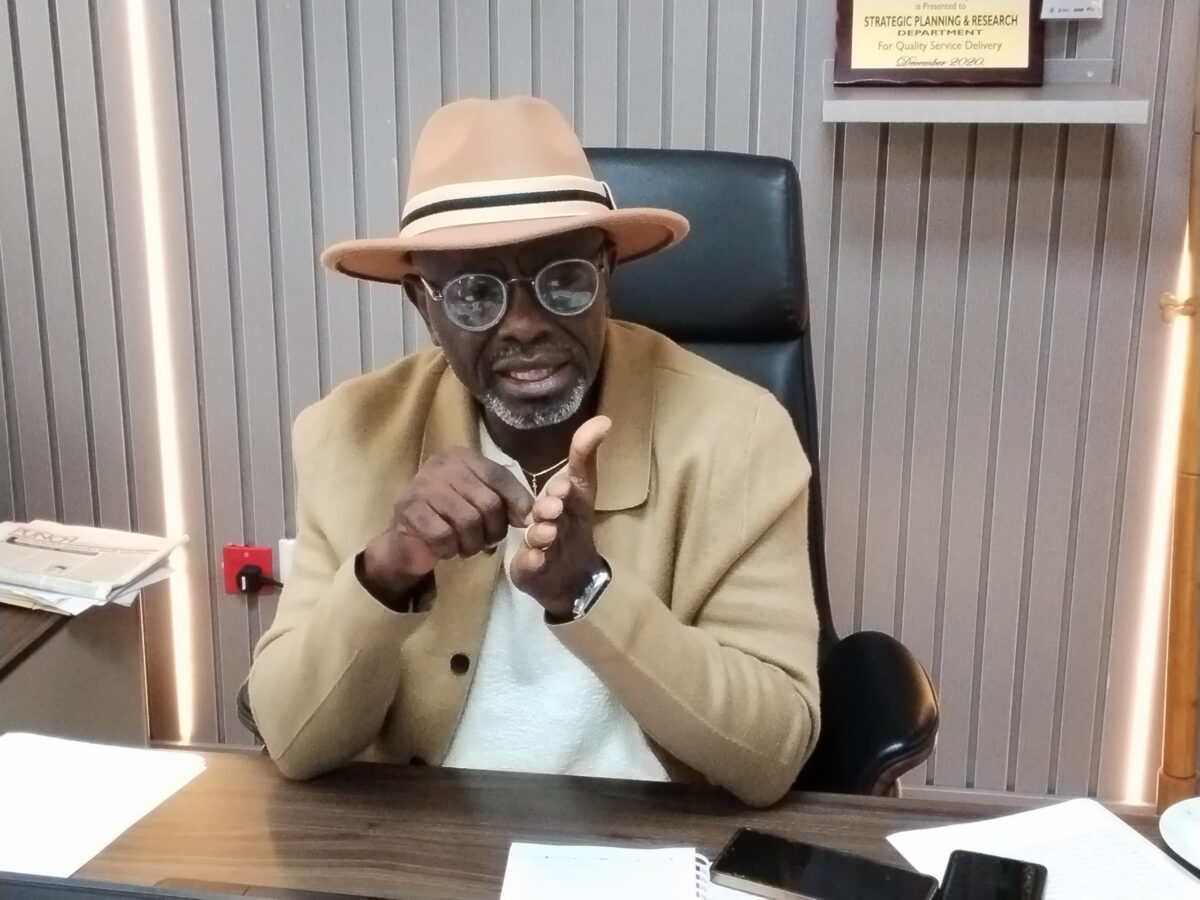
As he prepares to retire after 34 years of service at the Nigerian Shippers’ Council (NSC), Director of Strategic Planning and Research, Mr. Rotimi Anifowose reflects on a career defined by commitment, strategic thinking, mentorship and a deep sense of ownership. In this interview with Joshua Yousouph, he discusses his journey through the public service, major achievements, challenges, leadership philosophy, the future of the Council and Nigeria’s marine and blue economy sector, as well as his plans after retirement.
As you prepare to retire from the civil service, can you reflect on your career journey and the key milestones that shaped your professional life?
Thank you very much. First, let me say it is a great honour to have been given the opportunity to serve this country within the framework of the marine and blue economy sector. I joined the Nigerian Shippers’ Council in 1992 as a Public Relations Officer. Looking back today, I can say with profound gratitude and a deep sense of fulfilment that it has been a rewarding journey. It is a journey that has afforded me the opportunity to continue learning, to develop resilience, and to acquire a deeper level of commitment that enabled me to work for 34 years in the service.
When I reflect on my career, the first thing that defined my journey was the realization that I did not want to be merely a salary earner. I wanted to be a stakeholder. If you work and think only like a salary earner, you simply collect your salary and go. But I wanted to acquire a stake in the Nigerian Shippers’ Council and, ultimately, in the Nigerian economy. Having acquired those stakes, I wanted to nurture and cherish them. That principle guided me from day one.
In terms of milestones, I would particularly mention my time as Assistant Director in charge of Industrial Relations and Welfare Services. During that period, we introduced initiatives that promoted staff welfare and wellness. One of the most notable was the car loan scheme, which enabled about 25 to 30 staff members to purchase brand-new vehicles. It was gratifying seeing colleagues drive their own new cars and improve their quality of life.
We also introduced programmes that strengthened staff welfare and camaraderie, including celebrations and initiatives that brought employees together. Another defining period was when I served as Director of Strategic Planning and Research. That role gave me the opportunity to help shape the strategic direction of the Council. Beyond programmes and policies, one of my greatest achievements has been mentoring younger officers. From my days in Public Relations, through Industrial Relations, my tenure as South-West Zonal Coordinator, and later at headquarters, I have had the privilege of mentoring many officers who are today making meaningful contributions to the organisation.
During your tenure as Director of Strategic Planning and Research, what would you describe as your most significant achievements?
Before I discuss achievements, I must acknowledge the support of the Executive Secretary and Chief Executive Officer of the Nigerian Shippers’ Council, Dr. Pius Akutah. I am not someone who praises people unnecessarily. It is not because he is my Chief Executive Officer. I mention him because he created an enabling environment that allowed my team and me to ventilate our ideas and innovations. He encouraged initiative and gave us room to personalise and own the projects we developed. That kind of leadership is rare. I must also stress that whatever we achieved was not my achievement alone. I worked with a team of brilliant men and women, and I cannot claim sole credit for what was truly a team effort.
One of our major achievements was transforming the department from a primarily planning-focused unit into a strategic hub that supports evidence-based decision-making. We ensured that strategic thinking became central to the Council’s operations and that management decisions were supported by data, research and strategic analysis.
We also strengthened the culture of strategic thinking and planning, making it a continuous management process rather than a periodic exercise. Another achievement was improving the Council’s monitoring and evaluation processes. We introduced regular performance reviews and ensured stronger alignment between departmental activities and the Council’s strategic objectives.
Through annual management retreats, departments were required to align their goals and programmes with the Council’s overall strategic direction. We also introduced middle-management retreats for officers on Levels 12 to 14 because we recognised their critical role in translating management objectives into action. Research became a major priority. We strengthened the Council’s research capacity, promoted evidence-based policymaking and enhanced the Trade and Transport Data Bank. We also modernised and digitised the Council’s library, transforming it into a modern knowledge centre.
On budgeting, we improved the timeliness of budget preparation and institutionalised internal budget defence sessions. Every department and unit was required to defend its budget proposal before approval, ensuring that resources were allocated based on strategic relevance and impact. We also implemented a robust Budget Management System that improved monitoring, accountability and utilisation of approved funds.
What were the major challenges you faced during your public service career, and how did you overcome them?
It has not been easy. A journey of 34 years cannot be described as easy. One of the biggest challenges was adapting to constant policy and institutional changes. Public institutions are dynamic. Government priorities change, organisational priorities change, leadership changes and regulatory frameworks evolve. A good example is the creation of the Federal Ministry of Marine and Blue Economy. Before President Bola Tinubu established the ministry, the sector operated under Transportation. Such changes naturally require institutions and officers to adapt.
The way I dealt with this challenge was by embracing continuous learning. Whenever new policies emerged, I worked with my team to understand them and determine how they could improve service delivery. Another challenge was operating with limited resources while still being expected to deliver quality results. The Nigerian Shippers’ Council is a critical economic regulator, yet resources are often constrained.
To overcome this, we prioritised projects according to their impact, encouraged teamwork and ensured efficient utilisation of available resources. Managing diverse stakeholders was another challenge. Government, industry players, labour unions, colleagues, the media and the public all have different expectations.
Balancing these interests requires effective communication, transparency and fairness. On a personal level, I also encountered office politics. Some people misunderstood my commitment to the organisation and interpreted it as self-promotion. But I have always believed that there is no competition in service delivery. There is only complementarity. We are here to complement one another.
The mistake many people make is seeing competition where there should be collaboration. If you see your colleagues as competitors, you are already losing. Service delivery succeeds when people complement each other’s strengths. I also encountered situations where some leaders felt threatened because I was willing to express my views respectfully but honestly. Sometimes leadership ego can become a challenge in public service. However, I remained committed to speaking up whenever I believed it was necessary in the interest of the organisation.
What leadership principles guided you throughout your career, and what legacy would you like to leave behind?
I was fortunate to have civil servants as parents. My father rose to become a Level 14 officer at NEPA despite not attending a tertiary institution, while my mother rose to management level at the Federal Airports Authority of Nigeria. They prepared me for public service long before I joined the Nigerian Shippers’ Council. One of the key principles they instilled in me was that public service is an honour and a responsibility.
As I have said repeatedly, I never saw myself as merely a salary earner. I saw myself as a stakeholder. Another philosophy that has guided me throughout life is excellence. Whatever I do, I want to be proud of it. It is not about people praising me. It is about being able to look back and say, “You tried.” The legacy I want to leave behind is simple. I want younger officers to understand that they are stakeholders in this organisation. They must project and protect their stake. Challenges will come, but they should always remember that they have a responsibility to the institution and to the nation.
What opportunities and challenges lie ahead for the Nigerian Shippers’ Council and the marine and blue economy sector?
One of the biggest opportunities before the Nigerian Shippers’ Council is its evolution into the Nigerian Port Economic Regulatory Agency. We are awaiting presidential assent, and when that happens, it will strengthen our capacity to ensure transparent and fair port pricing, protect the interests of both shippers and investors, promote healthy competition and improve efficiency and accountability within the port system.
We must understand that economic regulation is not only about protecting shippers. It is also about protecting investors and ensuring balance. Another major opportunity lies in the African Continental Free Trade Area. We must ask ourselves whether we are fully maximising the opportunities it presents. There are opportunities for increased exports, greater cargo throughput, logistics hub development and the expansion of indigenous shipping and freight forwarding businesses. The marine and blue economy sector itself offers immense opportunities in fisheries, aquaculture, coastal tourism, marine biotechnology, offshore renewable energy, maritime transport and logistics, shipbuilding and related industries.
The Council must prioritise its transition into an effective economic regulator. It must strengthen consumer protection, promote competition and investment, improve stakeholder engagement, enhance research and data management systems and deepen digital transformation. We should also strengthen our regulatory impact assessment capabilities and improve dispute resolution mechanisms.
For the Ministry of Marine and Blue Economy, implementation of the National Blue Economy Policy should be pursued vigorously. The ministry should continue strengthening coordination among agencies, improving port infrastructure and multimodal transportation systems, promoting indigenous participation in shipping and logistics, enhancing maritime security and attracting both local and foreign investments.
As you transition into retirement, what are your plans?
First, I will keep playing golf. I honestly do not know what my life would be without golf. I remain grateful to the friend who introduced me to the game. Secondly, I am returning to my communication roots. Do not be surprised if you see me covering events like a journalist. I may even be competing with some of you. I also intend to return to programme anchoring. Before my administrative responsibilities increased, I used to anchor programmes regularly. Now that I am becoming a free citizen again, I will return to that passion.
I also plan to venture into podcasting, with a particular focus on golf. In addition, I will undertake some consultancy work, though golf will certainly remain a major part of my retirement life. And regarding the stake I spoke about throughout this interview, retirement does not mean abandoning it. After 34 years in the marine and blue economy sector, I am not walking away. I will continue to contribute, engage and advocate for the sector. People who think they will be free of me should forget it. I will still be around.
What advice would you give to young professionals seeking successful careers?
First, invest in your own development. Do not wait for your organisation to develop you. Spend your own resources if necessary. Attend programmes, acquire knowledge and continuously improve yourself. Second, build bridges. Some people call it networking, but I prefer to call it bridge-building. Do not build relationships simply because you want to exploit them. Build them because you want to learn, contribute and create value.
If all you do is take, people will eventually move away from you. Relationships should be mutually beneficial. Another important lesson is never to destroy relationships. Do not be too quick to maximise them. Invest in them. I often talk about what I call “media husbandry.” Just as livestock requires nurturing, relationships require nurturing. I left Public Relations about 16 years ago, yet I still maintain strong relationships with media professionals across generations because those relationships were nurtured over time.
My advice to young professionals is simple: develop yourself, build meaningful relationships, nurture them carefully and combine modern approaches with traditional values. Doing so will give you a strong foundation for long-term success.