
The minister of transport is currently toying with the idea of encouraging the Nigerian Maritime Administration and Safety Agency (NIMASA) to float a maritime bank. He has even gone ahead to direct relevant departments in his ministry as well as NIMASA to commence work on the documentation and put together all essential requirements for the take- off the bank and to start liaising with appropriate regulatory agencies for the issuance of operationk of Nigeria (CBN) on the other.
The minister of transport is currently toying with the idea of encouraging the Nigerian Maritime Administration and Safety Agency (NIMASA) to float a maritime bank. He has even gone ahead to direct relevant departments in his ministry as well as NIMASA to commence work on the documentation and put together all essential requirements for the take- off the bank and to start liaising with appropriate regulatory agencies for the issuance of operationk of Nigeria (CBN) on the other.
Alhaji Suleiman is not the originator of the concept of a maritime bank; his predecessor in office Alhaji Isa Bio had at one time assured that a regional maritime bank was in the offing, and like Suleiman, he had also set April 2010 as the take-off date for the bank.
The former minister had tos license for the new bank.
Probably desirous of adding it as one of his few achievements in office, the minister had even reportedly gone ahead to set a March deadline for the take-off of the bank. Top- level talks are said to have commenced between officials of the ministry of transport and NIMASA on one hand and those of the ministry of finance and the Central Banld the visiting Secretary-General of the Maritime Organisation of West and Central Africa, Teye Addico who paid him a courtesy visit in Abuja early in 2010 that a property had even been secured in Abuja to accommodate the bank and that the main banking activities would begin before the end of 2010. That date was never kept.
But, unlike what Suleiman has in mind, the maritime bank which his predecessor had in mind was to be a sub-regional financial institution with equities owned by all member states of the ECOWAS.
But, going by the way the minster said it; it is like Nigeria may have jettisoned the idea of a regional maritime bank for an indigenous bank that will solely take care of the financial needs of players in the nation’s maritime sector.
But when juxtaposed with an earlier comment which he made at recent stakeholders’ forum on participation by Nigerians in the lifting of petroleum products and crude oil, then there may be hope in the dream for a maritime bank. The minister had declared that government was not going to grant a lifeline to the sector.
He attributed that stance to what he termed as recklessness on the part of arrowheads of the sector; and by that, he probably meant the chief executives of federal government agencies.
The same government had given a lifeline of N500Billion to the aviation sector and $200million to the entertainment industry.
It is worthy of note that there has not been any effective policy for local participation in the maritime industry since 1960 when Nigeria gained its independence. The only event worthy of note was the acquisition of 32 bulk cargo vessels for the now-defunct Nigerian National Shipping Lines
The birth of the National Maritime Authourity 1987 led to the emergence of a cargo allocation policy for indigenous firms and the Ship Building and Ship Acquisition Fund (SASBF) policy.
Having confirmed the failures of previous interventionist policies, government enacted the Coastal and Inland Shipping (Cabotage) Act as another bold move to enhance the performance of indigenous players.
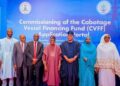
An integral part of the Cabotage Act is the Cabotage Vessel Financing Fund (CVFF) under the purview of the NIMASA, to promote the development of indigenous capacity by providing financial assistance to Nigerian operators in domestic coastal shipping.
Sadly however, as at mid- June 2010, proceeds from the CVFF was about USD$55 million.
Certainly, this amount is insufficient to finance any meaningful vessel acquisition given the amount of applicants to the CVFF and the going cost of acquiring the type of vessels that they require. To acquire a 5000 DWT vessel that can be engaged in transportation of crude oil and petroleum products within the lucrative Nigerian and West African markets require between USD$10 to USD$20 Million.
Apart from the maritime bank that the minister of transport is canvassing, we are aware that NIMASA has been exploring other means of facilitating more funding for the Nigerian maritime industry.
Recently, NIMASA announced that off-shore funding was being sourced for the benefit of indigenous shipowners and companies. The agency in fact spearheaded trip to some South East Asian countries where Nigerian shipowners struck some deals about ship acquisition.
For the fact that Nigerian banks are reluctant to invest in vessel acquisition for the development of the maritime industry, the option of a maritime bank has become relevant, but the modality is the problem.
Can the economy of the country shoulder a specialized bank like what the maritime bank represents? Can the proposed bank muster sufficient liquidity to meet the huge cost of vessel acquisition? Does the minister have the clout to push it through? Isn’t it better for the government to ensure that NIMASA continues with its marshaling of off-shore funds for indigenous shipowners and also encourage to grow the CVFF rather than encouraging the establishment of a public sector-driven bank solely for the maritime sector?











Discussion about this post