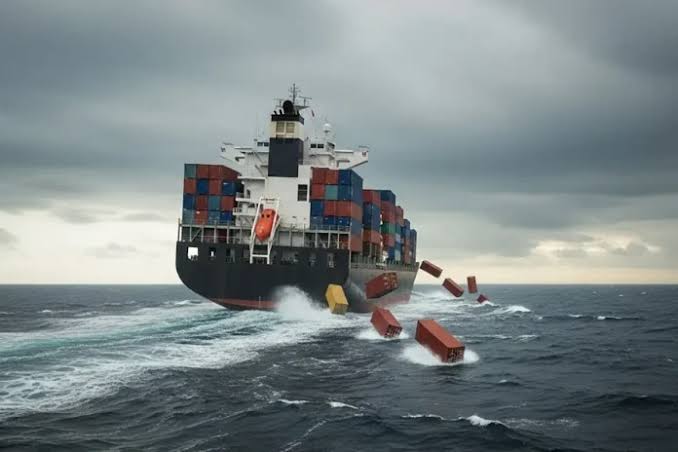
In the latest reminder of the vulnerabilities that persist in container shipping, Ever Lunar lost 50 containers into Callao Bay on August 1, 2025, just days after Ever Feat, another Evergreen vessel, lost an estimated 30 to 40 containers off the South American coast between Brazil and Uruguay..
Despite bigger ships, smarter software, and decades of operational experience, the industry still grapples with an age-old problem: containers going overboard..
The question is no longer “how” it happens.. It is “why”.. Why are we still losing containers in an era of digitised, optimised, and closely monitored shipping..??
When the sea gets rough, size does not matter——–
There are two trains of thought 1) that larger vessels are more stable and thus less likely to lose containers 2) that larger vessels are vulnerable to stack collapses.. Both thoughts could be wrong or could be right also depending on the weather conditions that the ship went through at that time and also condition of cargo on board.
Neither Ever Lunar nor Ever Feat were caught in a cyclone or rogue storm.. These losses happened under conditions once considered moderate, challenging the assumption that container loss is strictly a result of extreme weather or small ship instability.
Seas are not just rougher, they are less predictable—–
Scientific data confirms that ocean conditions have become more volatile in recent decades, particularly in the Southern Hemisphere:
Wave heights have been rising by 0.5 to 3 cm per year since the 1980s in regions like the South Pacific, Southern Ocean, and along the South American west coast..
The “100-year” wave height used in ship design has increased by up to 8% in some areas..
More energetic swell from the Southern Ocean now impacts coastlines such as Peru and Chile, destabilising anchorage zones and port operations..
Container loss data—
According to the World Shipping Council’s 2025 report:
An average of 661 containers were lost annually between 2020 and 2023..
Although the 2024 figure of 576 containers marks a rise from 2023 (221 lost), it is still below the 10-year average of 1,274..
Notably, 35% of 2024’s losses, nearly 200 containers, occurred around the Cape of Good Hope, following mass rerouting due to Red Sea conflict..
The South African Maritime Safety Authority (SAMSA) links these to four high-profile incidents in mid to late 2024:
- CMA CGM Benjamin Franklin (18,000 TEU): 44 containers lost
- CMA CGM Belem (13,000 TEU): 99 containers lost
- MSC Antonia (7,000 TEU): 46 containers lost
- MSC Taranto (14,000 TEU): 5 empty containers lost
Additional losses were recorded on Maersk Stepnica and Rio Grande Express, with over 350 containers damaged in total..
Even non-container ships have suffered.. m.v.Ultra Galaxy, a general cargo vessel, shifted its load, listed, grounded, and eventually broke apart off South Africa’s coast..
Where are containers being lost..??
While the North Pacific remains the top region for container losses due to long routes and winter storms, there is a clear geographic spread:
The North Sea continues to be risky in winter (e.g., MSC Zoe)..
South American corridors like those sailed by Ever Feat and Ever Lunar are seeing more container incidents tied to unstable swell conditions..
The Southern African coastline, once viewed as a secondary transit zone, has become a container loss hotspot due to rerouted traffic and converging wave systems..
The trend is clear.. Container loss is no longer confined to traditional hotspots.. Climate volatility is creating new risk corridors..
The issue may lie in the chain, not the ship—-
Both Ever Lunar and Ever Feat lost containers under non-extreme conditions.. This suggests the problem may lie deeper, in how containers are secured and managed across the chain..
Key issues flagged in recent investigations include:
- Inconsistent pre-voyage lashing inspections
- Manual checks instead of smart lashing systems
- Delayed or weak crew response to rolling or listing at anchor
- Poor cargo packing, weight mis-declaration, or degraded container integrity
While not every incident is caused by VGM non-compliance, even small errors across the chain can add up under pressure.. The real threat is not individual failure, but system-wide friction under dynamic sea conditions.
The common causes are not size, age, or route length, but a combination of motion sensitivity, poor cargo securing, and reactive planning..
Final thoughts: The “why” we must answer..
As vessels get larger and technologies evolve, the expectation was that container losses should be decreasing.. Yet hundreds of containers still go overboard each year..
This raises hard questions:
- Are we still relying on compliance instead of foresight?
- Are anchoring decisions informed by live swell data, or outdated norms??
- Are we investing in predictive safety tools, or just ticking boxes??
The cost of container loss goes beyond insurance claims.. It damages trust, pollutes oceans, and reveals system vulnerabilities..
It is time for carriers, ports, regulators, and shippers to work together on smarter, preventive solutions, because losing containers should not be the price of global trade in 2025..