Smuggling activities around the Seme-Krake axis on the Nigeria- Benin Republic border, particularly the illicit importation of foreign rice, have witnessed a noticeable decline in recent weeks following intensified enforcement by the Nigeria Customs Service (NCS), findings by Shipping Position Daily have revealed.
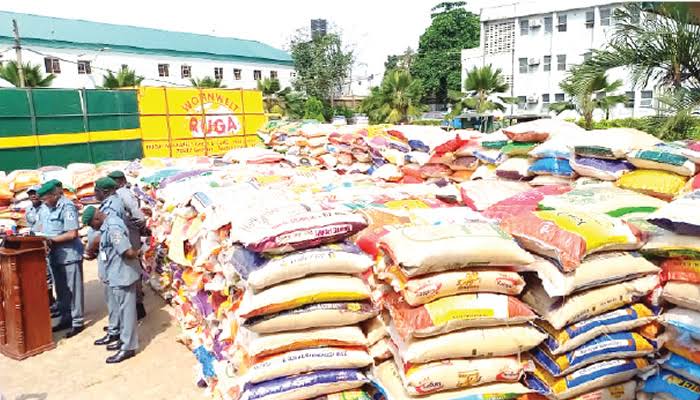
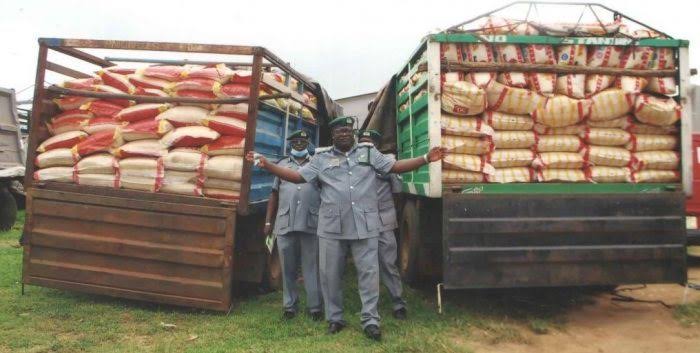
The clampdown, which sources linked to a massive seizure carried out by Customs operatives in July, caused a ripple effect in the market with the price of rice soaring to unprecedented levels.
Investigations by our correspondent revealed that the scarcity of smuggled rice in circulation initially pushed the cost of a 50kg bag of rice to between ₦65,000 and ₦70,000. However, traders and local operators confirmed that prices have begun to normalize as smugglers are gradually devising new ways to beat the system.
According to market sources, rice prices have now fallen to between ₦58,000 and ₦62,000 depending on the brand. The highest observed price is ₦62,000, while some brands are sold for as low as ₦58,000. This represents a significant reduction compared to the peak prices witnessed a month ago, when the aftermath of Customs’ massive seizure disrupted supply.
Many traders who purchased stock at inflated rates during the scarcity period are now struggling to sell, as the newly-smuggled consignments arriving through alternative channels are cheaper. This has left them caught between recovering their investments and competing with lower market prices.
Further findings show that instead of using vehicles and trucks that are more easily intercepted, smugglers now resort to transporting rice in smaller quantities via motorcycles.
The strategy involves moving bags of rice across the Seme axis up to the roundabout, where the goods are trans-loaded onto motorcycles. These motorcycles then navigate through villages and pathways, particularly routes stretching through Age Mowo and surrounding communities.
In a chat with our correspondent last week, a trader in Badagry who identified himself as Adams Avoseh noted that the price of rice currently ranges between ₦58,000 and ₦62,000, depending on the brand, unlike between ₦65,000 and ₦70,000 a month ago. He confirmed that prices have begun to normalize.
In his words: “About a month ago, right after the last massive seizure by Customs, we were buying at ₦65,000 to ₦70,000 per bag, and that made it difficult for many of us. But now, things are gradually stabilizing. The highest price you can get now is ₦62,000, while some brands go for as low as ₦58,000. The challenge is that those of us who are stocked at high prices are struggling to sell, because the new arrivals are cheaper,” he explained.
Also speaking, a clearing agent at the Seme chapter of the Association of Nigerian Licensed Customs Agents (ANLCA), Alhaji Kehinde Ibrahim who claimed to be familiar with smuggling operations confirmed that traffickers have adjusted their strategies to avoid Customs patrols along major routes.
Alhaji Ibrahim disclosed that instead of using vehicles, many now rely on motorcycles to move rice through villages and narrow pathways. He noted that the shift to motorcycles has increased the risks of accidents and losses, but remains one of the few viable alternatives for smugglers under the current tight surveillance.
Specifically, the ANLCA member said the motorcycle option has become increasingly common between Badagry Roundabout and Aradagun, areas where Customs checkpoints are non-existent. This allows smugglers to move consignments with less fear of seizure.
Contrary to speculations about persistent rice smuggling through the Seme border, the immediate past Chairman of ANLCA Seme Chapter, Mr. Onyekachi Ojinma, said there was no large-scale rice smuggling at the border. He explained that the occasional seizure of trucks laden with rice by Customs officers was proof of the Service’s uncompromising stance.
“There is nothing like smuggling of rice from Seme. People that tried to smuggle rice last month met stiff Customs resistance, and their trucks were seized. Carrying one or two bags of rice cannot be classified as smuggling—it only becomes smuggling when you bring in a trailer or lorry load of rice, and there is no route to pass without Customs intercepting you,” Ojinma said
On his part, the Public Relations Officer of the Seme Customs Command, spokesperson, Mr. Isah Sulaiman reaffirmed its resolve to sustain the fight against smuggling while balancing trade facilitation and revenue generation. He noted that the operational successes recorded were tied to the proactive leadership of the Customs Area Controller, who assumed office on February 11, 2025.
He further disclosed that collaboration with sister security agencies, constructive engagement with border communities, and cooperation with counterparts in the Republic of Benin have been central to the Command’s effective border management.
The Command spokesman noted that on the 1st July and 19th July 2025, it successfully intercepted and seized five trucks laden with smuggled goods along the Lagos-Abidjan corridor. The trucks were found to contain a total of 2,800 foreign parboiled rice 50Kg each with a Duty Paid Value of the seized rice and the means of conveyance (trucks) of 919,500,626.00k only.
He stressed that the Federal Government’s ban on rice importation through land borders remains in force as part of efforts to encourage local rice production and protect Nigerian farmers. Nigeria, according to the Customs Service, is currently Africa’s largest rice producer with an annual output exceeding 8 million metric tonnes. While rice smugglers continue to devise new ways to evade enforcement, the Seme Customs Command insists that its vigilance and intelligence-driven operations will sustain pressure on the illicit trade.