As many as 800,000 seafarers will require additional training by the mid-2030s to enable the shipping industry to transition towards alternative low- and zero-carbon fuels and technologies with the aim of keeping global warming to 1.5C or less by 2050, a DNV study shows.
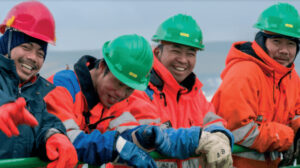
Findings also suggest that a lack of certainty on alternative fuel options is having knock-on effects for seafarer training, as the global maritime community works towards a clearer decarbonization pathway in a post-fossil fuel era.
The research was conducted by maritime consultancy DNV and commissioned by the Maritime Just Transition Task Force Secretariat, formed to ensure that shipping’s response to the climate emergency puts seafarers and communities at the heart of the solution.
The report outlines three decarbonization scenarios to provide insights into seafarer training and skills needed to support a decarbonized shipping industry. The scenarios have varying decarbonization trajectories and estimate the number of seafarers who would require additional training to handle alternative fuels up to 2050, with the timing and type of training dependent on the ambition of the decarbonization trajectory and the future fuel mix.
However, under all three of the scenarios, there is an immediate need to start putting the training infrastructure in place.
This includes investing in and enhancing maritime training establishments, including proper facilities and equipment, as well as fostering competent maritime trainers. National governments can also urgently revise or establish standards and training requirements for alternative fuel types through amendments to the STCW Convention at the International Maritime Organization.
Initial findings of the study were hinted a month ago by Guy Platten, Secretary General of the ICS. He insists that new training programs, standards, and courses need to be created for seafarers to handle low-carbon fuels and service zero-emission vessels safely
As a response to the growing need for upskilling of seafarers to meet the challenge of shipping’s decarbonization, a shipping action plan was launched at COP27 by UN organizations, shipowners, and unions.
The Action Plan makes recommendations for industry, governments, seafarer unions and academia (including training providers). They include:
· Strengthening global training standards
· Ensuring a health-and-safety-first approach
· Establishing advisory national maritime skills councils
“All three scenarios DNV identified require some form of retraining the workforce. The good news is that seafarers are prepared and willing to be part of this transition. But crew want to know that the fuels they’re handling are indeed safe, and that we as an industry have the training pathways established to upgrade their skills,” Stephen Cotton, General Secretary of the International Transport Workers’ Federation (ITF) said.
“Seafarers and other maritime workers are already feeling the effects of an unstable climate — dry unnavigable rivers, soaring ocean surface temperatures, shutdown ports with heatwaves and flash floods.”
“Climate action focused on people and job creation must be at the core of a Just Transition to Net Zero. This new paper highlights that aligning with a 1.5 C trajectory requires action now to support the upskilling of the maritime workforce as the shipping industry moves to rapidly cut its greenhouse gas emissions,” Sanda Ojiambo, Assistant Secretary-General and CEO of the UN Global Compact, said.
“The action-plan represents a global first — it marks the first business sector uniting in a tripartite framework — shipowners, seafarers’ unions and UN organisations — to discuss how to secure a Just Transition together.”
Platten pointed to an urgent need to establish the infrastructure and training required to prepare seafaring workforce, both in developed and developing countries, to meet the industry’s decarbonisation objectives.
Read Also: Top 9 Classification Societies In The World (1)
“This should be done as of today, so they are ready and able to meet the challenges that new green fuels and propulsion technologies will pose and mitigate any potential health and safety risks for ships, communities, the environment and seafarers themselves. This is an opportunity for all so that no-one is left behind. Shipping cannot decarbonise without its workers and the 10-point action plan developed by the Task Force maps out a pathway for how this can be achieved, as our industry continues to navigate towards a decarbonised future.”
”Decarbonization is bringing new opportunities, new technologies but also new risks. Our first priority must be to achieve safe decarbonisation. We must take a collaborative approach to safeguard our people, our ships and our environment. This report points to the challenges and the tangible actions the industry can take to support and protect its workforce,” CEO of DNV Maritime, Knut Ørbeck-Nilssen, said.
Kitack Lim, Secretary General of the International Maritime Organization, said that seafarers must have the appropriate training for a smooth transition to a greener future, adding that this is something that will be in sharp focus as IMO works on its comprehensive review of the STCW Training Convention.
“As shipowners and operators we must recognise that we cannot achieve a green transition without our seafarers. Shipping has an opportunity to be a leader in the creation of a just green transition, in which we invest in the training and upskilling of our workforce, create decent job opportunities for all, not just for the few, raise work standards, tackle safety concerns, and ensure diversity issues are addressed from the outset,” Karin Orsel, CEO, MF Shipping, said.
“This is good business sense, this is ethically and morally the right thing to do, and importantly, if we embed just transition practices into our operations from the outset, we will as an industry have a stronger chance of meeting our global carbon reduction targets.”
Kindly like us on Facebook/twitter