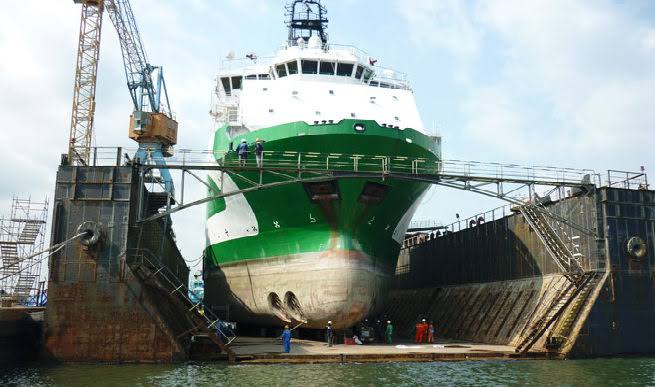
There is high connection between dry-docking and ship building. In fact, dry-docking is a crucial process in both ship construction and repair, enabling access to a vessel’s submerged parts for maintenance, inspection, and upgrades. It involves placing a ship in a specialized enclosure, either a basin (graving dock) or a structure that lifts the ship out of the water (floating dry dock), and then removing the water to expose the hull for work.
Dry docks are essential for building new ships, providing a stable platform for assembling the hull and other components. The ship is constructed in the dry dock, and once complete, it can be launched into the water, either by flooding the dock or by sliding the vessel down a ramp.
Dry docks allow for the efficient and safe construction of large vessels, which would be impossible to build directly in the water.
Connected to the above is the fact that, dry docking allows for the inspection and repair of a ship’s hull, propellers, rudders, and other underwater components.
Regular dry docking is necessary to ensure the ship’s seaworthiness and compliance with international regulations. It requires the ship’s hull to be cleaned, repainted, and have any necessary repairs made. The process may also lead to major overhauls and upgrades to a ship’s machinery and equipment.
Available records show that, there are few functioning shipyards in Nigeria where minimal repairs of Cabotage vessels of 500 tonnes are carried out. Among the lot is Nigerdock Limited, which was originally 100 per cent owned by the Federal Government. It was privatized following the demise of the Nigerian National Shipping Line (NNSL).
At its peak, before it was liquidated, the NNSL had 29 vessels. Sadly, today, Nigeria’s flag administration is essentially dead and we no longer have a single ocean-going vessel. Our shipyards can barely repair Cabotage vessels, forcing international shipping companies to other smaller African countries in order to retain their safety classification and insurance, as specified by the International Maritime Organisation (IMO).
Apart from Nigerdock, there was a time in the nation’s history, when we had the Calabar Ship Repair Yard, Warri Ship Repair Yard, Rivers State Ship Repair Yard, Koko Ship Repair Yard and Burutu Ship Repair Yard, among others.
It is a fact that the Nigerian shipping community and ships that patronize Nigeria currently depends on Ghana, Senegal, and South Africa etc. to dry-dock all ocean-going vessels doing business in Nigerian waters.
The imperative of Nigeria fully embracing ship building and dry docking venture can be seen in the fact that, conventionally ships are required to dry dock at least twice every five years to retain their seaworthiness. With an average of 5,000 ships calling on Nigerian ports annually, in addition several active coastal vessels and fishing trawlers, it is estimated that Nigeria could save billions of Naira and earn millions of dollars.
We recall rather sadly also, that the Nigerian Liquefied Natural Gas recently disclosed that it dry docks its ships outside of Nigeria, because the nation lacks the capacity. It however lamented that the choice was causing the firm a huge foreign exchange, owing to capital flight.
Managing Director of NLNG Ship Management Limited (NSML), a subsidiary of NLNG; Abdul-Kadri Ahmed affirmed that none of the dockyards available in Nigeria can dry dock any of its LNG vessels. Ahmed stated that his company would have wanted to dry-dock its 11 LNG vessels and one LPG vessel in Nigeria due to the huge revenue such would generate for the country, but lamented there is no such dry-docking facility that can handle an LNG vessel in the country.
While the modular floating dock acquired by Nigerian Maritime Administration and Safety Agency (NIMASA) some years ago, was meant to fill the gap, it’s unfortunate that this has not been achieved. It is our hope that the recent efforts by NIMASA under Dr Dayo Mobereola to re-activate the craft will yield expected results. It is bad enough that the multi-billion naira craft has been idle since it was brought into Nigeria. But the recent action of the management of NIMASA gives a ray of hope.
The state of the floating dock and other dry docks in the country has robbed Nigeria of revenue. Data obtained from the NIMASA indicate that Nigeria currently has a fleet of 4,610 flagged vessels with a total tonnage of 6,131,814.55 gross registered tonnage (GRT) and 1,102 Cabotage vessels with a combined tonnage of 2,037,184.63 GRT. This is huge revenue lost to neighbouring countries and beyond.
Nigeria should take a lesson from countries like Ghana, Kenya, Togo, Ivory Coast, Benin Republic and Cameroon, which are doing well in ship building, dry docking and repairs. Nigerians who go as far as these countries, do so because there are no facilities in-country to meet their demands, as said earlier by the CEO of NLNG Ship Management Limited.
If Nigeria had enough or near-standard facilities, there probably would have been no need for patronizing facilities outside the shores of the country, and in the process lose scarce foreign exchange. Due to the limitations of local shipyards and dockyards, the owners of the vessels resort to taking them to neighbouring countries. We agree with experts who have submitted that, this does not only lead to increased unemployment, but also impedes the development of skills in the maritime sector.
Perhaps the greatest challenge to this ambition is the lack of the most important requirements for ship building, and dry docking- finance, steel and energy. It’s a long way to go, however the few that are still pushing up to meet the required standards should be encouraged.
Even with the challenge of finance, steel and energy supply, some privately-owned facilities are still in the business. They deserve to be supported by the government.