The industrial unrest by clearing agents on account of the alleged arbitrary hike in tariff by shipping companies, is not new, neither in the manner that they have expressed their grievances, nor in the manner in which the regulator; the Nigerian Shippers’ Council has handled it.
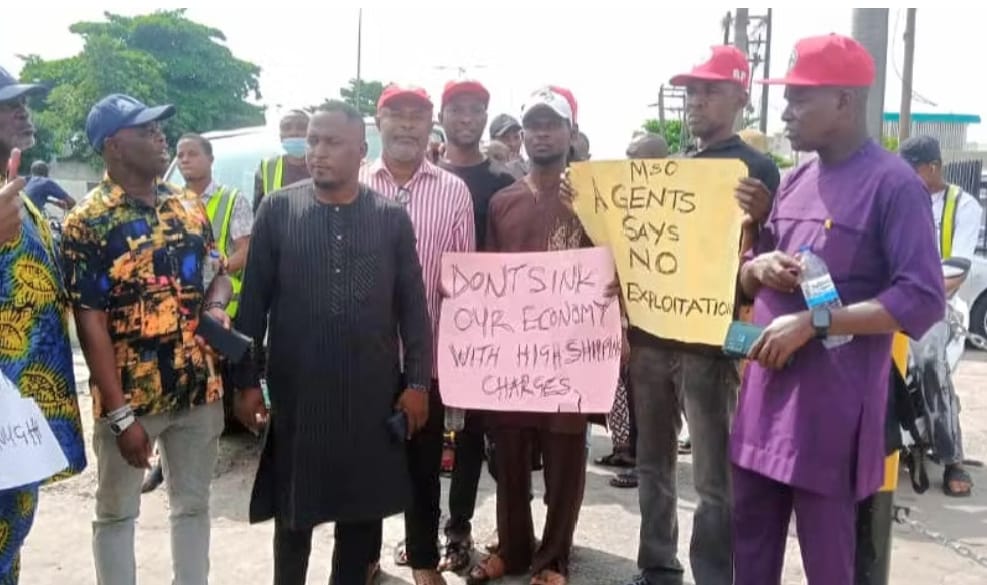
And for the umpteenth time and for the same reason, freight forwarders in Lagos ports, were recently on war path with shipping companies and shut down operations at major shipping companies, including MSC, Pacific International Lines, and others.
This action is similar to previous disputes where agents and transporters had in recent years, protested against similar, or sometimes “exploitative,” charges and conditions in the Apapa port area.
Prior to the recent, freight forwarders have at every opportunity complained of excessive and arbitrary charges on the part of the terminal operators and shipping companies.
While sympathising with the freight forwarders, we will like to ask the following questions: where are the importers in all of these and why should they be silent while freight forwarders face the fire? It is also pertinent to ask the embittered freight forwarders if they duly informed the Council for the Regulation of Freight Forwarding in Nigeria before embarking on the recent protests. This does not mean that we are not in support of their action, and it also does not indicate our endorsement of the action. We are only thinking aloud about the implications of this action on port operations, and the larger implication of the action.
Some stakeholders have accused freight forwarders of being the only group ‘standing in the front row’ to accuse shipping companies of arbitrarily high charges, when they are also guilty of imposing ridiculous charges on importers.
Our concern at this point is the hydra-headed issue that is called port charges. The freight forwarders do not have regulated charges or scale of charges that are uniform. Secondly, majority of importers do not have sufficient knowledge of the dynamics of port tariffs and charges. Similarly, in spite of about two decades of port concession, there still exist in the port system several ‘unreceipted’ charges which importers and licensed customs agents contend with.
We are happy that the Nigerian Shippers’ Council (NSC) eventually woke up to do the needful, by calling the shipping companies to order, and directing that the contentious charges be suspended. We are equally glad that the shipping companies complied.
Even though these actions came a bit late, it was needed to calm the anxieties which had built-up since the clearing agents first moved to picket the offices of Mediterranean Shipping Company (MSC) in Apapa.
The Nigerian Shippers’ Council’s immediate action of calling for dialogue between the shipping companies and licensed customs agents, escalated the protests. Sadly, this call for dialogue in the face of rising agitation is akin to playing the ostrich. By the Council. How else could the Council have played its role as the economic regulator, if not to step into the face-off frontally and meet the warring parties? Rather, it kept urging them to embrace dialogue, when all it was required to do, was to call the parties to a meeting, which its CEO or his representatives would preside over and look at all the sides to the issues,
We are persuaded to believe in the position of the shipping companies, as put forward by their association- the Shipping Association of Nigeria, which disclosed that the controversial tariffs were a product of stakeholder consultations, and that the position of the clearing agents which supported a total reversal of the charges, would be tantamount to running at a loss by the shipping companies. Their threat that such a reversal may lead to withdrawals of service as well as vessel shortages, higher costs, is unacceptable though.
It is a fact that the shipping companies have had to contend with rising operational cost for years, while freight forwarders have taken advantage of Nigerian seaports’ unique method of charging for services rendered. There is no data-backed evidence that the charges been contested by clearing agents are indeed commensurately high.
The protesting clearing agents are simply what they are – agents to importers. They don’t bear the brunt of the tariff hike. Rather, it is the importer, as represented by many bodies including the various chambers of commerce and industry and the organized private sector (OPS), who are best suited to contest the hike, and not clearing agents or any middle men or third party interests.
Picketing and disrupting activities at the shipping companies offices, is unacceptable where there are official and legal avenues to vent opposition. Unfortunately, both the clearing agents and the Nigerian Shippers Council lost it there.
The fact that the shipping companies approached the Council and got approval for upward review of their charges, tells a lot about all the parties.
Finally, we appeal to the Nigerian Shippers’ Council to urgently call a tripartite meeting of the shipping companies, the clearing agents and the Council to reach an amicable compromise. This compromise must be based on facts and data submitted by the two parties.
The recent matter, perhaps also offers an opportunity for the Council for the Regulation of Freight Forwarding in Nigeria (CRFFN) to step up its game by effectively regulating the activities of the various freight forwarding groups. Throughout the duration of the protests, the CRFFN was curiously silent and invisible. It left the protesters to their fate.
Shipping is global. Events of the past few weeks have negatively impacted on the Nigerian maritime sector. But, above all, it has further ridiculed Nigeria as a nation where there is no regulation and mediation, even in commercial disputes.