The Area Manager of the National Inland Waterways Authority, in charge of Niger and Kwara States, Mr. Akapo Adeboye in this interview with Joshua Yousouph speaks on the persistent challenges of inland water transportation in his jurisdiction. He sheds light on the root causes of recurring boat mishaps, human behavioral issues, operational bottlenecks, and the proactive measures NIWA is implementing to improve safety, including tree-clearing operations, rescue stations, river marshals, and community sensitization. He also discusses regulatory enforcement, infrastructure gaps, and the need for collaborative efforts to make Nigeria’s waterways safer and more efficient.
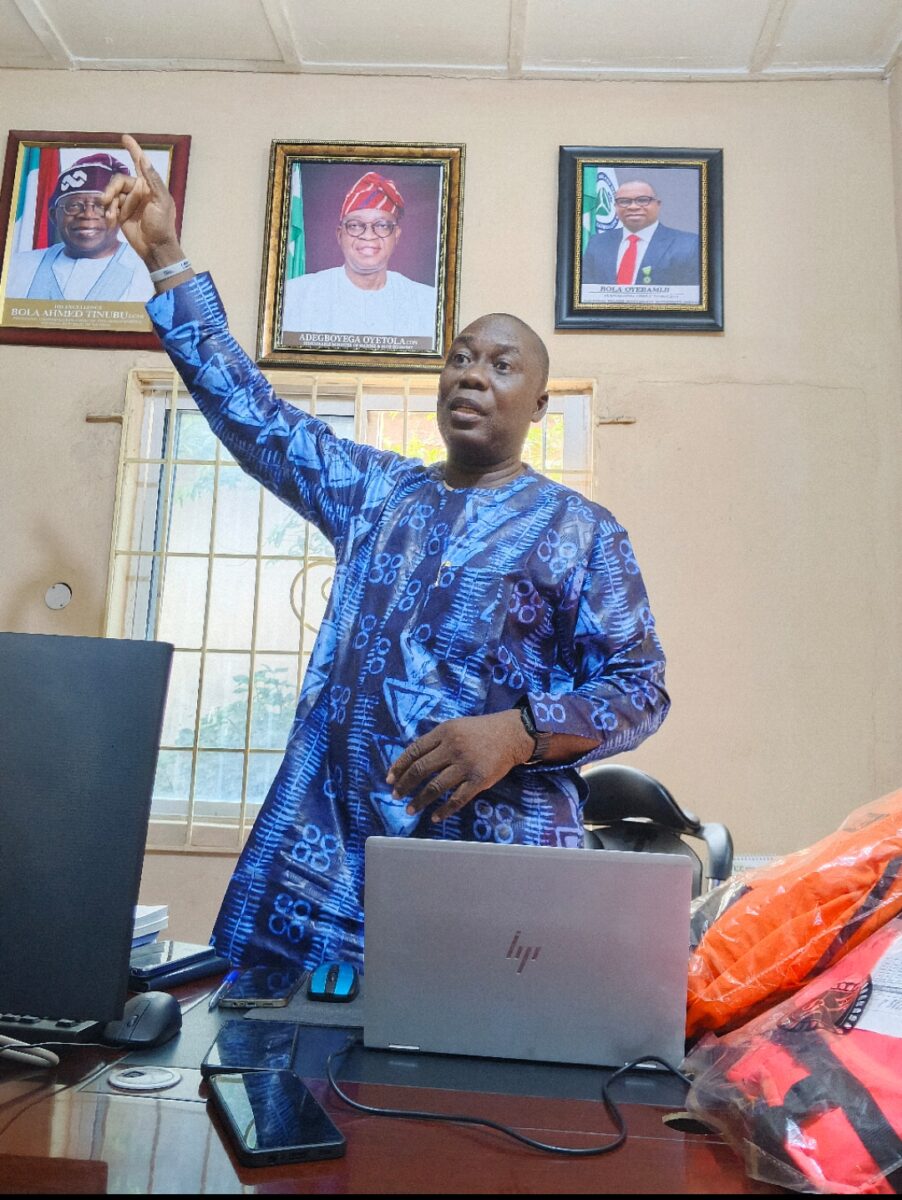
“Many accidents happen because people travel at night—sometimes as late as 2 a.m”
“We have river marshals in about 30 communities”
What are the major challenges contributing to boat mishaps in your area of jurisdiction?
One of the major challenges that cause boat capsizing is the presence of trees—what we call the “old Bussa.” The water has taken over those old Bussa areas, which include Malale, Lokumene, Shaguno, Duga, Kokoli, Garafuni Takwa. These areas have been submerged as water flows through the entry points of dam sites into Kainji Lake for power generation. The same happens downstream from Jebbad. These formations link various places: from Awuru to Gbagibo Mudi, which connects to Gbagibo Mokwa. Gbagibomudi is a boundary between Niger and Kwara. From there, water finds its way into Jebba dam. All these are human-linked waterways. In the course of water coming in, it overwhelms many communities, because they are not used to such situations. These people are traditionally water people—farmers and miners—using boats for movement. But to the glory of God, through the National Inland Waterways Authority in partnership with Hydroelectric Power Producing Areas Development Commission (HYPPADEC), we have been able to cut trees at Kainji Lake. That has brought a lot of peace there. Our office took over the cutting and maintenance of those trees. The same applies to Jebba.
How do seasonal water changes affect safety?
That’s another challenge. At certain times, we have high-high water, then high-low water, and sometimes low-low water. The way people move on high water is different from low water. We constantly sensitize them about this. Because these people come in thousands—especially on Fridays and Saturdays for market days—we talk to them in languages they understand: Nupe, Basa, Yoruba, Gwari, and English. We try as much as possible to make them understand safety.
You mentioned human attitude as a challenge. Can you elaborate?
Yes, the number one challenge is attitude. These people believe they were born on the waterfront and they know everything. For example, when we tell them to use life jackets, they call life jackets “singlets.” They don’t believe it saves lives. So, we produce customised life jackets for adults and children because most casualties during incidents are children and the elderly who cannot swim. Another behavioral challenge is carelessness—people are not mindful of the risks. That’s why we introduced boarding manifests, just like in motor parks. Before you enter a boat, you must register. We also have cargo manifests.
Aside from behavior, what other operational challenges do you face?
Another big challenge is insufficient boats, especially fiber boats. We’ve been encouraging people to phase-out wooden boats because they are outdated. NIWA, the state, and the Niger State Union (Boat Owners and Freshwater Association) are working together to enforce the 2023 Inland Waterways Transportation Code.
The rules include: No life jacket, no travel; no overloading or over speeding; no travel after 6 p.m, amongst others. Enforcement is done with NIWA, Marine Police, Civil Defense, DSS, and others. Violators will be prosecuted and jailed.
What measures have been put in place to improve safety and rescue operations?
We are setting up safety and rescue stations. For example, Bagibo will have a station linking down to Jebamoro and Baro. Currently, we have outlets at New Bussa and Baro, covering Malale, Lokomene, Shaguno, Duga, and Kokoli, down to Awuru (Jebba Lake axis). We have river marshals in about 30 communities. These marshals come from the communities themselves; most are trained divers. We also have patrol boats, surveillance boats, and ambulance boats on Kainji and Jebba lakes. We’ve installed live buoys along Bagibo Mokwa to Bagibo Muti and scanned the entire Kainji Lake channel for navigation safety.
Despite these efforts, accidents still occur, especially at night. Why?
Many accidents happen because people travel at night—sometimes as late as 2 a.m.—using torchlights to navigate. They often hit logs hidden underwater due to erosion uprooting big trees. Again, this boils down to attitude and ignorance.
Can you share some of the measures NIWA is putting in place to sensitize communities within your jurisdiction?
One of the major things we do is sensitization, and we do it in a way the people understand. We go into their communities, and because we have people of different languages—one of our staff is Nupe, another is Igala, I am Yoruba, and we have Hausa, Gwari—we use those languages to communicate effectively. We don’t rely only on radio, because some people don’t listen. Instead, we go to their markets with a megaphone while they are doing business and talk to them in their language. We tell them: “Don’t do this, don’t do that,” and we explain why. This approach has really helped us a great deal. We also collaborate with community leaders to appoint river marshals, ensuring local participation. Recently, we distributed 3,000 life jackets starting from Niger State Government House as a flag-off. However, people misuse life jackets—selling them, using them as pillows or farm tools. So, we now monitor distribution aggressively and ensure they are available at waterfronts.
Since assuming office here, what would you say has been one of your major challenges?
One of the major challenges is the swamps inside the river and fallen trees that obstruct navigation. These pose serious dangers for boat users. That’s why we make efforts to mark the channels and cut down some of these trees, though it’s not easy because some communities use them as landmarks for navigation. When we first went to Bagibo, they were happy because they said God remembered them—NIWA was the first government presence there. We cut down dangerous trees within the channels, but we didn’t cut all, because the people told us some trees serve as signs to know their route. For example, in Malale, there’s a big tree we left because, during high water, that tree is their only visible guide for almost 100 kilometers. After clearing the channels, we put buoys there as photo channel guides to show boat operators the safe routes. We are now planning to do the same from Jebamoro down to Lokoja and then to Escravos. We work in partnership with the Nigerian Navy and our surveying department to ensure safety.
We’ve noticed there are few or no jetties along the waterfront. What’s your view on this development?
Yes, most waterfronts now have jetties. But here’s the challenge: River Niger is dynamic in nature. If you build fixed jetties, during low water season, the river can shift up to 10 kilometers away, rendering the jetties useless. That’s why we are proposing floating jetties. They are already in the country, and we hope to position them to solve this issue.
From statistics, your area—covering Niger and Kwara States has been a hotspot for boat mishaps. What’s NIWA doing differently to address this?
NIWA is doing its best, but the truth is that communities and local governments also need to step up. In many cases, 90% of the work has been left for NIWA alone, even though these indigenous people are the ones operating the boats. We realized that sensitization and life jacket distribution alone are not enough. For example, 3,500 life jackets were distributed during a flag-off in collaboration with the state, but when we went back, we couldn’t find one in use. People were selling them, using them as pillows, bed sheets, or even on farms.
To tackle this, we created safety agents called “River Marshals.” They are community-based, selected by their leaders, and most of them are divers who can save lives. We also collaborate with community leaders like Village Heads and District Chiefs. This grassroots approach has helped us build trust and enforce safety.
How do you deal with issues of overloading and unsafe practices among boat operators?
The environment here is very different from Lagos or Port Harcourt. People’s main businesses are trading and farming. Sometimes, one boat will carry two or five cows, bags of rice, and people all at once. Why? Because they believe another boat won’t come soon. If there are 1,000 people waiting, they all want to enter the same boat. We are educating them that it’s safer to make multiple trips. This way, life is safe, business continues, and they make more money. It’s a mindset issue, and we are working hard to reset that thinking.
What about boats registration? We understand most of the boats are wooden, and some fibre boats distributed by the state government are yet to be registered.
Yes, registration is another challenge. We are careful because of the nature of our environment. People think registration means we want to tax them heavily, so they resist. We have written several letters and even created an association called the Nigeria State Boat Owner and Freshwater Association. This was our initiative after years of training and sensitization. The association now helps us engage boat owners better. Our goal is to tag every boat with an identity like “NG/BOR/MAL/001” (indicating the state, local government, and community). This will help us trace boats in case of mishaps. But resistance is high, so we apply wisdom and work gradually through their association.
Finally, what support do you need to sustain these efforts?
We need continuous support from the Federal Ministry of Marine and Blue Economy, under Alhaji Adegboyega Oyetola, and our Managing Director, Mr. Bola Oyebamiji, who have been very supportive. We also need states and local governments to be more involved. NIWA cannot do it alone. Water transportation is coming back, but it requires all hands to be on deck—federal, state, local governments, and communities.