By Joshua Yousouph
Investigations by Shipping Position Daily have revealed that tensions have continued to mount in Nigeria’s maritime sector as importers and cargo owners accuse industry regulators and service providers of excluding them from consultations on shipping tariff adjustments, with stakeholders blaming the proliferation of shippers’ associations for deepening confusion over representation.
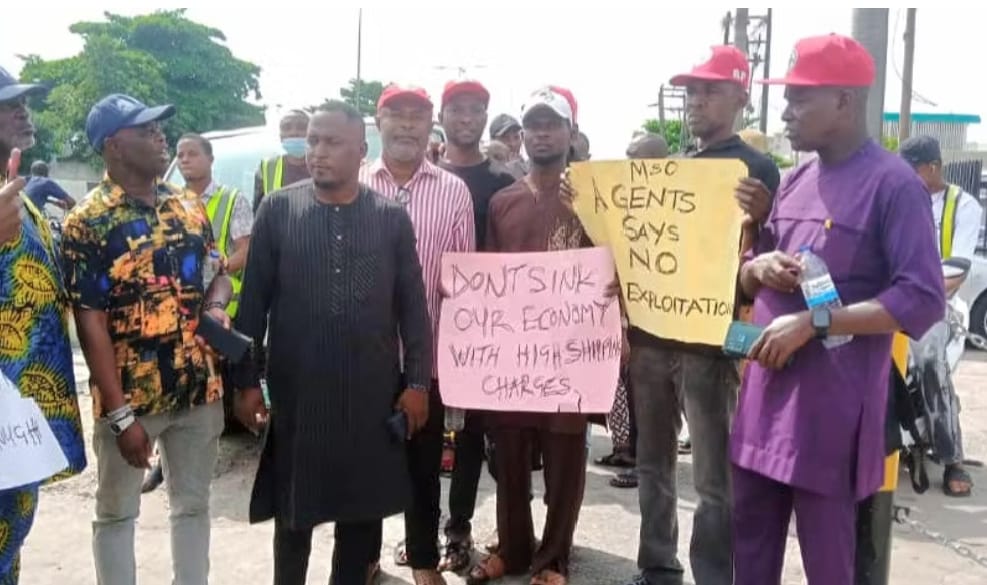
At the centre of the dispute is the Importers Association of Nigeria (IMAN), which insists that its members are repeatedly left out of stakeholder engagements preceding shipping tariff hikes imposed by terminal operators and shipping lines.
Stakeholders who spoke with Shipping Position Daily last week say the ongoing disagreement highlights a broader governance challenge in Nigeria’s maritime industry, where overlapping associations continue to compete for recognition, often complicating efforts to reach consensus on tariff policies and stakeholder representation.
As shipping costs remain a sensitive issue for import-dependent businesses, stakeholders warn that failure to resolve the representation crisis could further strain trade efficiency and deepen distrust within the sector.
Speaking exclusively with our correspondent last week, Chief Joseph Ajoku, Southwest Chairman of the Importers Association of Nigeria, alleged that importers—the real drivers of the maritime economy—are routinely sidelined while decisions affecting freight costs are taken without their input.
He faulted what he described as the replacement of importers with freight forwarding associations in key negotiations, arguing that clearing agents cannot speak for cargo owners.
“We were not involved in the consultations. We were not involved in the negotiation. The shipping companies only came and announced their decision to us. They are negotiating for increment without involving the real people, which are the importers,” he added, insisting that agents only serve as intermediaries handling documentation and cargo clearance.
Ajoku maintained that while agents play operational roles in the supply chain, they do not have the mandate to represent importers in policy formulation processes that directly affect trade costs.
He also dismissed claims of internal division within IMAN, describing such narratives as outdated and misleading, adding that the association remains unified and functional.
However, the controversy has exposed deeper structural disagreements over who truly represents cargo owners in Nigeria’s maritime space.
Reverend Nicodemus Odolo, President of the Shippers Association of Lagos State (SALS), argued that the root of the crisis lies in what he described as “abnormal” representation structures within the industry.
According to him, the enabling law establishing the Nigerian Shippers’ Council was designed to ensure that shippers operate under a unified framework to protect cargo owners’ interests, but multiple parallel associations have weakened coordination. “The truth of the matter is that the Act says the Shippers’ Council is to protect the interests of shippers, and there must be a body—the shippers association,” Odolo said.
He maintained that allowing multiple groups with different names and affiliations to participate in stakeholder discussions has created confusion and diluted the voice of genuine cargo owners.
Odolo further argued that many industrial disruptions in the sector end up burdening importers with demurrage and storage costs, stressing that proper consultation with cargo owners would reduce such losses.
Meanwhile, Chief Frank Ukor, an IMAN chieftain and trustee, called for stronger legal recognition of importer associations, similar to other industry bodies such as transport unions like RTREAN and Maritime Workers’ Union of Nigeria (MWUN).
He urged the government to formalize IMAN under a statutory framework to improve regulation, streamline stakeholder engagement, and enhance revenue generation in the sector.