By Oluyinka Onigbinde
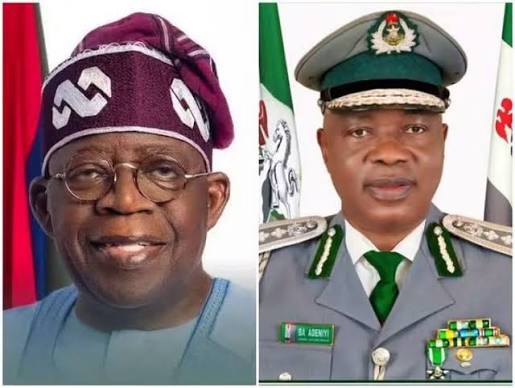
President Bola Ahmed Tinubu’s decision to extend the tenure of Comptroller-General of Customs, Bashir Adewale Adeniyi, by six months is widely seen as a vote of confidence in a reform programme that has significantly reshaped the Nigeria Customs Service (NCS) over the past three years.
The extension, announced as Adeniyi is completing his initial tenure, comes at a time when the Service is implementing far-reaching reforms, including full digitalisation of customs operations, implementation of the Nigeria Customs Service Act 2023 and the rollout of the indigenous B’Odogwu Unified Customs Management System. Government insiders believe the extension is intended to provide continuity for these reforms and ensure they are fully institutionalised.
When Adeniyi assumed office in June 2023, the Service faced persistent revenue leakages, cumbersome cargo clearance procedures, promotion backlogs, low staff morale and widespread allegations of corruption. Although the Customs Act 2023 had opened the door for sweeping reforms, translating the legislation into practical improvements required decisive leadership.
Three years later, the narrative has changed considerably.
Perhaps the most remarkable achievement has been in revenue generation. Within his first year, Customs recorded a 74 per cent increase in collections, generating N4.49 trillion between June 2023 and May 2024, compared to N2.58 trillion in the corresponding period before his appointment.
The momentum continued. In 2024, the Service generated more than N6.1 trillion, surpassing its annual target by over N1 trillion and representing a 90.4 per cent increase over the N3.2 trillion realised in 2023. Customs has since remained one of the Federal Government’s most dependable revenue-generating agencies.
Industry observers attribute the performance to tighter enforcement, improved valuation systems, enhanced compliance, exchange rate reforms and sustained efforts to block long-standing revenue leakages.
Beyond revenue, Adeniyi’s administration has aggressively pursued technology-driven reforms aimed at reducing human interference and improving transparency.
Central to this effort is the deployment of the indigenous B’Odogwu platform, designed to replace the ageing Nigeria Integrated Customs Information System. The platform automates cargo processing, improves efficiency and minimises opportunities for leakages.
The administration has also expanded the Authorised Economic Operator (AEO) Programme, introduced improved risk management systems, deployed additional non-intrusive inspection technology and strengthened collaboration with other government agencies to facilitate trade.
Although stakeholders acknowledge that full automation is still evolving, many agree that cargo clearance has become more predictable and efficient than it was three years ago.
Adeniyi has equally raised Nigeria’s profile internationally.
In a historic development, he became the first Nigerian Comptroller-General of Customs elected Chairperson of the World Customs Organization (WCO) Council, the highest decision-making body of the global customs organisation. The appointment was widely interpreted as international recognition of Nigeria’s ongoing customs reforms and Adeniyi’s leadership within the global customs community.
Internally, one of the administration’s most visible achievements has been its emphasis on personnel welfare and career progression.
For years, delayed promotions had frustrated officers across the Service. Adeniyi responded with one of the largest promotion exercises in Customs history. In December 2024 alone, the Customs Board approved the promotion of 1,419 junior officers, while subsequent exercises advanced hundreds of senior officers.
The promotions boosted morale and restored confidence among personnel who had experienced years of career stagnation.
However, some retired officers have expressed concerns that the accelerated promotions have created competency gaps in certain management positions, underscoring the need for continuous leadership training and capacity development.
The Service has also strengthened its national security role.
Under Adeniyi, anti-smuggling operations have led to major seizures of arms, ammunition, narcotics, petroleum products and other prohibited items. One of the administration’s most significant achievements was the interception and transfer of 3,897 arms and ammunition to the National Centre for the Control of Small Arms and Light Weapons, reinforcing Customs’ role in protecting both national revenue and national security.
Despite these gains, significant challenges remain.
Corruption continues to cast a shadow over Customs operations. While Adeniyi has maintained a zero-tolerance policy against misconduct, incidents involving extortion and abuse of office still occur.
The recent case of an officer allegedly demanding N200,000 from a motorist along the Lagos-Benin corridor once again highlighted the persistence of unethical practices within some operational commands. Although the officer was immediately subjected to investigation by the Customs Police Unit, stakeholders argue that preventing misconduct should receive as much attention as punishing offenders.
Freight forwarders and transport operators continue to complain about unofficial payments, multiple checkpoints and inconsistent operational practices.
These concerns have renewed calls for the strengthening of the Customs Police Unit through improved manpower, modern investigative tools, enhanced intelligence capabilities and greater operational independence to effectively enforce discipline within the Service.
Another issue requiring urgent attention is the welfare of officers who lose their lives in active service.
Over the past three years, several Customs personnel have died during anti-smuggling operations and other official assignments. Stakeholders have urged the Service to establish more comprehensive support packages for their families, including educational scholarships for children, improved insurance benefits, housing assistance and enhanced compensation.
Many believe such initiatives would honour the sacrifices of fallen officers while boosting the morale of serving personnel.
Observers also believe the six-month extension granted by President Tinubu provides an opportunity for Adeniyi to consolidate ongoing reforms, complete the nationwide implementation of the B’Odogwu platform, deepen trade facilitation, strengthen internal accountability and address unresolved institutional challenges.
Complaints regarding multiple checkpoints, overlapping functions among government agencies and delays in cargo dispute resolution remain areas requiring sustained attention.
As Adeniyi marks three years at the helm of the Nigeria Customs Service, his record reflects an administration that has fundamentally altered the institution’s direction through higher revenue generation, digital transformation, improved officer welfare, stronger stakeholder engagement and enhanced international recognition.
The President’s decision to retain him beyond his statutory tenure suggests that government considers the reforms too important to interrupt at this critical stage.
Whether history ultimately remembers Adeniyi as the Comptroller-General who permanently transformed Customs will depend not only on the impressive revenue figures or technological innovations recorded under his watch, but on whether the reforms become enduring institutional practices capable of outlasting his administration. For now, the six-month extension appears to be an acknowledgement that the reform journey is not yet complete, and that continuity is considered essential to securing the gains already achieved.