By Oluyinka Onigbinde
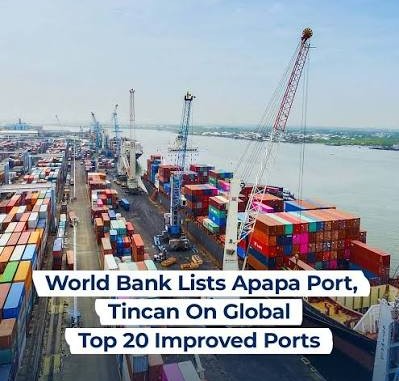
The latest World Bank Container Port Performance Index (CPPI), which ranked the Lagos Port Complex (Apapa) and Tin Can Island Port among the world’s most improved ports, has sparked fresh debate in Nigeria’s maritime sector, with stakeholders divided over whether the recognition reflects real economic gains or only statistical improvement in efficiency indicators.
The CPPI report, jointly released by the World Bank and S&P Global Market Intelligence, placed the two Lagos ports among the top global improvers over a five-year period, citing improvements in vessel turnaround time, cargo handling efficiency, and overall operational performance between 2020 and 2025. The ranking has been described as one of the strongest global acknowledgements yet of Nigeria’s port reforms.
Speaking on the ratings, the Centre for the Promotion of Private Enterprise (CPPE) said the development validates sustained reform efforts in the sector, describing it as evidence that Nigeria’s trade facilitation agenda is beginning to yield results.
The group’s Chief Executive Officer, Dr. Muda Yusuf, said the improvement reflects coordinated interventions by key institutions including the Nigerian Ports Authority (NPA), the Nigeria Customs Service (NCS), the Presidential Enabling Business Environment Council (PEBEC), and the Federal Ministry of Industry, Trade and Investment.
According to him, “The recognition is a strong validation of ongoing reforms within Nigeria’s port ecosystem and the broader trade facilitation environment.”
He added that improvements in digitalisation and automation were beginning to reshape operations, noting that “the implementation of the National Single Window initiative and automation of customs and port processes are helping to reduce bureaucratic bottlenecks, improve transparency, and strengthen Nigeria’s trade competitiveness.”
However, Yusuf cautioned that the progress should not be misinterpreted as a full resolution of Nigeria’s port challenges. He warned that “while the progress is commendable, it should serve as a catalyst for deeper reforms,” stressing that issues around access roads, logistics costs, and regulatory coordination remain significant constraints.
He further stated that “efficient ports are critical to economic growth, export competitiveness, investment attraction, and job creation,” urging stakeholders to sustain reform momentum to ensure long-term gains.
In contrast, maritime expert and freight forwarding stakeholder; Chief Eugene Nweke, said the global recognition has not translated into meaningful relief for port users, particularly in terms of cost of doing business at the ports.
While acknowledging improvements in operational efficiency, Nweke argued that “it is a heavy development for global image, but operationally it has not translated into cost of doing business.”
He questioned whether efficiency gains had impacted port charges, insisting that importers and exporters are yet to feel the benefits in real terms. “So it does not in any way affect the cost of operational costs,” he said.
Nweke stressed that despite improvements in performance indicators, multiple charges remain a major burden on port users. “If they have improved the port and the cost of doing business reduced, then we can say there is progress. But did they reduce handling charges? Did they reduce administrative charges? Did they remove scanning charges? The answer is no,” he said.
He further warned that without pricing reform and transparency in tariff structures, efficiency improvements would remain incomplete. “Every charge must have a cost function. There must be a determination, a proper pricing structure for any charge in the port system,” he added.
Nweke also called for stronger regulatory oversight and coordination among agencies operating in the port environment, arguing that fragmented charges and weak enforcement continue to undermine competitiveness despite reforms.