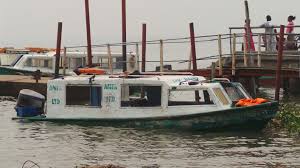
 Despite official announcement directing a return to operations, findings by Shipping Position Daily have revealed that Ikorodu Ferry Terminal remains largely unnavigable as decayed water hyacinth continues to block waterways, forcing boat operators to stay away from the jetty and count estimated revenue losses of over ₦560 million from nearly three months of disrupted services.
Shipping Position Daily recalls that the National Inland Waterways Authority (NIWA) Lagos Area office, last year suspended all boat operations to the Ikorodu ferry terminal. The Lagos Area Manager, NIWA, Engr. Sarat Braimah, in a statement said the development was due to strange rebounds of water hyacinth, which affected the Ikorodu water corridors.
The terminal was closed on Monday, 20 October 2025 due to navigational concerns caused by water hyacinth infestation, and services were temporarily diverted to Ibeshe Terminal and Offin Jetty. Braimah had said the immediate suspension of boat operations to and from the Ikorodu ferry terminal was to avoid possible breakdowns of boat engines and boat mishaps.
However, the Lagos State Waterways Authority (LASWA) in a public notice recently, informed all ferry operators and terminal users that the Ikorodu Ferry Terminal would reopen for passenger ferry operations with effect from Monday, 19 January 2026.
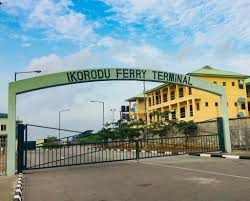
Findings by Shipping Position Daily last week revealed that commercial activities are yet to pick up, because water hyacinth still dominates the waterways, making navigation unsafe. Operators who spoke with our correspondent say the rotten vegetation continue to clog the channels, disorganize movement and threaten boat engines.
Several operators who attempted to return on Monday and Tuesday were forced to abandon the terminal again after discovering that the water surface remained heavily covered, especially during evening peak periods when passengers return to Ikorodu.
Before the shutdown, Ikorodu Jetty was a vibrant economic hub for water transport between Ikorodu and the Island. Checks by Shipping Position Daily show that passengers paid about ₦3,000 from Ikorodu to the Island and ₦2,500 on the return journey, with each boat carrying an average of 17 passengers per trip. This meant a single round trip generated about ₦93,500 per boat. Operators also made up to two trips on busy days, especially Mondays, Fridays and Saturdays, when passenger traffic was highest putting daily earnings per boat at about ₦187,000.
With roughly 50 boats operating daily under the A and B scheduling system, estimated turnover at the terminal stood at about ₦9.35 million per day. Over the three-month shutdown period, calculated at about 60 active working days, operators are believed to have lost close to ₦561 million in revenue, excluding additional costs of maintenance, diversions and engine repairs.
Although NIWA and LASWA reportedly deployed harvesters to clear the water hyacinth, operators insist the intervention has not delivered tangible results. They maintain that pathways created quickly close again as the vegetation returns.
Speaking on the development, Lagos State Chapter Secretary of the Association of Tourists Boat Operators and Water Transporters (ATBOWATAN), Mr. Ayomikun Aworetan said the reopening announcement did not match the reality on ground.
According to him, operators have agreed to remain at Magidun and Ibeshe for now while monitoring the water condition. He explained that by the weekend they would reassess the situation to see if the water hyacinth clears enough for operations to restart at Ikorodu by the following Monday (today).
Aworetan noted that an average of about 50 boats used to operate under an A and B system, introduced after fuel subsidy removal reduced passenger volume and increased operating costs. “Some years ago, before subsidy removal, we had close to 80, 90, even 95 boats working in a day. But because of high petrol cost and high cost of rides, passengers dropped and we divided into A and B.
Referring to the publicized reopening of the Ikorodu jetty, he said: “Boat operators have not returned to their terminal. That was just a press release. Unfortunately, the dead water hyacinth did not leave and it is still affecting their operations. There was disorganisation on Monday and Tuesday on where precisely they will operate,” he said.
Also speaking with our correspondent last week, the Zonal/Ikorodu Chapter Chairman of the Association of Tourist Boat Operators and Water Transporters of Nigeria (ATBOWATON), Mr Olusoji Mojofodun explained that while the water sometimes appears navigable in the morning due to wind direction, the situation worsens later in the day.
He explained that on Monday operators attempted to resume work and actually loaded passengers, but could not bring them back in the evening because the surface of the water had been completely covered by the decayed vegetation. This forced them to divert to Magidun, creating confusion for passengers who had parked their vehicles at Ikorodu terminal.
The closure he said has also scattered operations across Magidun, Bayeku and Ibese, making passenger tracking difficult and weakening the once-centralised Ikorodu transport economy. According to Mojofodun, forcing engines through the decayed hyacinth damages ventilation systems and leads to costly breakdowns. He said operators would rather relocate or park their boats than destroy engines worth millions of naira.
On his part, Chief Raymond Gold, Public Relations Officer of the Waterfront Boat Owners and Transporters Association of Nigeria (WABOTAN), expressed surprise that the hyacinth problem persists after the closure. He said the expectation was that authorities would have fully planned and resolved the issue before reopening the terminal.
Gold advocated a bottom-up and inclusive approach to solving the challenge, rather than top-down directives. According to him, sustainable solutions must be co-created with operators who work daily on the water.
He added that operators have lost millions of naira over the period of disruption. “Let us assume each operator takes home about ₦20,000 daily. In five days that is ₦100,000. In a month ₦400,000, and over three months, multiply that by over 20 to 30 operators. You are talking of millions of naira lost,” Gold stated.