By Oluyinka Onigbinde
The Federal Government has identified the timely and efficient resolution of maritime disputes as a critical factor in attracting investment, facilitating trade and positioning Nigeria as Africa’s preferred maritime hub.
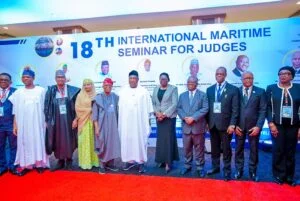
Speaking at the opening of the 18th International Maritime Seminar for Judges in Abuja, the Secretary to the Government of the Federation (SGF), Senator George Akume, said an efficient maritime justice system is indispensable to the growth of the nation’s maritime economy and the successful implementation of the Federal Government’s Renewed Hope Agenda.
Represented at the event, Akume stressed that investors and international shipping companies would only commit substantial investments to Nigeria’s maritime sector if they were confident that commercial disputes would be resolved fairly, professionally and without undue delay.
He said a predictable and commercially aware maritime justice system was no longer optional but an essential requirement for economic growth.
According to him, delays in resolving maritime disputes weaken investor confidence, increase the cost of doing business and ultimately translate into higher prices for imported and exported goods.
“A credible, efficient and commercially aware maritime justice system is not merely favourable to that ambition; it is indispensable. No investor will commit capital to Nigeria’s maritime economy if they cannot trust that contractual disputes will be resolved fairly and swiftly,” he said.
He further noted that international shipping lines would be reluctant to patronise Nigerian ports if they perceived the country’s legal processes as slow, uncertain or lacking the technical expertise required to handle complex maritime disputes.
The SGF described maritime justice as a national economic issue rather than merely a legal concern, saying efficient dispute resolution remains central to Nigeria’s competitiveness in international trade.
He commended the Nigerian Shippers’ Council for sustaining the International Maritime Seminar for Judges since its inception in 1995, describing the programme as one of Africa’s leading judicial capacity-building initiatives.
Akume also praised the collaboration among the Nigerian Shippers’ Council, the National Judicial Institute and the Nigerian Maritime Law Association, noting that the partnership has strengthened the capacity of judges handling admiralty matters.
He reaffirmed the Federal Government’s commitment to implementing practical recommendations from the seminar, including legislative reforms, ratification of relevant international conventions and improved coordination among maritime institutions.
The SGF urged agencies such as the Nigerian Maritime Administration and Safety Agency (NIMASA), the Nigerian Ports Authority (NPA), the Nigeria Customs Service and the Federal Ministry of Marine and Blue Economy to deepen inter-agency collaboration in order to create a more predictable operating environment for shipping and international trade.