By Joshua Yousouph
The Barge Operators Association of Nigeria (BOAN) has raised serious allegations over what it described as financial and institutional barriers to accessing top government officials, claiming that engagement with ministers and even the Presidency is increasingly tied to unofficial dollar-based demands.
The operators made the claim against the backdrop of a steep decline in indigenous participation in Nigeria’s barge sector, which it said has crashed from 83 operating companies to just eight, raising alarm over the survival of local players in the inland water transport sub-sector.
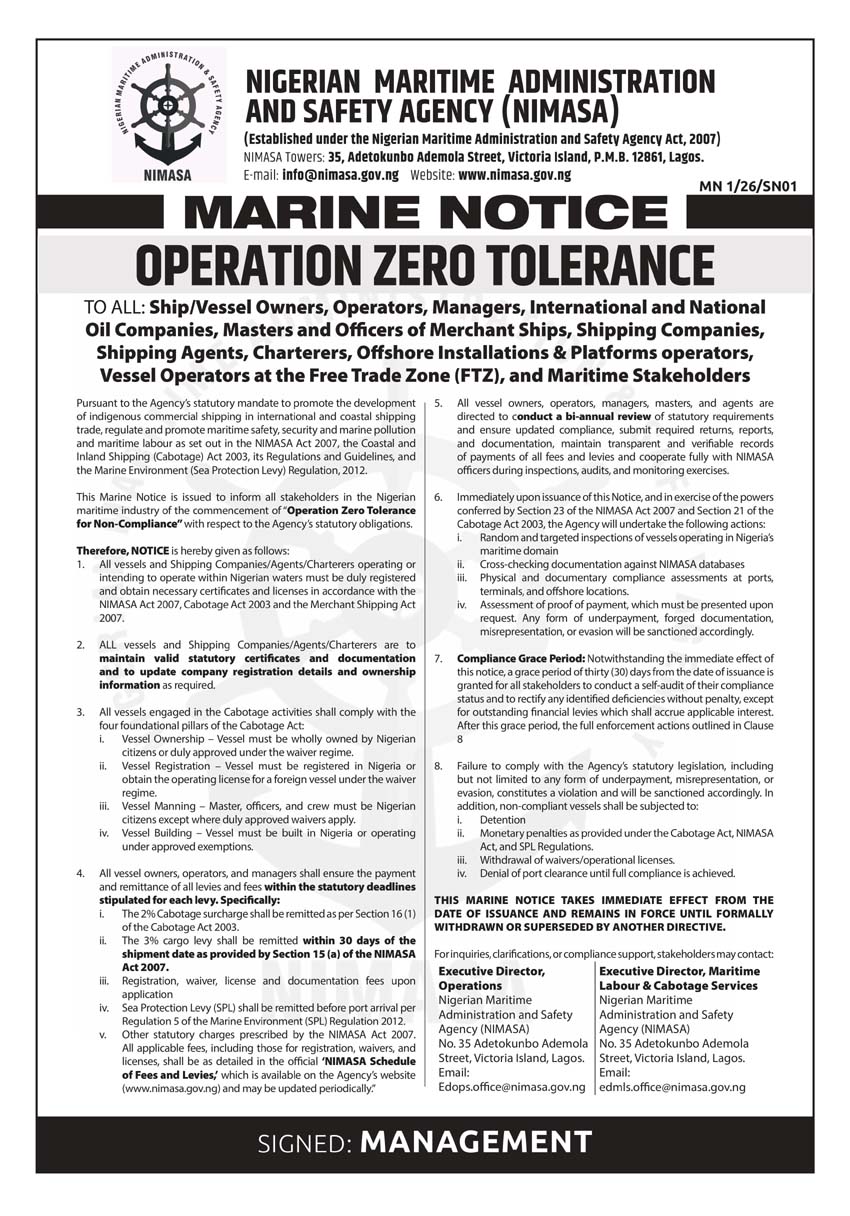
Shipping Position Daily recalls that the disclosure was made by the Director of Operations for Barge Operators Association of Nigeria (BOAN), Mr. Nura Wagani, during a Ministerial stakeholders’ engagement about three months ago, where he appealed to the Federal Ministry of Marine and Blue Economy to establish a dedicated desk for barge operations under the Directorate of Maritime Services.
In his response, the Minister of Marine and Blue Economy, Adegboyega Oyetola, directed the Executive Secretary of the Nigerian Shippers’ Council (NSC) Dr. Akutah Pius to look into the matter and make formal recommendations.
However, while giving an update on the situation last week, BOAN President, Mr. Bunmi Olumekun told Shipping Position Daily that there has been no significant progress within the month under review, despite renewed meetings with relevant agencies including the Nigerian Ports Authority (NPA) and the Nigerian Shippers’ Council.
However, Olumekun alleged that stakeholders in the maritime industry face severe difficulty gaining direct access to policymakers, insisting that in some cases, unofficial financial expectations in dollar terms, are requested before meetings are arranged or meaningful engagement can take place.
According to him, such barriers have weakened stakeholders-government dialogue and contributed to policy delays that continue to frustrate indigenous operators struggling to remain competitive in a capital-intensive environment.
“You want to see your minister, they will tell you that you have to go and bring dollars. What kind of life is that? You want to see this one, they will tell you that you have to go and pay, you have to pay 1 million naira to see a President. What kind of something is that? I was in Liberia some years ago. I met with the Liberia president in a birthday party. He is accessible, you can meet there. But in Nigeria here, even to meet the Chairman of your local government is a Herculean task” Olumekun said.
Olumekun argued that the situation has created a widening gap between regulators and operators, making it difficult for genuine industry concerns to be addressed at the highest levels of decision-making.
He further lamented that the cost of entering the barge business remains extremely high, noting that a single barge can cost between ₦2 billion and ₦5 billion, while full operational capacity may require investments running into several billions of naira, placing indigenous firms at a disadvantage.
The BOAN President warned that the collapse from 83 companies to just 8 reflects a deep structural crisis in the sector, driven by funding constraints, policy uncertainty, and what he described as limited access to government support systems.
He added that inland water transportation, which was originally expected to move a significant share of cargo away from congested road corridors such as Apapa, Tin Can Island, and Lekki, is now operating far below its potential.
Olumekun maintained that waterways were designed to complement road transport and ease pressure on Lagos ports’ logistics network, but poor integration and inadequate support have left the system underutilised. He called for urgent government intervention, including accessible financing schemes, targeted incentives, and improved stakeholder engagement mechanisms to restore confidence in the sector and prevent further collapse.
Meanwhile, BOAN’s Director of Operations, Mr. Nura Wagani, said follow-up engagements have been held with key maritime agencies, including the Nigerian Ports Authority (NPA) and the Nigerian Shippers’ Council, with reports already submitted to the Federal Ministry of Marine and Blue Economy for consideration.
He noted that the matter is now awaiting ministerial approval, before any policy direction or implementation can be communicated to stakeholders.
Wagani also observed that despite the challenges, cargo movement and vessel traffic have increased in recent months, driven by rising import and export activities across Nigerian ports. He said Nigeria continues to account for a significant share of maritime traffic in Africa, creating renewed demand for inland water transport services, though multinational operators still dominate due to stronger financial capacity.
According to him, indigenous operators are gradually returning to activity, but recovery remains slow and uneven across the sector.
“They have written the report and sent it to the Minister. So, this is now turned to internal issue. So we don’t have jurisdiction over that. So we would not have it until when the minister give approval, that is when they will translate it and they will tell us the outcome of the approval” Wagani noted.