The Federal Government’s decision to commence the implementation of the Green Tax Surcharge through the Nigeria Customs Service (NCS) marks another ambitious attempt to align Nigeria with global efforts aimed at reducing carbon emissions and promoting environmentally-friendly transportation. On paper, the objective is noble. In practice, however, the policy raises critical questions that government must answer if it hopes to secure the confidence of stakeholders.
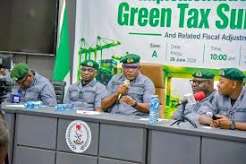
The NCS has already begun sensitising freight forwarders, licensed customs agents, importers and other stakeholders ahead of the enforcement of the policy, explaining that imported vehicles with larger engine capacities will attract a Green Tax Surcharge, while electric vehicles, mass transit buses and smaller-engine vehicles remain exempt. The government argues that the measure is intended to discourage the importation of high-emission vehicles while encouraging cleaner alternatives.
That explanation sounds convincing. Yet Nigerians have every reason to ask a simple but fundamental question: Will this tax genuinely improve environmental sustainability, or is it merely another avenue for raising government revenue?
This concern is understandable. Over the years, Nigerians have witnessed the introduction of numerous taxes, levies and surcharges, many of which were launched with lofty objectives, but their outcomes remain difficult to identify. Road taxes have not translated into better roads. Various port charges have not eliminated congestion.
Environmental levies have not necessarily produced cleaner cities. Consequently, skepticism surrounding the Green Tax is neither misplaced nor unreasonable.
The principle behind Green Tax is globally recognised. Several developed economies impose carbon taxes, congestion charges or environmental levies designed to discourage pollution.
Countries such as Sweden, Finland, Canada, the United Kingdom, Germany and Singapore have various forms of environmental taxation.
The European Union increasingly ties vehicle taxation to carbon emissions, while nations such as Norway and New Zealand combine taxes on high-emission vehicles with generous incentives for electric vehicles. These policies, however, are typically accompanied by significant investments in clean transport infrastructure, public transit, charging stations, renewable energy and transparent environmental programmes.
Nigeria, therefore, is certainly not the first country to adopt an environmental tax. But there is an important distinction.
In most successful jurisdictions, environmental taxation is not merely about collecting more money. It forms part of a comprehensive climate strategy backed by measurable investments and visible outcomes. Citizens are able to see where the money goes. Governments publish climate targets, environmental impact reports and expenditure records. The tax becomes part of a larger social contract.
Can Nigeria honestly make the same claim? That is where the debate begins.
Government says the Green Tax seeks to reduce carbon emissions by discouraging the importation of high-engine vehicles. While the logic may be sound, Nigeria presently lacks many of the conditions necessary for such a transition.
Electric vehicles remain prohibitively expensive for the average Nigerian. Charging infrastructure is virtually non-existent outside a few urban centres. Even conventional electricity supply remains grossly inadequate. Public transportation systems remain underdeveloped, leaving millions dependent on imported used vehicles for daily mobility.
Without providing affordable alternatives, imposing additional costs on vehicle importation risks punishing consumers, rather than changing behaviour.
One cannot successfully discourage the purchase of conventional vehicles where cleaner alternatives remain beyond the reach of ordinary citizens. This is perhaps the greatest weakness of the policy.
Government must also recognise the peculiar realities of Nigeria’s economy.
Businesses are already struggling under multiple taxes, inflationary pressures, foreign exchange volatility, rising logistics costs and high interest rates. Importers continue to battle expensive financing costs, while freight charges remain elevated despite relative exchange rate stability. Adding another layer of taxation—regardless of how well-intentioned, may ultimately translate into higher vehicle prices, increased transportation costs and further inflationary pressure across the economy.
Indeed, some automobile dealers have already expressed concern that the ultimate impact of the reduction in import levies may be neutralised if the Green Tax substantially increases overall landing costs. Until the full financial implications become clear, uncertainty continues to dominate the market.
The Federal Government may argue that import duty on vehicles have simultaneously been reduced upon the introduction of the Green Tax, thereby cushioning the financial impact. That may be true in theory. Yet experience teaches Nigerians that additional charges introduced into the import chain often find their way into the final retail price of goods,
Beyond the economics lies an even bigger issue of trust. Public confidence in government policies has been weakened by years of abandoned projects, policy inconsistencies and poor accountability. Nigerians have repeatedly seen intervention funds whose utilisation remains unclear. Environmental initiatives have come and gone with little measurable impact, while climate commitments have been announced with great publicity, but followed by limited implementation.
Against that backdrop, government cannot simply ask citizens to believe that this latest tax will produce different results. Trust must be earned through transparency.
If the Green Tax is truly intended to protect the environment, government should establish a clearly identifiable Green Fund into which all proceeds are paid. Annual audited reports should be published showing how much was collected, where the funds were spent and what environmental outcomes were achieved.
Citizens deserve measurable evidence, such as: How many electric charging stations have been built? How many public buses have been converted to cleaner energy? How much investment has gone into renewable energy infrastructure? What reduction in vehicle emissions has been recorded?
Without clear answers to these questions, the Green Tax risks becoming another fiscal instrument wearing an environmental label.
There is also the danger of policy inconsistency. Successive governments have often introduced policies with considerable enthusiasm, only to reverse or abandon them after a few years. Investors require certainty. Importers require predictability. Manufacturers require stable policy direction. Environmental policy cannot succeed if it changes with every administration.
The Nigeria Customs Service deserves commendation for engaging stakeholders before implementation, rather than imposing the policy without consultation. Such dialogue is essential for improving compliance and reducing uncertainty. However, stakeholder engagement should not end with sensitisation seminars. It should extend to continuous monitoring, periodic reviews and genuine willingness to modify the policy where unintended consequences emerge.
Environmental sustainability is a goal that every responsible nation should pursue. Climate change is no longer a distant threat but an economic reality affecting agriculture, coastal communities, flooding, infrastructure and public health. Nigeria cannot remain indifferent to global environmental obligations.
However, environmental responsibility must never become an excuse for excessive taxation.
Good environmental policy balances sustainability with economic competitiveness. It encourages cleaner technology, while avoiding unnecessary hardship for businesses and consumers.
The Green Tax should therefore be judged not by the amount of revenue it generates, but by the environmental improvements it delivers.
If, five years from now, Nigeria has cleaner transportation, more electric vehicles, improved public transportation, reduced emissions and transparent utilisation of Green Tax revenues, then history will regard the policy as visionary.
But if all Nigerians remember is, paying yet another tax without seeing corresponding environmental benefits, the Green Tax will simply join the long list of well-intentioned policies that became little more than additional financial burdens.
The Federal Government still has an opportunity to prove that this initiative is genuinely about protecting the environment rather than expanding the tax net.
That opportunity must not be wasted.