Recently, the Minister of Marine and Blue Economy, Adegboyega Oyetola emphasised that the ports in the eastern corridor of the Nigerian Ports Authourity (NPA) are due for rehabilitation and modernization.
This is coming on the heels of a similar attention that has been focused on the ports in Lagos. Even though, nothing concrete has been done in terms of physical reconstruction, there is hope that Lagos ports of Apapa and Tin Can will benefit from the recent £746 million (about $990 million) rehabilitation deal.
Backed by UK Export Finance (UKEF) and arranged through Citi Bank, the project aims to modernize key port infrastructure, with substantial material supply and contracting awarded to UK firms, including British Steel. There was no mention of eastern ports in the arrangement.
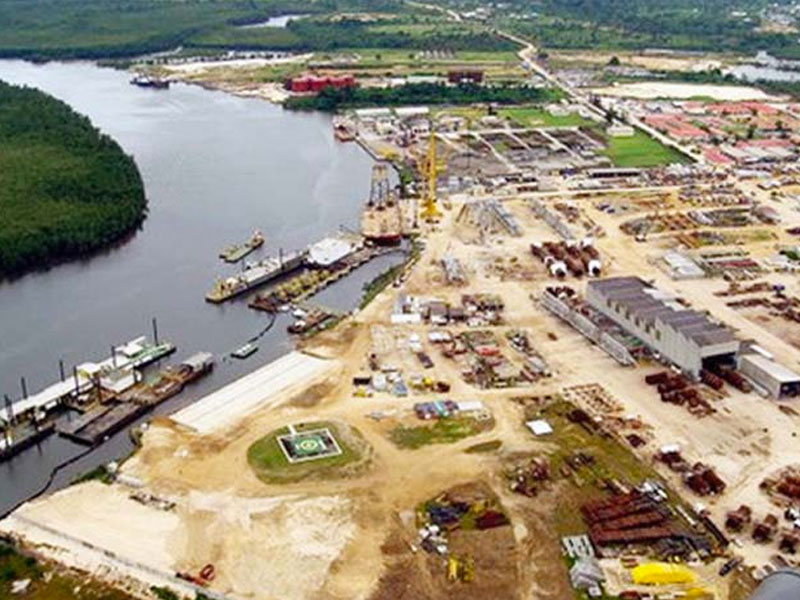
Prominent in the eastern flank of the NPA is Onne Port in Rivers state. Largely driven by oil & gas logistics and expanding container traffic, this port contributed about 19.1% of national cargo in 2025. Others are: Port Harcourt Port, Delta Port, and Calabar port
It is a fact that, these ports collectively face severe underutilization due to shallow channel draughts, dilapidated hinterland infrastructure, high cargo dues, and security concerns. These challenges result in high operating costs, long vessel turnaround times, and low cargo throughput compared to Lagos ports, prompting shippers to avoid these facilities.
The gravity of the issues leading to low patronage at these ports was amplified recently when the President-General of the Maritime Workers Union of Nigeria, Comrade Francis Bunu confirmed that insecurity has significantly reduced vessel calls to the eastern corridor, noting that shipping companies now factor in unofficial payments when planning their operations.
The twin factors of insecurity and quasi-insurance premium that is often placed on cargoes destined for the ports in the eastern flank will certainly make them non-competitive, when compared to Lagos ports.
We recall that, in 2020, the Nigerian Ports Authority announced that vessels that could not secure berthing space in Lagos ports would be diverted to ports outside Lagos; that is, Calabar, Onne, Port Harcourt and Warri.
The decision to diver these ships came when terminals in Lagos could not discharge vessels within four days, and there was a deluge of ships awaiting berths.
The decisions, according to NPA were aimed at tackling congestion which had almost crippled activities in Lagos ports, at that time.
According to the NPA, it was in the interest of everybody to divert such vessels to other ports instead of waiting endlessly, sometimes for three weeks, to berth and discharge cargoes while accumulating costs on elongated dwell time.
From available data, Onne Port has cargo throughput often exceeding 25–29 million tonnes in recent years. Specifically, in 2025, it was responsible for 19.1% of national throughput. On its part, Delta Port of Warri handled vessels averaging 17,414 Gross Registered Tonnage (GRT) in 2025, with data showing volumes around 6–8 million tonnes. In the same vein, Port Harcourt Port recorded around 6–7 million tonnes in recent years. And Calabar Port, which is generally the lowest throughput among the four, accounted for volumes roughly around 2–3 million tonnes.
What these figures mean is that, with adequate facilities and cargo handling equipment, and baring security threats, these ports can adequately do more than what they are currently doing. It pointedly means that, developing the eastern ports of Onne, Warri, Calabar, and Port Harcourt is essential.
Having a more geopolitically-balanced port system would reduce pressure on Lagos, cut transportation costs for businesses in the South-East and South-South, and improve national logistics resilience. It would also curb the diversion of cargo to neighbouring countries, which remains a significant drain on Nigeria’s customs revenues.
Not considering extension of rehabilitation to ports in the east and utilizing all the funds to rehabilitate Lagos ports alone appears strategically narrow and economically unwise.
That, more than 70 per cent of Nigeria’s cargo come in through Lagos is not enough reason to deny other ports of the opportunity to contribute to the nation’s economy. So neglecting eastern ports will in the long run be economically detrimental.
Yes, we know that these draught limitations, which makes it impossible for certain categories of vessels to berth there. Specifically, inadequate dredging makes it impossible for large container vessels to call at Calabar and Warri ports, thereby limiting them to smaller, and economically unviable ships.
With shallow channels, poor infrastructure, poor access roads, and high operational costs and charges, how do these ports compete with Lagos port and contribute meaningfully to the overall performance of the NPA.