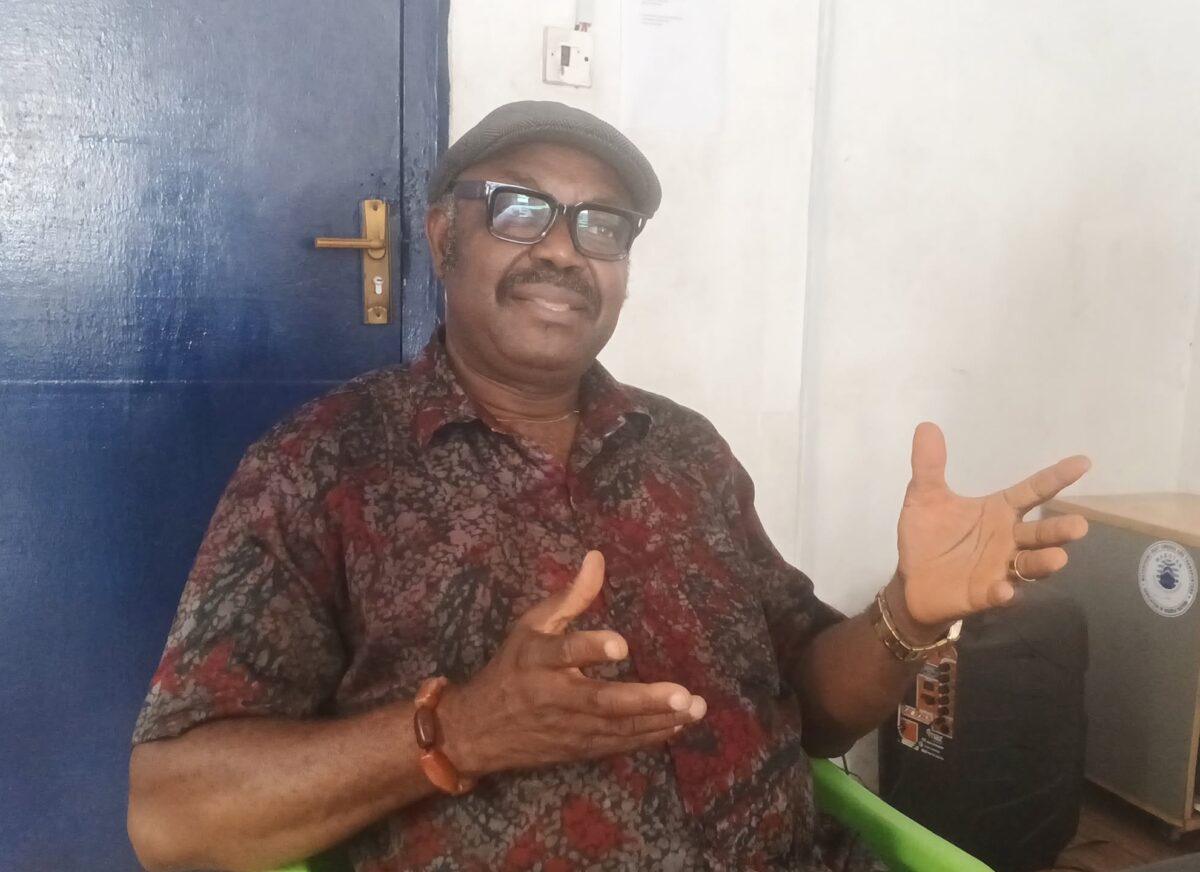
Chief Gold Raymond, Head of Desk, Corporate Communication and Strategy at Sustainable Waterways Awareness Advancement Advocacy (SWAAADO), in this exclusive interview with Joshua Yousouph, speaks extensively on the state of regulatory enforcement, the cultural and structural factors behind persistent boat mishaps, and the practical solutions his organisation is championing across Nigeria. He also addresses the controversies surrounding the Cabotage Vessel Financing Fund (CVFF), proposing innovative financing models to support standard boats for local operators.
Why not take a fraction of that CVFF for the provision of standard boats for inland operators?
“Water accidents destroy not only families, but also the social fabric of society”
How do you assess regulatory enforcement on the waterways in 2025?
So far, there has been progress. The immediate past Managing Director of NIWA made notable efforts. There was a reduction in boat mishaps between January and August during his tenure. He introduced waterway codes, oversaw massive life jacket distribution and recruited river marshals. However, more still needs to be done, particularly in the area of training and retraining boat skippers. Licensing processes should not be unnecessarily cumbersome. Many operators are not highly educated, so practical, hands-on training works better than overly academic procedures. Ultimately, safety on Nigeria’s waterways requires government investment in standard boats and jetties, stronger enforcement, community re-orientation, environmental sustainability and continuous training. Waterways are natural endowments, and no state government that develops its waterways will regret it. SWAAADO remains committed to correcting dangerous beliefs, strengthening partnerships with regulators and ensuring that human errors, not myths, are addressed in order to save lives.
What explains persistent boat mishaps, especially in Northern Nigeria?
There are many reasons. In many northern communities, boats are substandard because operators cannot afford standard ones. Yet waterways offer immense economic value through transportation, tourism, fishing festivals and agro-tourism. We have visited places where there is no regulatory presence at all. Boats meant for 50 or 60 passengers carry up to 100. Many journeys take place at night, making emergency response extremely difficult, if accidents occur. Cultural beliefs also play a role. In some communities, when someone is drowning, others hesitate to rescue them because they believe it is their destined time and that intervention may anger the gods. I encountered a situation where a young educated lady refused to wear a life jacket, saying that if anything happened, she would take it by faith that her end had come. This shows that beyond infrastructure, orientation and education are critical.
As an NGO, what is your core approach to addressing waterways challenges?
As an NGO, our approach is more from the side of advocacy, more or less trying to create solutions and to be as inclusive as possible in providing and suggesting solutions to social problems. It is not a company aimed at making money or running an office for shareholders. We have a collective responsibility and it is important that what we do is assessed from the angle with which we are approaching it. We did not just start this campaign by merely taking messages to communities. We are not inviting people out to anything; we are taking the campaign down to them. What led to that was our commission and investigation. During the COVID-19 crisis and even beyond, we began to notice a series of very frequent boat mishaps. Our investigations revealed that there is a belief system among some waterfront communities that these waters are ancestral lands and that marine spirits are the main force behind boat accidents. There was this feeling that if the marine spirit wants something to eat, it will always cause people’s mishap. That belief is terrible and pathetic because it suggests that no human effort can prevent accidents. When we got these reports, we felt there was every need to take the message down to the people and let them know that it is not so. Human errors and some natural factors are probably behind every boat mishap — not a marine being trying to eat someone.
Beyond beliefs, what structural issues did you identify?
We also observed a series of government policies aimed at enforcement. There would be sudden arrests of non-licensed operators and face-offs between authorities and boat drivers. While it is good to be licensed, we asked what training had been provided for these people. Our investigation showed that many boat drivers never had any form of training, no capacity building and no understanding of the rules of the waterways. They could manipulate the engine and believed that because they had been doing it for years, that was enough. When people are not trained, they constitute serious danger to themselves, their passengers and other waterway users. So SWAAADO decided not only to take the message down to them but also to create practical solutions.
What practical solutions has SWAAADO introduced?
We developed a comprehensive package with the goal of training about 5,000 boat drivers across the country free of charge. We encourage them to obtain either the Power Driven Small Craft (PDSC) or the National Boat Skippers License, also free. We see this as a better way to capture them into the regulatory net and under the oversight of regulatory agencies. Both certifications expire after three years. To ensure compliance and credibility, SWAAADO developed the Nigeria Waterways Directory where trained and licensed skippers are listed as qualified operators. Employers can verify their names there. After three years, if a license expires, the skipper is reminded to renew. If renewal is not done, the individual is blacklisted. Nobody wants to be blacklisted because it affects credibility and employability. Renewal requires retraining, ensuring continuous capacity building. These efforts are aimed at bringing boat skippers and other waterway users under proper regulatory oversight.
SWAAADO stands for sustainable waterways. What are your sustainability initiatives?
Water safety also includes environmental responsibility. Part of our campaign is educating waterfront communities and market operators not to drop waste inside the water because doing so does not support sustainability. It affects aquatic life and deprives future generations of the benefits of these natural resources. We are engaging waste recyclers to provide bins in waterfront markets. Often, when boat drivers pick up ropes, sacks or debris entangled in their propellers, they throw them back into the water. We now encourage them to bring such waste ashore and dispose of it properly in designated bins. Recyclers then collect recyclable waste. On water hyacinth, SWAAADO sent a team to Ghana where it is being put to productive use. On return, we developed a plan to harvest water hyacinth and convert it into useful products. The strong fibre can be used to produce biofiber for crafts such as bags and other items. It can also generate biofuels like biogas and bioethanol. In one waterfront community, SWAAADO secured two plots of land donated for this project. It is capital intensive, so progress is steady. The goal is to empower women and youths to harvest the hyacinth and process it into biofuel and craft materials, creating economic value while cleaning waterways. Professor Isaac, a professor of chemical engineering at the Federal University of Technology, Minna, serves as consultant on this initiative.
How long has SWAAADO been in existence and what are your achievements?
The activities of SWAAADO date back to around 2017 or 2018. COVID presented some challenges, but formal operations resumed around 2022. Incorporation with the Corporate Affairs Commission was completed in late 2024 or early 2025. In terms of achievements, SWAAADO’s advocacy contributed to the establishment of a dedicated Ministry of Transport in Kwara State, including directorates for road, land and water transport, thereby ensuring that water transport receives specific attention. The organisation has reached over 50 communities across eight coastal and two inland states. Each year, life jackets are distributed, with a special focus last year on children. A child’s life jacket costs about ₦15,000, which many families cannot afford. SWAAADO maintains cordial relationships with regulatory agencies such as the Nigerian Maritime Administration and Safety Agency and the National Inland Waterways Authority, which often provide resource persons for training programmes.
Where is the campaign currently focused, and what are the expansion plans?
We started from the South, particularly in coastal communities. From around March or April, the campaign will spread up North. We are targeting eight coastal states in the South and about four or five inland states across the Middle Belt and Northern parts of the country. Why are we bringing it to them? To change their orientation. In one of the places we visited in Lagos, some community members said, “Ah, now we know better. Please keep doing this.” That alone shows the impact. Even in Lagos, we still hear statements like, “If a boat has an accident, that is how God wanted it.” Some even ask why every boat is not having an accident if it’s truly unsafe. We tell them clearly: that is not it. Human error causes many accidents. Natural factors also play a role. It is not always destiny. This campaign is about giving them a new orientation — replacing fatalistic thinking with safety consciousness.
Your research reportedly touched on the Cabotage Vessel Financing Fund (CVFF). What did it reveal?
Yes, the research examined the possibility of leveraging the Cabotage Vessel Financing Fund (CVFF). From what the researchers presented to us, about $700 million is believed to be lying somewhere in the fund. Part of what that fund is meant for is to promote indigenous ship ownership. It also supports, to an extent, those engaged in inland water transport, whether in coastal or inland waters. Our proposal is simple: why not take a fraction of that CVFF fund to support the provision of standard boats for inland operators? The research suggests creating a revolving loan scheme that operators can access and repay over five to ten years. The report has been submitted, and we are preparing to go public with it. We may call a press conference and engage relevant Ministries, Departments, and Agencies to review it carefully.
There has been debate about whether the CVFF is meant only for those who contributed to it under the Cabotage regime. How do you respond?
Yes, that argument exists. Some stakeholders say the CVFF was contributed by operators under the Cabotage regime and, according to the Act, should be accessed only by eligible contributors. That is an argument. But we must also be flexible as a nation. Flexibility can help solve serious problems. If the money is lying fallow, is that the best use of it? We are suggesting that if necessary, the National Assembly should consider amending the Act to address this issue. Ship owners are major players, moving goods at scale. There is nothing wrong with structuring access in a way that benefits citizens by improving safety on inland waterways. Part of our recommendation is that the National Assembly fine-tune the law so that this argument does not become a permanent obstacle.
There are also claims that the CVFF may not even be available. What is your position?
Some people argue that the funds are not there. Others say that is why the government has delayed disbursement. However, the Ministry and relevant government agencies have consistently given assurances that the fund exists. There was even a release recently in January that suggested the fund is available. They mentioned the establishment of a Primary Lending Institution (PLI) framework. If they are telling us this, then we have reason to believe the fund is there. But there is a trust gap between leaders and the led. When the government says the fund exists, many citizens hesitate to believe it. That trust deficit complicates the conversation. Still, based on official statements from the Ministry and government agencies, we are working with the understanding that the fund is available.
Looking ahead, what is your projection for Nigeria’s inland waterways sector by 2036 in terms of tourism, business, transportation, and safety?
SWAAADO commissioned a research group to study this exact question, because we are passionate about waterways safety. When lives are lost, they are not just numbers. A child who could become someone great tomorrow is gone. A mother who went to the market may never return to her children. A father, the breadwinner of a family, loses his life, and the family begins to suffer. Water accidents destroy not only families but also the social fabric of society. By 2036, the waterways sector can become a major driver of tourism, transportation, and commerce — but only if safety is prioritized. There is enormous potential. However, one major issue causing accidents, particularly in the North, is the use of substandard boats. Operators are told to wear life jackets and comply with regulations, which is good. But many of them simply cannot afford standard boats. That is a structural issue that must be addressed.
What is your final message regarding waterways safety and reform?
The waterways hold tremendous promise for Nigeria — for tourism, transportation, and commerce. But safety must come first. Cultural beliefs that normalize accidents must be challenged. Substandard boats must be replaced. Operators must be supported. Lives lost are not statistics. They are futures cut short, families shattered, and communities destabilized. If we address safety comprehensively — through orientation change, proper equipment, regulatory reform, and financial support, by 2036, Nigeria’s inland waterways sector can be transformed into a safe, thriving contributor to national development.