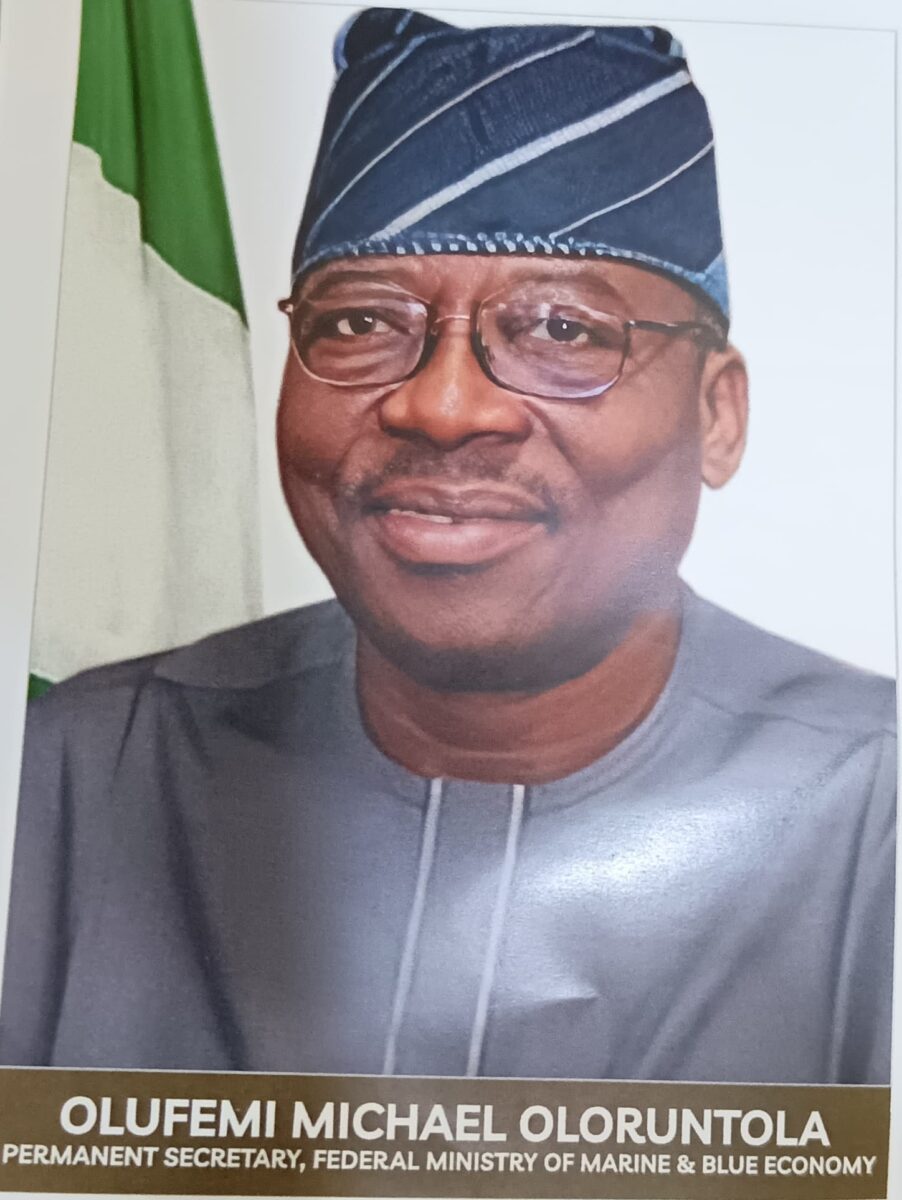
At the commemoration of the 2025 World Maritime Day which held in Lagos recently, the Federal Ministry of Marine and Blue Economy joined industry stakeholders, government agencies, and maritime professionals to reflect on this year’s global theme and Nigeria’s role in advancing sustainable ocean governance. At the event, the Permanent Secretary of the Ministry; Mr. Olufemi Oloruntola shared insights on Nigeria’s strides in developing the blue economy, strengthening maritime safety, and enhancing the sector’s contribution to national growth. In this interview, he spoke on the Ministry’s strategic plans, achievements, and the collaborative efforts shaping the future of Nigeria’s maritime industry.
· “The Marine And Blue Economy Sector Is Vast, Complex, And Capital-Intensive”
· Public resources alone cannot carry the weight of the marine and blue economy
· We therefore call on the National Assembly, to prioritise the marine and blue economy sector
Could you please give us an overview of your paper and its central argument?
The synopsis of my paper is to attempt to make a strong argument that, while the policy focuses on funding the sector mainly from the private sector and private sector investments, some critical public sector investments are needed to galvanise investments into this sector. This agreement is timely and it is my honour to present this paper on behalf of the Ministry.
You mentioned that this agreement is timely. Why do you think so?
This agreement is timely because it addresses a central challenge before us — how to move from well-articulated policy to viable, visible and measurable plans with finance as the indispensable driver. The marine and blue economy sector stands as a vital pathway for Nigeria’s growth, job creation, environmental sustainability, and diversification beyond oil. This vision cannot be achieved without deliberate public investments that drive private sector participation, strengthen institutions, and secure long-term developments.
You emphasised the need for public investment. Why is it so imperative for the marine and blue economy?
Public investment is not charity. It is a safe capital and policy signal that converts vision into reality. Without it, policy remains rhetoric and the marine and economic sector will remain underdeveloped, underfinanced, and underutilised. Public funding is therefore required to de-risk private sector participation, particularly in infrastructure and heavy sectors, to strengthen regulatory frameworks and institutions for transparent governance, to provide catalytic finance in areas where social returns are higher than the immediate commercial return, and to align investments with national policy priorities such as food security, energy transition, grid employment, and climate resilience.
What challenges does the Ministry currently face in terms of funding and resources?
It is important to acknowledge that the resources we currently receive from the national budget are grossly inadequate compared to the enormous responsibility before the ministry and the sector. The marine and bleu economy sector is vast, complex, and capital-intensive. Yet, our annual budgetary allocations remain a fraction of what is required to modernise boats, secure our waters, grow fish, promote tourism, and invest in renewable marine resources. This gap between mandate and resources underscores the urgency of innovative financing mechanisms and stronger public-private partnerships if we are to truly move from policy to impact.
Can you highlight some of the priority areas that require urgent financing?
Nigeria’s marine and blue economy spans multiple sectors, with each requiring targeted public investments to catalyse sustainable development. For clarity, this may be grouped into two broad clusters: infrastructure and transport, and sustainable public-private partnership. Under infrastructure and transport, the expansion and modernisation of seaports, dry ports, and inland waterways are key. Our ongoing port modernisation agenda, including the revitalisation of eastern ports and the adoption of smart port systems, requires substantial public investment. Without such infrastructure, Nigeria risks losing regional competitiveness to neighbouring states.
The acquisition of national fleets and support for additional shipping lines, incentives for shipbuilding, repair, and support for indigenous maintenance facilities are also very key. Public investment in these areas will reduce capital costs from freight payments, estimated to be in billions annually, and strengthen Nigeria’s maritime sovereignty.
Under sustainable economic sectors, fisheries and aquaculture are critical. Strengthening value chains in industrial, artisanal, and inland fishery is key. The establishment of fish landing sites, processing facilities, and cold chain logistics are vital. This is an untapped sector with high foreign exchange earning potential. The initiative will enhance food security, reduce imports, and create employment opportunities for our youth and women. However, due to public-private sector investment, some basic public sector financing is needed to galvanize this sector.
Beyond fisheries, what other areas of the blue economy should Nigeria focus on?
Marine tourism and coastal development are also critical. Every festive season, thousands of Nigerians in the Afro-American community create a surge in spending across the economy. With the right investments in associated facilities such as coastal resource centres, eco-storage infrastructure, and marine tourism hubs, Nigeria can capture a share of this inflow — generating foreign exchange, stimulating retail consumption, and expanding government revenue. Here too, some basic incentives are needed through public finance.
Marine renewable energy involves harnessing offshore wind, tidal, and wave energy. Public financing for research in these aspects, bio-projects, and the establishment of enabling frameworks to regulate and monitor these activities are necessary and key. We must align Nigeria’s energy transition plan with global climate agreements in this regard.
Marine biotechnology research is another vital area. Research and development investments in pharmaceuticals, cosmetics, and bio-products from marine resources hold vast potential. This will position Nigeria in the global knowledge-based economic future.
Additionally, environmental sustainability and climate adaptation remain essential, including coastal protection against erosion, sea-level rise, marine pollution control, waste management, and plastic reduction initiatives. These measures protect communities and future generations and cannot be left only to commerce.
How does the Ministry intend to fund all these priority areas?
To fund these priorities, the Ministry must adopt a blended financing approach that includes national budgetary allocation, public-private partnerships, blue bonds and green financing, funds from development partners and multilateral agencies, and community and cooperative financing. The urgency of public investments at this point cannot be overstated. Delaying financing will entrench Nigeria’s over-reliance on oil, undermine the livelihood of coastal communities by exposing them to poverty and climate change, and allow other nations in our region to have better advantages against us.
Timely investment will open access to over 1.5 trillion dollars in global blue economy opportunities by 2030, create jobs across sectors, strengthen Nigeria’s position as the maritime hub in Africa, and guarantee sustainable livelihoods and resilience for our people.
You mentioned financial constraints earlier. How can Nigeria address these challenges?
The financial constraints earlier highlighted are not merely a statement of facts; they are a reminder of the urgency to act differently. The mismatch between our vast mandates and limited resources calls for more than incremental adjustments. It requires us to step up our approach to innovative financing mechanisms, stronger public-private partnerships, deeper engagement with development partners, and deliberate efforts to attract the private sector into critical areas of our sphere.
Public resources alone cannot carry the weight of the marine and blue economy. The private sector, when de-risked, well-coordinated, and incentivised by public investments, will be central to achieving the scale of impact Nigeria would like to reach. At the same time, government support to improve budgetary allocations remains indispensable. Even the most innovative financing tools and private investments require a solid public funding base to thrive. We therefore call on relevant authorities, most especially the National Assembly, to prioritise the marine and blue economy sector and provide inspiring incentives to deliver revenue, create jobs, and strengthen national resilience.
Finally, what message would you like to leave with policymakers and stakeholders?
The marine and blue economy should not be seen as a distant promise, but as an immediate opportunity for growth, diversification, and sustainability. The pathway from policy to impact begins with finance as a key driver. Public allocations provide the foundation, and private capital delivers. Together, they can generate the confidence, jobs, and prosperity that our nation seeks. To realise this, we must merge ambition with resources, strategy with execution, and ambition with impact.