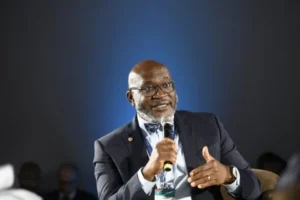
In this interaction at the recent launch of a Technical Training on Maritime Anti-Corruption Network (MACN) tools for staff of the Council for the Regulation of Freight Forwarding in Nigeria (CRFFN) last week, Mr. Soji Apampa, Co-founder of the Convention on Business Integrity (CBI) and a major driver of the Maritime Anti-Corruption Network (MACN) Nigeria project since 2013, explains why the initiative is tightly linked to Nigeria, how the UK Bribery Act triggered the movement, the central role of Standard Operating Procedures (SOPs) and data in reducing corruption in vessel clearance, why the international community now speaks of a “Nigerian miracle,” and why the next challenge is extending these gains to cargo operations across the ports.
“Without SOPs, enforcement becomes arbitrary, without data, enforcement becomes noise”
“We were training officials between 2016 and 2018, but corruption kept increasing”
Can you explain who is funding the training you are conducting today and how the Maritime Anti-Corruption Network came into the picture?
The training we are having today is funded by the Maritime Anti-Corruption Network, not just Convention on Business Integrity (CBI). So I want to thank Maria and MACN for their continued support. In the early days, we had support from Danish Shipping, support from DFID, support from the Siemens Integrity Initiative, and support from DANIDA. In fact, all the activities we’re doing now are directly funded by the Danish Development Agency, DANIDA, through the Maritime Anti-Corruption Network. Our colleague Maria is speaking from Denmark. She’s actually based there, which is where the head office of MACN is. And the reason it is so tightly tied to Nigeria is because of where the whole thing began.
What triggered the creation of the Maritime Anti-Corruption Network?
To understand the trigger, you have to go back to 2012 when the UK Bribery Act came into force. You cannot be in shipping and not touch the UK somehow. The biggest insurance companies, like Lloyds, are UK-based, so it’s very difficult to operate in shipping without touching the UK system. The Act introduced something very serious. It didn’t just criminalise bribery, it criminalised failure to prevent bribery. So imagine you are a shipping company coming to Nigeria. If a third party bribes for your benefit, you are liable in the UK. That was the first alarm. Failure to prevent is now an offence. So the industry, as we say in Nigeria, “borrowed themselves brain.” People quickly came together and asked, what do we do?
So in the beginning, eight companies came together in 2012 and started MACN, including Maersk. It was actually housed within Maersk at first, which is a Danish company. That is where the Denmark connection started. They then came to Nigeria to seek collaboration with government and found that the Nigerian government itself already had ambitions to reform the port sector. That’s how government and private sector came together. And it wasn’t just two parties; it was three: government, business and civil society. Convention on Business Integrity came in on the civil society side.
How did your organisation get involved in the MACN project in Nigeria?
In 2013, they decided to start with a corruption risk assessment. They said, “Where do we begin? We need to know where the problems are.” So they carried out a risk assessment across the ports. That was driven by a government agency called TUGAR – the Technical Unit on Government Anti-Corruption Reforms – and it was funded by United Nations Development Programme (UNDP). I was one of the specialists hired by UNDP to train government and civil society on how to perform corruption risk assessment. That was my own entry point into the project.
After the assessment, one thing became very clear: port officials did not understand professional ethics. They had no idea. So the remediation plan, called the Integrity Plan, recommended that 1,000 port officials must be trained. MACN then hired Convention on Business Integrity to roll out training to those officials. While doing that, we discovered that most officials did not even know the right actions, wrong actions, or standard operating procedures. So we began giving feedback to MACN and suggesting ways to improve implementation.
Eventually, MACN said, “Why don’t you represent us and help drive and shape this project in Nigeria?” So we didn’t just wake up one day. We were service providers who added value and were retained to help shape the future of the project. We’ve been involved from 2013 till today.
Why are Standard Operating Procedures (SOPs) so important in fighting corruption at the ports?
Before you can tell a government official that he is doing wrong, you must first know what he was supposed to do. What step was he supposed to follow? If he doesn’t follow that step, then you can say he has breached the SOP. Why are our members having problems on transport? Because there are no SOPs for checkpoints. When you stop at a checkpoint, do you know what they are authorized to do, how they are supposed to carry it out, and what they should ask for? At that time, there was no SOP for anything across the maritime sector. So agencies agreed to document their procedures. Through MACN, we even brought officials from East African ports like Kenya to sit with Nigerian ports officials and explain how reforms improved efficiency. Then came Presidential Order 001 under the Buhari administration, which focused on ease of doing business. Agencies were told to define timelines: how long customs must take, what documents must be issued, and when. So if you comply and the agency fails within the timeline, you are right and the force of law backs you.
How did the grievance reporting mechanism come about?
If we have SOPs and customs doesn’t follow them, what remedy do I have? That question led to the grievance reporting mechanism. All port stakeholders agreed that the Nigerian Shippers’ Council was the most neutral, since it does not charge fees for port usage. So it became the central clearing house for complaints. A portal was set up where SOPs and complainants could talk to each other. But even with SOPs and grievance mechanisms, corruption did not reduce. In fact, it increased.
So what changed the game?
Data and evidence. We were training officials between 2016 and 2018, but corruption kept increasing. We asked for data from Shippers’ Council, but we were told they had no authorisation to release information. So we created what we called the Help Desk. Every vessel sends a pre-arrival notification to its agent. We persuaded them: “When you send it, copy our help desk.” We also provided a WhatsApp number. If you encounter any problem, send a message. That way, we tracked every vessel and every problem. By 2019, we recorded 266 cases. We shared the data with the Vice President’s office. The Presidency escalated it to Independent Corrupt Practices and Other Related Offenses Commission (ICPC). ICPC, with DSS, started sting operations. They caught officials coming off vessels with frozen fish and other extorted items. Some were sent to Kirikiri. That sent shock waves into the system. From 266 cases in 2019, it dropped to 128 in 2020, 84 in 2021, then 48, then 45, and eventually around 30 cases. Year after year, it came down. The international community started calling it the “Nigerian miracle.”
Why did Nigeria become a global reference point for MACN?
At the beginning, people argued whether it even made sense to start with Nigeria because it was the hardest environment. But to their surprise, Nigeria produced the biggest success. From eight companies, MACN now has over 200 entities. They represent more than 75% of containerized goods globally and over 50% of everything that sails. Ship registries and even insurance companies are now joining. Very important to that movement was the success in Nigeria on vessel clearance. But let me add something: the success is on vessel clearance, not the cargo side which we are now working on.
What is the challenge with cargo movement compared to vessel clearance?
We tried tackling the cargo side with the then Permanent Secretary, Dr. Magdalene Ajani. She came to Lagos with armed men and dismantled illegal checkpoints on the outward leg of the ports. They succeeded there, but not on the inward leg. Then the Ministry was converted to the Ministry of Marine and Blue Economy, and the traction reduced. So the big question now is: how do we replicate the vessel clearance success on cargo clearance? The game changer before was data. We had evidence of every vessel, every officer, the time they boarded, and what they did. So today’s question is: how do we collect that kind of evidence for cargo?
You raised an important point about enforcement. What exactly should be enforced?
When I hear “enforcement,” my question is: what are CRFFN enforcing? Are they enforcing against their own members, or are they enforcing SOPs against breaches? What exactly are they enforcing? Without SOPs, enforcement becomes arbitrary. Without data, enforcement becomes noise. But when you have SOPs plus evidence, enforcement becomes justice.