
The International Chamber of Commerce (ICC)’s International Maritime Bureau’s (IMB) global piracy report has revealed that pirate attacks against vessels in East and West Africa accounted for the majority of world attacks in 2011, signaling a rising trend.
According to the report which was released late last week, out of the 439 attacks reported to the IMB in 2011, 275 attacks took place off Somalia on the east coast and in the Gulf of Guinea on the west coast of Africa.
The International Chamber of Commerce (ICC)’s International Maritime Bureau’s (IMB) global piracy report has revealed that pirate attacks against vessels in East and West Africa accounted for the majority of world attacks in 2011, signaling a rising trend.
According to the report which was released late last week, out of the 439 attacks reported to the IMB in 2011, 275 attacks took place off Somalia on the east coast and in the Gulf of Guinea on the west coast of Africa.
The report showed a slight drop in the total number of recorded incidents of piracy and armed robbery worldwide, comparing the 439 recorded incidents of piracy and armed robbery in 2011 to 445 in 2010. The falling numbers come after four consecutive years of increased piracy and armed robbery worldwide.
The 802 crew members taken hostage in 2011 also mark a decrease from the four-year high of 1,181 in 2010. Overall in 2011, there were 45 vessels hijacked, 176 vessels boarded, 113 vessels fired upon and105 reported attempted attacks. A total of eight crew members were killed throughout the year, the same number as 2010.
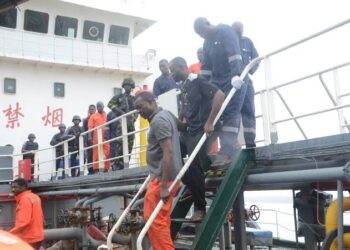
The global body however reported that Nigeria and Benin continued to be piracy hotspots. While 10 attacks were reported in Nigeria, including two hijackings, IMB warns that this number is not representative of the real threat of Nigeria piracy. Underreporting of attacks in Nigeria continues to be a cause for concern, and IMB states that it is aware of at least another 34 unreported incidents in Nigerian waters.
Also in 2011 a probable extension of Nigerian piracy into neighbouring Benin included 20 incidents against tankers, eight of which were hijacked and had cargoes partly stolen. Although the average length of captivity for ships taken off the coasts of Nigeria and Benin tends to be roughly 10 days, compared to six months in Somali hijackings, IMB warns that these attacks can be more violent…….
On piracy in Somalia, the body noted that “Somali pirates continue to account for the majority of attacks – approximately 54%. But while the overall number of Somali incidents increased from 219 in 2010 to 237 in 2011, the number of successful hijackings decreased from 49 to 28.”
The overall figures for Somali piracy could have been much higher if it were not for the continued efforts of international naval forces, IMB reports. In the last quarter of 2011 alone, pre-emptive strikes by international navies disrupted at least 20 Pirate Action Groups (PAGs) before they could become a threat to commercial fleets. The last quarter of 2010 saw 90 incidents and 19 vessels hijacked; in 2011, those numbers fell to 31 and four, respectively.
“These pre-emptive naval strikes, the hardening of vessels in line with the Best Management Practices (BMP) and the deterrent effect of Privately Contracted Armed Security Personnel (PCASP), have all contributed to this decrease,” said Captain Pottengal Mukundan, Director of the IMB Piracy Reporting Centre (IMB PRC), which has been monitoring piracy worldwide since 1991. “The role of the navies is critical to the anti-piracy efforts in this area.”
Although the number of vessels employing and reporting the carriage of PCASP increased in 2011, the regulation and vetting of PCASP still needs to be adequately addressed, Captain Mukundan warned. Until such time as a comprehensive legal framework is in place, owners and Masters should follow the International Maritime Organization and industry guidelines on the carriage of PCASP.
The IMB report shows that Somali pirate attacks were predominantly concentrated within the cross roads of the Arabian Sea and the Gulf of Aden. However, 2011 marked the first hijacking by Somali pirates of an anchored vessel from within the territorial waters of a foreign State – namely, Oman – highlighting the need for ports and vessels at anchorages in the region to be vigilant.













Discussion about this post