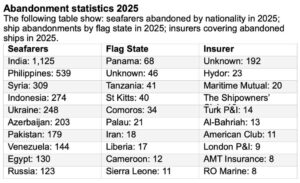
Seafarer abandonment hit record levels in 2025, according to new data compiled by the International Transport Workers’ Federation (ITF), with 6,223 seafarers abandoned across 410 ships, the sixth year in a row that the number of vessels on which abandonments occurred has broken records. The numbers represent a 31% increase in such ship abandonments compared to 2024, and a 32% increase in seafarer abandonment.
ITF data, which will be submitted in a report to the International Maritime Organization (IMO) ahead of its discussion at a legal committee meeting this year, also shows that seafarers were owed a total of $25.8m in 2025 as a consequence of the abandonments. From this total, the ITF has recovered and returned $16.5m to seafarers.
“It’s nothing short of a disgrace that, yet again, we are seeing record numbers of seafarers abandoned by unscrupulous shipowners,” said David Heindel, chair of the ITF Seafarers’ Section.
“Every day, all around the world, seafarers face horrific violations of their human and labour rights, all so that bottom-feeding companies can make a quick buck at their expense. It’s very clear that this is a systemic issue in the industry – and that means we need the entire industry to come together with seafarers and their unions to say, ‘enough is enough’, and take action together to end this crisis.”
We are normalising treating seafarers like disposable pawns
Seafarer abandonment is defined by the IMO under three criteria: failing to cover the cost of a seafarer’s repatriation; leaving a seafarer without necessary maintenance and support; unilaterally severing ties with a seafarer, including failure to pay contractual wages for a period of at least two months. The IMO and the International Labour Organization (ILO) run a joint seafarer abandonment database.
Indian seafarers were the worst affected national group in 2025, as in 2024, with 1,125 seafarers abandoned. At the end of 2025, the Indian government announced that blacklisting measures would be taken to protect seafarers from ships with a record of repeat abandonments and other bad practices.
Filipino seafarers were the second worst affected, with 539 abandoned, followed by Syrians with 309 abandoned.
The worst region for abandonment was the Middle East, followed by Europe. The two countries where most ship abandonments took place – the countries with the highest number of vessels on which abandonments occurred – both of which have significantly higher abandonments than any other country, were Türkiye (61) and the United Arab Emirates (54).
Flag of convenience (FOCs) vessels feature prominently in abandonment: 337 vessels abandoned in 2025 – 82% of the total – were flying FOC flags.
Commenting on the statistics, Carl King, founder of Seafarer Social Consultants, told Splash today: “Every abandoned seafarer is a step backwards for the shipping industry. With one hand we talk about a retention crisis; with the other, we normalise treating seafarers like disposable pawns.”
King called the data a “disgrace”, warning shipowners and flag states need to fix the issue quickly, or accept an even steeper decline in the skilled people needed to crew vessels.
Chirag Bahri, international operations manager at the International Seafarers Welfare and Assistance Network (ISWAN), described how abandonment has lasting impacts on the mental wellbeing of seafarers and their families ashore, alongside severe financial distress.
“Many seafarers are left struggling with unpaid wages, ongoing loans, and money lost to fraudulent agents in the hope of securing work. The continued rise in abandonment cases highlights systemic failures that necessitate immediate attention and coordinated action across the industry,” Bahri said.
ITF general secretary Stephen Cotton urged the International Maritime Organization to be given more power to play a coordinating role in eradicating abandonment.
The ITF has three ideas to tackle seafarer abandonment. First, flag states must be compelled to log a ship’s beneficial owner, including contact details, as a pre-condition for registration. Secondly, national blacklisting of ships should happen to protect seafarers from ships with repeated involvement in abandonment cases. Finally, the ITF is calling on governments to investigate the use of flags of convenience.
Steven Jones, the founder of the Seafarers Happiness Index, hit out at how regulators were not dismantling the mechanisms which allow bad actors, “the fundamentally evil owners” who have such blatant disregard for seafarers.
“Until we drive real change, until the regulation aligns with the response, and until we get more agile in spotting the warning signs and in dealing with them, then next year the numbers will be bigger. And the year after that,” Jones said.