By Oluyinka Onigbinde
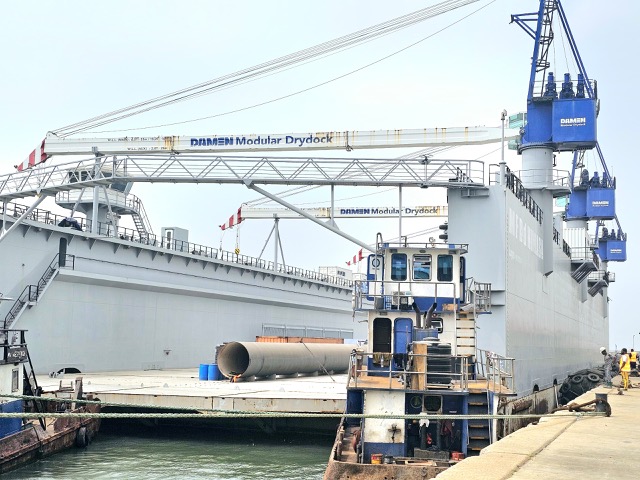
Stakeholders in Nigeria’s maritime sector have renewed calls for the privatisation or concessioning of the Nigerian Maritime Administration and Safety Agency (NIMASA) floating dock; a multi-billion-naira asset which has remained largely idle years after its acquisition.
Findings indicate that the floating dock, procured during the administration of Dr. Dakuku Peterside in 2018 to enhance Nigeria’s ship repair and dry-docking capacity, is currently situated around the Igbo Efon axis of Lagos State. However, its operational status and level of utilisation remain unclear, raising fresh concerns over accountability and efficiency in the management of critical maritime infrastructure.
Igbo Efon, is a residential and commercial riverine area along the Lekki-Epe Expressway in Eti-Osa LGA of Lagos.
Uncertainties have however heightened over the current location of the floating dock because Igbo Efon faces the open Atlantic oceanfront and shallow coastal lagoons. It lacks the protected deep-water harbor infrastructure, specialized dolphin jetties, and heavy engineering workshops required to stabilize and run a 10,000-metric-ton vessel repair facility.
The development has sparked criticism among industry players, who argue that the continued inactivity of such a strategic asset represents a major setback for Nigeria’s blue economy ambitions and a drain on potential revenue that could have been generated from local and regional ship repair services.
Speaking with our correspondent, the National President of the Nigerian Merchant Navy Officers and Water Transport Senior Staff Association (NMNOWTSSA), Engr. Bob Joseph Yousou, strongly advocated private sector participation in the management of the floating dock, insisting that government has consistently struggled to run commercial ventures effectively.
According to him, assets of such nature are better managed by private operators who are driven by efficiency, profitability, and continuity, rather than government structures that are often affected by policy disruptions and administrative transitions.
“In anything that is business-oriented, government should pull out and allow the private sector to handle it,” he said. “When government runs such things, it takes time, and before one administration completes its plans, another comes with a different agenda. Nothing is consistent.”
He argued that privatisation would not only improve efficiency but also ensure sustainable revenue generation for government through taxation and regulatory oversight, rather than direct involvement in operations.
“The truth is that for all the money put into it, nothing has come out of it,” he added. “If the private sector is allowed to run it, they will make it work and generate revenue.”
Engr. Yousou further stressed that government should focus on policy formulation and regulation, while leaving the operations of commercial maritime assets to private investors with technical capacity and business orientation.
He maintained that the prolonged dormancy of the floating dock underscores broader challenges in Nigeria’s public sector management of revenue-generating infrastructure, warning that continued neglect could further deepen capital flight in the maritime industry, as shipowners continue to patronise foreign dry-docking facilities.
On his part, Julius Adagha, a maritime engineer, argued that the idle state of the floating dock represents a missed opportunity for job creation, skills development, and foreign exchange savings within Nigeria’s maritime ecosystem.
He noted that a functional dry dock facility would significantly reduce the need for Nigerian vessels to travel abroad for repairs, thereby strengthening local capacity and positioning the country as a regional maritime hub.