By Rishab Joshi
The Republic of Benin is a small country in West Africa. It borders Togo, Nigeria, Burkina Faso and Niger. Most of its population resides near the southern coastline of the Bight of Benin, part of the Gulf of Guinea.
Benin does not have a strong economy as it is primarily dependent on agriculture. Mostly subsistence farming is practised here, which is a major generator of employment and income in the country.
Benin is a major exporter of cotton and palm oil. The tropical climate helps in the production of varied crops such as cocoa, maize, pineapple, rice, peanuts and cashews. These are distributed within Africa and also exported to the neighbouring countries. Marine goods are also exported mostly to Europe.
Benin was once a poor nation but in recent years the economy of Benin has seen much progress and its GDP has also risen considerably. This is due to the development of its major seaport- the port of Cotonou, which has witnessed increased investment and infrastructural development.
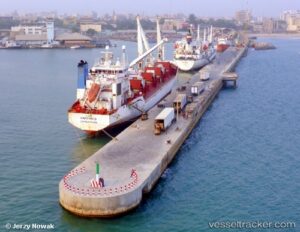
The Port of Cotonou
The Cotonou Port is located in the southern part of the city of Cotonou, one of the largest cities in Benin and also the seat of the country’s government. It is also referred to as the economic capital of Benin.
The port of Cotonou exports cargo to its landlocked neighbouring countries like Burkina Faso, Niger, Mali, Chad and Nigeria. The port also has trading agreements with some nations and is also a part of the Economic Community of West African States. This regional integration helps the Cotonou port to grow and also attract foreign investment.
It covers an area of around 400,000m2 and is quite close to the sea. It is also close to other ports in the region such as the Ports of Lagos in Nigeria and Lome in Togo. As it is located on a sandy coast, it is a well-sheltered port that provides perfect conditions for refuelling operations.
The Port is managed and operated by the Cotonou Port Authority, which is owned by the government. The SOBEMAP, a state-owned enterprise has a monopoly over handling and managing manual labour at the port. Other shipping companies like Maersk and Bollore offer container services. At this port, different government and private entities take charge of varied services to enable the smooth functioning of trade and commerce.
Statistics show that Cotonou Port handles 90% of the country’s foreign trade and is a major contributor to its GDP, around 60%. Port of Antwerp International has stated that Cotonou port handles 12 million tonnes of freight every year. These figures are enough to gauge the Port’s importance for the economic development of Benin.
The government is increasingly investing in the expansion of the port. The construction of a second-deep terminal is underway. The terminal called ‘Seme Terminal’, which is not yet operational is a link between Cotonou and Nigeria.
Presently, the Port handles a wide variety of cargo including manufactured and processed food, agricultural products, fertilisers, Chinese cloth, second-hand fabrics, used vehicles, electric and household appliances.
However, the trade of second-hand vehicles has tarnished the port’s reputation as these used vehicles and other electronic appliances do not meet the technical standards of developed nations. Cotonou Port also transports to inland regions- huge shipments of rusting trucks and old appliances. These products are cheap but not of good quality and detrimental to the environment.
The port also faces some administrative and managerial issues. Logistics companies have complained that they have to wait for long hours at the port. The Government is trying to restructure the services, modernising the port facilities to meet global port standards, and encouraging a professional code of conduct among its staff.
Read Also: Maritime Terms and Definitions
Nonetheless, Port of Cotonou has come a long way in terms of development. It saw container traffic of around 276,000 TEUs in 2017 and has witnessed continuous growth over the years. This has resulted in port congestion. However, the container handling facility has also improved manifold along with a significant decrease in waiting time for trucks and other cargo.
The Millenium Challenge Corporation has greatly contributed to the improvement in the port’s infrastructure and storage facilities.
The Cotonou port has 5 conventional berths, 150-300 meters long and can handle vessels having around 15-meter draft. It also has 3 container berths, 500 meters in length with a draft capacity of 10 meters. It can handle containers and ro-ro vessels. It also has a 150 m long silo berth, which needs to be rebuilt, along with 3 berthing tugs and 10 water barges.
Berth 5 is the only berth that handles heavy general cargo ships. The vessels come to berth 5 and are then moved to the other berths. There are two private container terminals operated by SMTC, a subsidiary of Bollore and COMAN, owned by Maersk. They have two shore cranes for loading and unloading heavy cargo. Tanker vessels can sail only during the day.
The port boasts of modern and fully operational equipment which includes 4 dockside cranes, 2 container gantries, 4 mobile cranes with a capacity of 140 metric tonnes, 7 reach stackers with a capacity of 45 metric tonnes, 13 ro-ro tug trailers, 11 metric tonne grain elevator and 7 forklifts with a capacity of 4 to 16 metric tonnes.
The port’s storage area spans 91,000m2. The Benin Terminal has two gantries. The port offers services such as container facilities, container freight stations, refrigerated container stations and 56 reefer stations.
· Multipurpose Terminal
There is a Ro-Ro berth plus a fully mechanized Ro-Ro terminal managed by Roro Terminal, Benin SA. It is spread over 4.5 hectares and can handle around 3000 vehicles.
· Handling Grain and Bulk cargo
Pier four and five handle bulk cargo. Pier five is used by private company ORYX/ADDAX. The port also has a grain silo with a capacity of 11,000 metric tonnes. Tanks that store vegetable oil and petroleum, have a capacity of 43,700 m3.
· Main Storage Terminal
The main storage facilities are quite huge, with a capacity of 100,000m2, including warehouses, three container terminals spanning 15,000m2, a container park and a fully paved open area spanning 60,000m2. The port also has a fish warehouse, large storage tanks and also silo tanks. The port offers free zone warehouses for Nigeria, Burkina Faso and Mali.
Kindly like us on Facebook