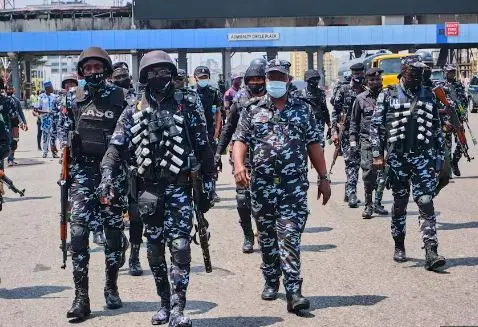
Prior to 2013, there was no distinct Police formation for Nigerian seaports. It was in that year that the Nigeria Police Force created the Maritime Command, to ‘swallow’ the Marine Police Command, the Ports Authority Command and the Inland Waterways Formation.
The new command was domiciled at Force Headquarters in Abuja, but has the status of a zone; headed an Assistant Inspector General of Police.
The Maritime Command is further broken into Western Maritime Command with headquarters in Lagos, the Eastern Maritime Command with headquarters in Port Harcourt, Rivers State and the Marine Command with headquarters also situated in Lagos. Each of these subsidiary Commands under the Maritime Police Command is headed by a Commissioner of Police.
There is no over-emphasising that the seaports, just like any entry point need the presence of the Police. The establishment of the Ports Authority Police Command was therefore essentially to ensure safety of lives and property and to guarantee hitch-free economic activities in the ports.
Specifically, the roles of the Police in the ports have always included the enforcement of the provisions of the Nigerian Ports Authority Dock and Premises By-Law of 1955 and other Ports related laws.
So, when the idea of a distinct creation of the Police to be in charge of the nation’s seaports became a reality more than a decade ago, the fear was that it may not make the ports safer and that it would hinder trade facilitation.
The fear was predicated on the fact that, from the mandate that the Police headquarters gave the then-new command, it appeared like the nation’s maritime sector is going to witness friction among agencies whose responsibilities are likely to be infringed upon by the new Police formation.
These fears have materialized over the years. From its initial dignifying presence at the ports, the Police have entrenched itself into the cargo clearance and delivery process all over the place. From Lagos ports to eastern ports, the Police have grown and created sub-divisions.
Consequently, its personnel have become a key player in all aspects of corruption in the ports, be it- extortion and bribery, systemic delays in the process leading to cargo clearance and exit from the ports.
This apparently unacceptable conduct is becoming unbearable to members of the shipping community, who have had to bear the brunt Police meddlesomeness in cargo clearance and delivery.
In November 2025, the Executive Secretary of the Nigerian Shippers’ Council (NSC), Dr. Pius Ukeyima Akutah openly lamented what he called incessant slamming of ‘Detention Orders’ on cargoes, by officials of the Nigerian Police in the ports. He raised the alarm that the action is increasing cargo dwell time at the ports and also increasing demurrage and storage charges payable by consignees, ultimately leading to an increase in the cost of doing business at the ports.
We are in agreement with Dr. Akutah on this. The danger in these notorious roles that the Police have taken-up, is that, Nigerian ports are being labelled as expensive and non-competitive.
In actual fact, while it takes only about six hours to clear a containerised cargo in Singapore port and seven days in Lome port, it takes an average of 21 days or more to clear a containerised cargo in Nigerian ports. Sadly, the process in Nigerian ports is not near the global threshold at all. No thanks to state actors like the Police, whose personnel are visible in all parts of the ports; from the terminals to the warehouses, to the gates and even beyond the ports’ gates.
Overtime, stakeholders have accused the Police of unwarranted interference in cargo delivery. They lament that containers that were duly cleared by all relevant government agencies at the point of examination are often ‘blocked’ by the hierarchy of the Police in the ports.
It is very clear that these delays constitute a delay in port process. While we are not condoning clearance of ‘questionable’ containers, the interference by Police, especially after such good have been duly cleared serves no purpose except the pecuniary interest of the force.
Stakeholders, especially shipping lines complain that containers are picked at random from the manifest and placed on hold for investigation, by the Police. Even the shipping agents are complaining that they are receiving multiple requests daily—sometimes as many as 15—and these police interference is affecting operations because the containers are taken out of circulation. These containers belong to shipping companies, but when they are held by the Police, they are tied down.
Finally, the Nigerian Shippers’ Council must rise above the sentiments and hold the Police accountable for the interference and the consequences.
The defence by the Police that, its actions are intelligence-driven and are carried out strictly within its statutory mandate to prevent crime and safeguard maritime trade, is untenable, because the Standard Operating Procedure in the ports, especially as it concerns cargo examination, excludes the Maritime Police.
What the Police cleverly clarifies as ‘investigation holds’, is nothing more than a ploy to extort. There has not been any tangible evidence that such interventions have led to any meaningful recovery of questionable cargoes.
While it may be difficult to evict the Police from the ports, it is important to restrain them and spell out their areas and scope of operations.