By Joshua Yousouph
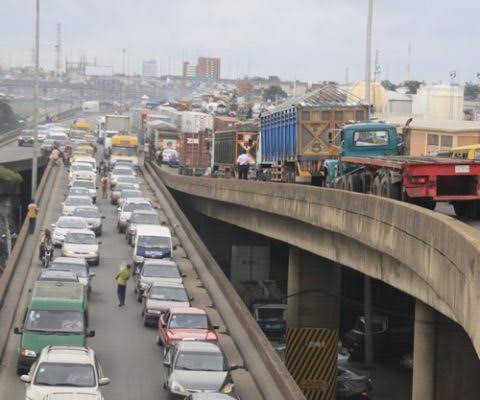
The frequent closures of the popular Marine Bridge in Apapa, Lagos for repairs have continued to paralyze cargo movement, leaving truckers and exporters counting multi-million naira losses as prolonged delays, fuel wastage, and harassment on alternative routes worsen operational challenges across the port corridor.
Recall that last week, Shipping Position Daily reported concerns over the deteriorating state of the bridge, which has been repeatedly closed for repairs over the past 10 years. The Bridge which has remained a major artery for the movement of imports and exports in and out of Lagos ports has however made years of intense usage and neglect leave the bridge in a worrisome state, raising safety concerns among road users and port stakeholders.
As at last week, the bridge was still closed for maintenance by the Federal Ministry of Works till 25th of October, 2025. However, stakeholders who spoke with our correspondent lamented that the situation has resulted in multi-million naira losses, prolonged delivery times, and heightened operational challenges.
In an exclusive chat with our correspondent, the National Secretary of the National Association of Road Transport Owners (NARTO), Aloga Ogbogo, said that while the closure of the bridge may be necessary for maintenance and rehabilitation, it has created a chain of economic and logistics setbacks for operators and businesses relying on the route.
According to him, each closure of the bridge without a viable alternative route significantly increases journey time, fuel consumption, and exposure of drivers to harassment, extortion, and even brutalization by security operatives along alternative routes.
Ogbogo noted that such delays ultimately affect the entire value chain, as goods expected at specific times fail to arrive as scheduled, disrupting production and trading activities for both exporters and local distributors.
The NARTO chieftain described the frequency of repairs as alarming, calling on the Federal Ministry of Works to take proactive steps in providing a permanent solution rather than resorting to repeated temporary fixes. He emphasized that the excessive tonnage and deadweight of trucks plying the bridge daily have placed immense structural stress on it.
He identified poor planning and over-dependence on road transport as root causes of the recurring crisis, stressing the urgent need for an effective and functional railway system to reduce pressure on the bridge and the Apapa corridor.
Ogbogo further pointed out that the government’s enforcement of axle load limits has been selective, focusing mainly on tanker trucks, while other categories of vehicles—including cement and industrial goods carriers often exceed safe weight limits.
“If the bridge is being closed down, it is for maintenance and rehabilitation, I guess. But I would also assume that an alternative route would have been provided. What that means is longer journey time, more fuel consumption, and more harassment from security forces. This slows down cargo movement and delays delivery to the final destination.
“The railways should be made functional. The Apapa-Ibadan rail line should be effectively used to move cargo. Some of these deadweight goods can be transported by rail to nearby cities to ease the load on the bridge and roads,” Ogbodo said.
Corroborating Ogbogo’s views, a prominent exporter and Chief Executive Officer of Hallmark Investment, Alhaji Nofiu Inaolaji, lamented that the incessant closure of the Marine Bridge has continued to take a heavy toll on port users and businesses.
Speaking on the impact of the incessant bridge repairs, Inaolaji stated that while the bridge shutdowns directly disrupt truckers’ activities, exporters and importers ultimately bear the financial burden, as the cost of delays, demurrage, and prolonged logistics challenges are transferred to them.
He expressed disappointment that despite several appeals and recommendations made by stakeholders in the maritime and logistics sector over the years, little to no action has been taken to address the root cause of the recurring bridge closures.
Inaolaji noted that the continuous disruptions caused by the closure of the Marine Bridge have far-reaching effects on Nigeria’s port operations, trade efficiency, and overall economic productivity. He urged the government to implement a sustainable and long-term solution to the recurring infrastructure problem, warning that the current situation threatens ease of doing business in the maritime industry.
In a quite dissenting voice, President of the Association of West African Exporters and Marine Professionals (AWAEMAP) Mr. Olubunmi Olumekun, allayed fears of a major disruption to export activities, saying the effect on exporters will be minimal due to the availability of alternative terminals across Lagos.
Speaking with Shipping Position Daily, Olubunmi Olumekun said that while the closure may inconvenience road users and create temporary traffic challenges, exporters are not likely to experience significant setbacks in their operations.
He explained that apart from the Export Processing Terminals (EPTs) within the Apapa and Tin Can areas, several other facilities in Ojota, Amuwo Odofin, Okokomaiko, Kirikiri, and Brawal have been operational, providing exporters with multiple access points for cargo movement and documentation.
Olumekun, however, urged authorities to carefully plan and communicate any bridge closure schedules to minimize delays and additional costs for logistics operators. He noted that considerations must be given to the “extra cost of time delivery and port access” before embarking on such maintenance exercises.
The AWAEMAP boss also disclosed that cargo movement through Tin Can Island Port has remained relatively smooth, suggesting that the route could serve as an alternative for truckers and exporters during the repair period.
“Yes, the people who use that environment (Marine Bridge) will be somehow affected. But when we talk in terms of export, it is not going to have much effect, because we have export terminals in different locations. We have one at Lilypond, one somewhere around Ojota, some in Amuwo and parts of Okoko, and even close to Kirikiri. So, closing that bridge will not have much effect. But for those who are using that route frequently, there may be a little bit of chaos”, Olumekun emphasized.