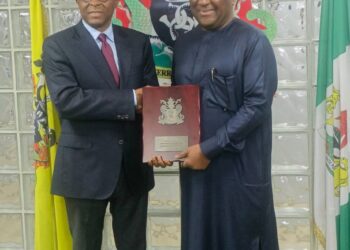
The Registrar and Chief Executive Officer of the Council for the Regulation of Freight Forwarding in Nigeria (CRFFN), Mr Igwe Kingsley reaffirms the statutory powers of the Council amid recent legal controversies. In this interaction with the media, the Council cleared the air on ongoing misconceptions and laid out its next steps. Our Assistant Editor; Oluyinka Onigbinde was there.
“Collection of POF is not directly under the control of the Council……”
· Members of National Council of Managing Directors have been paying POF and will not stop.
Can you tell us why this press conference was called?
This press conference becomes very important to correct some errors in the industry media space and to straighten the facts and some of the misgivings. This conference is a reaffirmation of CRFFN’s statutory mandate on POF (Practitioners Operating Fee) collection and the regulation of customs licensed agents amidst the recent court ruling. Our attention has been drawn to various viral reports regarding a judgment delivered by the Federal High Court in Ikeja, Lagos, on 26th May 2025. This has led to some misconceptions about the Council’s statutory mandate.
You mentioned a court judgment. Can you clarify the Council’s view on it?
We express deep concern over the secretive manner in which the judgment was issued, reportedly without due notice to the defendants as named in the suit. Such a process somehow is contrary to expected principles and processes as enshrined in the Constitution of the Federal Republic of Nigeria. The Council views this report as the handwork of some mischief makers aiming to derail the peace, reforms, and progress achieved in the freight forwarding sector in recent times. These achievements have been made possible through the renewed hop agenda of His Excellency the President of Nigeria, the Federal Republic of Nigeria President Bola Ahmed Tinubu, GCFR, and with the support of the Honorable Minister of Marine and Blue Economy, His Excellency Alhaji Adegboyega, Oyetola CON. As a matter of fact, in the light of the foregoing, CRFFN wishes to reaffirm its statutory powers amid recent legal controversies to the general public and industry stakeholders.
What exactly is the CRFFN’s legal mandate?
The Council was established by Act No. 16 of 2007—now part of the laws of the Federal Republic of Nigeria—as the legally empowered regulatory authority for freight forwarding practice in Nigeria. Specifically, Section 4, subsection A to G, outlines the Council’s core functions. These include regulating and controlling freight forwarding services in Nigeria, determining the standards of knowledge and skill for registration, issuance of licenses, registration of freight forwarders, and enforcement of discipline and professional conduct among practitioners. This mandate unequivocally includes oversight over all freight forwarding service providers, including Customs licensed agents, when engaged in freight forwarding activities.
How do Customs licensed agents and the Nigeria Customs Service Act of 2023 affect this?
The Nigeria Customs Service Act 2023 further reinforces CRFFN’s role over Customs licensed agents who operate within the freight forwarding value chain. Notably, Section 106, subsection 4 of the Nigeria Customs Service Act 2023 states—and I quote—“A customs representative, if you like, a customs licensed agent, shall be a freight forwarder and shall be subject to the regulations and code of conduct of the freight forwarding profession in Nigeria.” In this case, a profession regulated by Council for Regulation of Freight Forwarding in Nigeria. This provision legally integrates Custom representatives into the freight forwarding profession, making them subject to the regulatory control and code of conduct established by CRFFN.
There’s been much debate on the Practitioners Operating Fee. Can you elaborate on its legal standing?
The Practitioners Operating Fee (POF) is not a tax or revenue levy. It is a statutory fee gazetted by the Federal Republic of Nigeria and created under the powers conferred on CRFFN by its establishing Act. Section 4E of the CRFFN Act empowers the Council to maintain a register of persons and organizations engaged in freight forwarding and regulate their conduct—including the imposition of fees as may be prescribed. The POF is therefore a regulatory instrument designed to promote professionalism, support continuous training and certification, strengthen institutional capacity, and ensure transparency and data integrity within the sector.
Regarding the judgment, will the Council be appealing?
Absolutely! Our legal team is thoroughly reviewing the contents and context of the judgment. We reaffirm that, where necessary, we will exercise our rights of appeal, review, or clarification through competent judicial channels. On stakeholders’ engagement and regulatory continuity, CRFFN remains firmly committed to continuous stakeholder engagement, including with the Nigeria Customs Service, terminal operators, government agencies, customs license agents, freight forwarders, and other logistics service providers. Together, we aim to achieve a professional, standardized, and globally competitive logistics and freight forwarding system for Nigeria. Let no one be misguided as to declare statutory rules and mandates of the Council and let every practitioner go about their businesses normal, without fear or favor, for everything is under control and we shall keep updating as issues unfold. Therefore, the Council urges all practitioners to remain calm, law-abiding, and in full compliance with the regulations of the profession. Further guidance will be issued as developments unfold.
And in the meantime, will POF collection continue?
Yes, collection will continue. The court never said we should stop collecting POF. It only declared it illegal—it did not stop henceforth. So the collection of POF is ongoing and continuous and as a matter of fact, this is not against the court ruling. Let me be clear on that. The court never said stop collecting. It’s two different things, so that people don’t misunderstand it that way. Then, we are already almost at the point of submitting the appeal, and we will pass the same submission and we’ll put it across the public space.
Stakeholders have raised questions about the amount generated from POF. Can you tell us how much has been collected so far?
I’ll excuse that question for now, because it’s something we are still trying to gather. The collection is not directly under the control of the Council. We engaged the consultants who handle this process. They are in the best position to provide a clear account on how much they have collected on POF. As we speak, the Council does not have the figures. They haven’t been transparent enough. We have been demanding for the figures, but they are yet to declare to us how much they have collected. It is still on their table to let the public know how much they have collected from POF. It is not supposed to be a secret. So today, I’m still establishing that we need to know how much they have collected so far.
There have also been claims that the National Council of Managing Directors and License Customs Agents (NCMDLCA) and some associations have not been paying POF. What is CRFFN’s position on this?
It’s a bit complicated because they have their internal issues. This is not to lock horns with any association or group or any entity or persons. However, it is one of the issues CRFFN is looking into – the activities of the associations. We just concluded stakeholder engagements and trainings, and more workshops are on the way and CRFFN will come up with a report at the end of it. So we are reviewing the participation of all the practitioners. As you know, we just finished our stakeholder engagement and the trainings, which will also be ongoing. The training will continue, and we’ll also be having some more workshops and stakeholder engagement in no distant time. More information will be given at these events. At our last engagement, the National Council of Managing Directors were fully represented. The attendance speaks for itself. At the level of the training that was conducted, they attended and participated. They have been paying POF and will not stop. For now, until the matter is conclusively dealt with, the status quo remains. We will get across to you with updates as the situation unfolds.
Let’s look at the current reforms in the Council. Can you reflect on the state of the industry in the past and how it is now?
To fully appreciate the progress we are making, we must reflect on our past. For several years, the freight forwarding industry was weighed down by disunity, weak institutional frameworks, and a lack of direction. The Council itself suffered from internal instability, disjointed leadership, and systemic inefficiencies that eroded public trust.
What has changed? What brought about the progress we’re seeing today?
Under the current administration of His Excellency, President Bola Ahmed Tinubu, GCFR, and with the focused leadership of the Honourable Minister of Marine and Blue Economy, a new dawn has emerged. Today, internal peace and harmony have been restored within the Council. Under my leadership as the substantive Registrar/CEO, we’ve implemented clear administrative procedures, internal governance frameworks, and a performance-driven culture. These reforms have strengthened institutional integrity, improved staff capacity, and ensured operational consistency across all departments. The Council is no longer encumbered by internal wrangling or policy confusion. We are operating under structured administrative processes that prioritize transparency, accountability, and responsiveness.
Beyond internal reforms, how has CRFFN engaged with the broader industry?
Through consistent engagement and strategic partnerships, the Council is transforming its image from a crisis-ridden agency to a proactive, professional, and visionary institution. We’ve entered into meaningful collaborations with terminal operators, shipping lines, trade associations, and government stakeholders. We are no longer on the sidelines—we are at the heart of the logistics and trade ecosystem, shaping the future of freight forwarding in Nigeria.
Can you highlight some of CRFFN’s recent achievements?
Some of our key milestones include: The commissioning of the Zenith Carex Cold Chain Facility in Abuja, which enhances supply chain efficiency and supports national food security and pharmaceutical logistics. Also, we had the launch of the CRFFN Free Nationwide Capacity Building Programme, training thousands of freight forwarders in global best practices, regulatory compliance, and digital tools—at no cost to participants. We also had the digitisation and standardisation of freight logistics services, creating a tech-enabled, efficient national logistics framework. We also have our regular stakeholder engagements across seaports, airports, and border stations, which foster unity, rebuild confidence, and align operations with regulatory mandates.
What are your final words to stakeholders?
Let no one be misguided as to the statutory roles and mandate of the Council. Let every practitioner go about their business as normal, without fear or favour. Everything is under control and we will continue to update the public as issues unfold. The Council urges all practitioners to remain calm, law-abiding, and fully-compliant with the regulations of the profession.