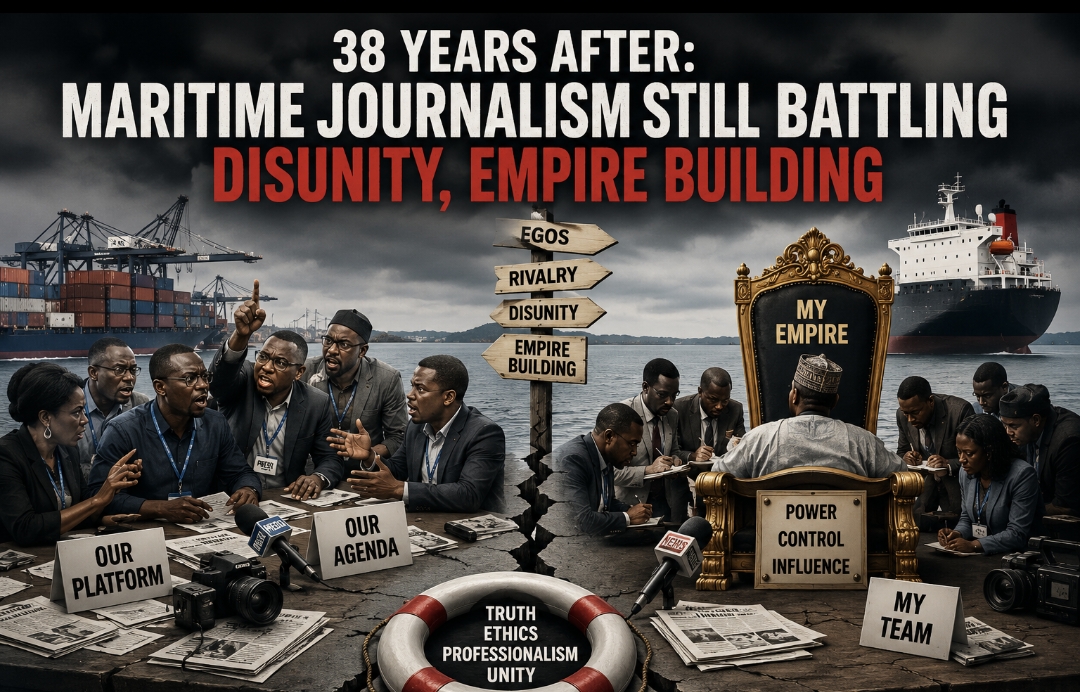
The recent leadership transition in Maritime Reporters Association of Nigeria (MARAN) is more than just another election cycle within a professional body. It is an opportunity for sober reflection on the state of maritime journalism in Nigeria and a defining moment to ask difficult, but necessary questions about the future of the profession.
As MARAN ushers in a new administration, the focus should not merely rest on who occupies the seat of leadership. The larger concern must be the survival, relevance, unity, and professional advancement of maritime journalism itself. For an association that is approximately 38 years old, the level of fragmentation among maritime journalists in Nigeria has become both alarming and counterproductive.
MARAN, founded in 1988, remains the pioneer and foundational association of maritime journalists in Nigeria. In essence, if MARAN is 38 years old, then organized maritime journalism in Nigeria is also about 38 years old. This fact has been affirmed by pioneers of maritime journalism in Nigeria.
Therefore, every maritime journalists’ group existing today traces its roots, directly or indirectly, to MARAN. That historical truth cannot be disputed.
For 10 years after its establishment, MARAN stood as the only recognized body of maritime journalists in Nigeria. However, in 1998, the League of Maritime Editors (LOME) emerged following disagreements among some senior practitioners who believed that, as founding fathers of maritime journalism, they were not accorded sufficient respect within MARAN. Under the leadership of its first president, Alban Opara, LOME became the first major splinter maritime media association in the industry.
Sadly, what started as one breakaway group has today snowballed into a maze of associations and factions. Presently, the maritime media landscape is populated by bodies such as Shipping Correspondents Association of Nigeria (SCAN), Maritime Journalists’ Association of Nigeria (MAJAN), Association of Maritime Journalists of Nigeria (AMJON), Congress of Nigerian Maritime Media Practitioners (CONMMEP), Online Maritime Media Association of Nigeria (OMAN), and recently, the Maritime Correspondents Organization of Nigeria (MARCON) was revived to join the train. This is in addition to another group that simply refers to itself as the “Non-Allied Group.” Altogether, the sector now has over eight different maritime journalists’ groups; all operating within the same industry, pursuing largely similar objectives, often with overlapping memberships and duplicated functions!
The irony is painful. Nigeria, a sovereign nation that is over 60 years old, operates with 36 states. Yet maritime journalism, barely 38 years old, now struggles under the weight of more than eight associations. Such proliferation does not reflect growth; it reflects division and stunted growth.
To be clear, the existence of multiple associations is not necessarily the problem. Diversity of thought can strengthen democratic engagements within any profession. The problem arises when these groups become empires built around personalities rather than institutions, when ego supersedes collective interest, and when leadership becomes more about titles than impact.
Maritime journalists must resist the temptation to operate like freight forwarding factions where silos, camps, and empires define professional existence. Journalism is a profession built on collaboration, advocacy, and shared values. The maritime media space cannot continue producing “emperors” who, in reality, are overrated chiefs who preside over shrinking fiefdoms of no influence.
Disunity has robbed maritime journalists of strength. It has stolen the power of collective bargaining. It has cost practitioners opportunities that could have transformed lives and improved welfare. If maritime journalists were united under a stronger common front, the industry would possess a single powerful voice capable of negotiating welfare packages, establishing health insurance schemes, creating emergency support funds, securing legal protections, improving access to training opportunities, and guaranteeing a meaningful safety net for practitioners. None of these exists.
Instead, the current fragmentation has weakened practitioners’ negotiating power and reduced their influence within the maritime industry, where they seek to be stakeholders. The painful reality is that many maritime journalists today operate under difficult economic conditions, with limited institutional support and inadequate professional protection. Yet the same professionals remain divided across numerous associations, many of which struggle independently with the same challenges.
This is why unification is no longer a matter of convenience; it has become a matter of survival. The African philosophy of Ubuntu teaches that: “I am because we are”. Maritime journalism in Nigeria must rediscover that philosophy. The profession’s future depends on its ability to rise above petty divisions, ego battles, and factional rivalries that have yielded little beyond collective weakness.
Encouragingly, efforts toward unification have not been entirely absent. The Network of Nigerian Maritime Journalists (NNMJ), an umbrella coalition established to foster cohesion among maritime media groups, remains a commendable initiative. Through the NNMJ, many of the associations now engage on common industry matters under a shared platform. There have also been several attempts at a broader merger process over the years. We recall that, the NNMJ spearheaded discussions last year involving representatives from different associations who came together with genuine intentions to chart a path toward unity. Though the effort ultimately failed to achieve full integration, it demonstrated that the desire for unity still exists among many practitioners.
Those efforts must not die. The leaders driving the unification process deserve commendation, encouragement, and support. The dream of a common front for maritime journalists remains achievable if sincerity, sacrifice, and collective interest are allowed to prevail over individual ambition.
At this critical point, the emergence of a new leadership in MARAN should serve as a fresh beginning — not just for MARAN, but for the entire maritime journalism community. The association deserves commendation for conducting a peaceful and successful transition of leadership. Stability within the pioneer body is important for the health of the profession. But beyond electoral victories and congratulatory messages lies a larger responsibility to serve and also push for unification.
The industry deserves a united and professional media front capable of advancing the interests of maritime journalism, defending practitioners, and strengthening the quality of reportage within the sector. Professionalism, relevance, and productivity must once again become the defining values of maritime journalism. The focus should shift from endless association politics to capacity development, investigative reporting, ethical journalism, data-driven maritime analysis, policy advocacy, and improved welfare for practitioners.
The maritime industry itself is evolving rapidly through digitalization, port reforms, blue economy expansion, regional trade integration, and port modernisation. Maritime journalists cannot effectively report and shape conversations around these developments, while remaining trapped by internal divisions.
History will not remember how many associations existed. It will remember what maritime journalists collectively contributed to national development, policy accountability, and industry transformation.
After 38 official years, maritime journalism in Nigeria has matured enough to understand that unity is strength, it should not be feared as a possible instrument of fear or marginalisation. The time has come to move from fragmentation to fraternity. The time has come to speak with one stronger voice. And the time to begin is now.