Oluyinka Onigbinde
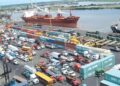
Despite efforts by the Federal Government to ensure carbon emission control in the marine environment, findings by Shipping Position Daily have revealed that the nation’s seaports remain neck deep in environmental crisis with most in-port factories emitting huge gases at the ports.

Major companies involved in these environmental hazards include: Dangote Group, BUA, Honeywell, Flour Mills, among others. Their operations are accountable for huge emissions, despite moves by regulatory agencies to attain the 2050 deadline for zero carbon emission and reduction of Greenhouse Gas (GHG) emission as directed by the International Maritime Organization (IMO)
Carbon is shorthand for greenhouse gas emissions, including CO2, methane, nitrous oxide and F-gases. These gases are released by many different types of activities through the burning of fossil fuels, deforestation, and industrial processes among others.
Investigations by our correspondent, as well as submissions by environmentalists in the country have revealed that the 2050 deadline may be unrealistic.
Prior to port concession in 2006, there were not many factories in the port environment. But, since the private sector were invited into the ports, factories bagging salt, flour, sugar and confectioneries have sprung up. This is a[rt from the several tank farms that now dominate the port environment.
The four major heavy industries operating within the nation’s seaports are: Dangote, BUA, Flourmills, Honeywell. Experts say that these factories contribute nearly 40% of the carbon dioxide (CO₂) emissions at the seaports.
The two major ports in Lagos; Apapa and Tin Can have the presence of at least six factories; all running on diesel, despite the call for de-carbonization in the country.
For instance, the Apapa port has Flour Mills, Dangote, Olams, among others, while the Tin Can Island Port has Honeywell, BUA, with numerous tank farms, among others all also running on fossil fuel that produces a high-level carbon emission responsible for ozone depletion and other environmental hazard.
Speaking during his recent visit to Nigeria, the Secretary General of IMO, Mr. Kitack Lim harped on the need for the entire maritime community in the country to play a role in bringing about a greener and sustainable maritime industry in the areas of resource mobilisation, maritime training, awareness, job creation and full implementation of maritime laws and regulations.
In a chat with our correspondent, an environmentalist and ‘Climate Justice’ campaigner with Friends of the Earth Nigeria and Africa; Mr. Babawale Obayanju, opined that the 2050 zero emission projection of the IMO may be a difficult one, considering the impact of the carbon produced by these industries in the maritime sector.
He said decarbonizing the maritime sector will require a holistic, drastic and dogged political will and action. He added that decarbonizing the sector will require first – a change of lifestyle, one where the country starts depending on homegrown products as a solution in order to reduce the importation rates.
He noted that the Nigerian government has made a commitment to cut its Greenhouse Gas emissions intensity by 20 per cent by 2030, and a further 45 per cent reduction conditional on receiving climate finance, technology transfer and capacity building, and has also indicated a move to transit to green energy in the maritime sector.
He said: “Yes, the Nigerian government has made a commitment by their Nationally Determined Contribution to cut its Greenhouse Gas emissions intensity by 20 per cent by 2030 – and a further 45 per cent reduction conditional on receiving climate finance, technology transfer and capacity building. And have also indicated a move to transit to green energy in the maritime sector.’
“But the same government has given licenses for coal extraction in parts of Benue, Kogi etc. The same government is now tagging gas as renewable and a transition fuel needed to make the just transition to clean renewable. They have also made some investments to explore for oil in the Chad basin and Gombe state.
“The argument has been that gas is clean, emitting less Co2 , we are energy-poor and we need funding to transit to a renewable energy system when in actuality, gas emits methane which is 34 times more potent than carbon dioxide over a long period of time in the atmosphere. 60% of gas already in production is geared for export to Europe, the required infrastructure for building new gas fields may take up to 10 years if not more, under business-as-usual scenario.
He asked: “If all we hope to produce is geared for export, how are we ever going to reduce the carbon footprint of the maritime sector? If most of the technology required to help get to net zero is imported and not home-based or grown, how will the maritime sector meet the 2050 target?
“We cannot say we are de-carbonizing by re-carbonizing. This is hypocritical and would only spell doom for our peoples and the climate”, he argued.
Read Also: DIPLOMATIC PRESSURE: ICS Rallies IMO, ILO, ITF, Others For Release Of Crew of MT Heroic Idun
Speaking also with our correspondent, the spokesman Corporate Accountability and Public Participation Africa, Mr. Philip Jakpor said the government is only playing lip service to transmitting to cleaner gas,
Jakpor urged that the government should provide incentives for some of the industries operating in the port to switch to alternative engines for cleaner gas as it is capital-intensive.
“We are not serious. If we are talking about transmitting and we are all also celebrating a new oil refinery, it means we are sending mixed signals out there to the world, we should now be talking about how to really transit because we have all it takes, we have filtered away over 60 years oil extraction; that’s why some argue that well we should also benefit from first time fuels, a carbon economy just like the western world it’s a sound argument
“We have technology that use Lithium, Lithium is very much here in Africa and has more potentials, but unfortunately if we go where you have this Lithium deposit they are consumed by the Chinese, Chinese have infiltrated everywhere, we have Lithium including in Nigeria that’s if we do not give ownership of this to the Chinese.
“But I think what the government should do for the industries in the maritime sector is to give incentives, because transiting is very important, but it’s also capital intensive, these companies we are talking about are using diesel now for them to transit ,we can intensify the whole process to either put incentives in place, if they now fail to transit in time frame then we can sanction them” he said.
shippingposition
Kindly like us on Facebook/twitter