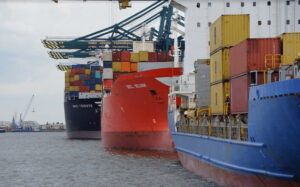
Ports and maritime reforms shaped industry performance in 2025, as governments and operators pursued efficiency gains while contending with infrastructure gaps and funding constraints across major trade corridors.
Ports remained central to economic activity, handling the bulk of international trade and serving as critical gateways for imports, exports and industrial supply chains that drive national and regional economies.
Targeted reforms in port governance and terminal operations improved vessel turnaround time, reduced cargo dwell time and enhanced service delivery, strengthening confidence among shipping lines and cargo owners.
Customs administrations equally influenced maritime outcomes, with increased deployment of automation, risk-based inspections and improved inter-agency collaboration at ports.
The expansion of electronic documentation and single-window platforms eased congestion, improved predictability for shippers and freight forwarders, and reduced discretionary delays in cargo processing.
In Nigeria and other emerging maritime economies, customs efficiency reforms translated into smoother cargo clearance processes and improved revenue collection, reinforcing trust in port systems.
However, investment gaps in port infrastructure persisted, limiting the ability of ports to accommodate rising cargo volumes, larger vessels and evolving global trade demands.
Industry experts stressed that without sustained funding for infrastructure, connectivity and technology, the full benefits of operational reforms would remain constrained.
Registrar of the Council for the Regulation of Freight Forwarding in Nigeria (CRFFN), Mr Kingsley Igwe, said the initiative would transform Nigeria’s trade environment by cutting red tape, boosting efficiency and driving competitiveness.
Igwe noted that studies showed full implementation of the NSW could lower logistics costs by between 25 oer cent and 30 per cent, improving Nigeria’s attractiveness to investors and positioning it among Africa’s leading trade hubs.
He said digitising and integrating trade processes would foster transparency, reduce documentation duplication and enhance Nigeria’s participation in the African Continental Free Trade Area (AfCFTA).
“Nigeria is at a critical juncture,” Igwe said. “Our businesses continue to grapple with high logistics costs, delays, and inefficiencies. The National Single Window offers a proven solution, as demonstrated in Singapore, South Korea, and Rwanda.”
Director of the National Single Window Project, Mr Tola Fakolade, described the initiative as a digital one-stop platform enabling traders, shipping lines, banks and government agencies to process trade documentation through a single secure interface.
According to Fakolade, the NSW would drastically reduce manual processing by automating approvals, licences and inspections, all tracked in real time to promote transparency and accountability.
“With the NSW, importers and exporters will only process documents once, and all relevant agencies will recognise them immediately.
“This will eliminate duplication and corruption-prone bottlenecks,” he explained.
Fakolade added that the system targets 24-hour cargo clearance, with technology reducing physical examinations by up to 90 per cent and providing real-time data analytics for monitoring trade flows and compliance.
The Comptroller-General of Customs (CGC), Dr Bashir Adeniyi, said the NSW represented more than a technology upgrade, describing it as a fundamental shift in Nigeria’s cross-border trade management.
“For too long, our traders have battled multiple agencies and redundant paperwork.
“This reform will finally bring efficiency and speed to Nigerian trade operations,” Adeniyi said, announcing March 2026 as the platform’s launch timeline.
He also said Customs had introduced an indigenous platform, B’Odogwu, a Unified Customs Management System integrating declarations, risk management, duty calculation, permits, manifests and cargo tracking into one system.
Assistant Comptroller-General of Customs, Zone ‘A’, Mr Muhammed Babadede, said customs officers understood traders’ frustrations, noting that speed and predictability were essential in today’s global economy.
“We recognise that in today’s global economy, speed and efficiency are not luxuries but necessities.
“Countries that can move goods faster and more predictable will attract more trade and investment,” he said.
Babadede added that trade facilitation tools such as the Authorised Economic Operator programme, Advance Ruling System and Time Release Study were building blocks for the NSW.
Maritime stakeholders in Lagos, including clearing agents, importers and exporters, also expressed satisfaction with the Customs operational platform, B’Odogwu.
President of the Bonded Terminal Association, Mr Jerald Mbamara, said the platform was flexible, mobile-friendly and had improved cargo tracking, reducing time and business costs compared to the NICIS II system.
Vice Chairman of the Port Consultative Council of Nigeria, Chief Jean-Chiazor Anishere (SAN), described the reforms as “a major leap toward a transparent, efficient, and globally competitive trade ecosystem.”
Experts agree that the balance between effective port reforms, efficient customs operations and closing investment gaps would determine the maritime industry’s performance beyond 2025.