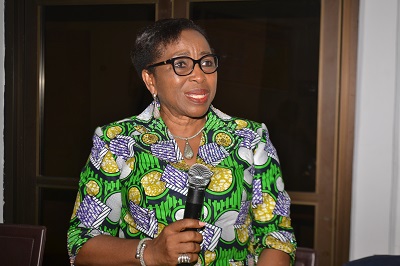
Mrs Chinwe Ezenwa is a former Director in the Federal Ministry of Transportation as well as Chairman, Le Look Nigeria Limited, and CEO at Ocean Serve & Logistics. She made history recently when she emerged as one of the 10 pioneer Nigerian exporters under the Guided Trade Initiative (GTI) of the African Continental Free Trade Agreement. In this interview with Oluyinka Onigbinde, she speaks about her journey to becoming a history maker.
Congratulations for being one of the 10 companies that were recognized to have started export under the African Continental Fair Trade Agreement. What does that award or recognition mean for export business, especially for your kind of unique business?
Well, I call that certificate, a certificate of prosperity because, I have been waiting for a day that we can trade among ourselves in Africa. Having been in this bag business for the past 39 years and also training people in the same industry, I was looking forward to using that platform to prosper the students I’m training in this industry, so that they can start looking into exports, not necessarily local markets. So, I was really overwhelmed because to be a trailblazer comes with its responsibility. And my own commitment is that if I train someone and I want to empower them, I can only do that through this export trade in Africa, so they can earn money.
Now that we are looking at regional exports, can you compare the regional market and the international market, in terms of how seamless it will be?
There is no basis for comparison really, because in Europe you’re competing with China. You’re competing with known industries. The competition is very keen. In Africa there isn’t too much of that competition. The only challenge you will have is this logistics and it is surmountable because in Europe, we have our challenges. In America, sometimes because they want to under-price their product, they start finding faults. In Africa, I find that shipping in Africa for me is better because I have tested the teeth. To penetrate the European or American market is tough; it is. To get into Kenya, I didn’t have much problem, or to Rwanda, or to Ethiopia, or to Ghana and the market is huge. You know, these are people who don’t really have much industry. Nigeria is supposed to really take advantage of the AfCFTA because of our population. We need to grow our industries and make our people more productive. Why should Nigerians go to bed by ten or nine in the night and not use the night hours to work? Why? So, I like the African market. There’s a lot of market. 1.4 billion people. I mean, that is huge.
Being one of the 10 companies that were selected to be part of the first shipment under AfCFTA protocol and now that we are talking about some of the challenges surrounding our exports, from experience, what do you think exporting under AfCFTA protocol is going to do differently?
Talking about what the African Continental Free Trade Agreement is going to do, it is going to checkmate those Chinese because that certificate of origin that I got yesterday is telling you that this particular product originates from Nigeria and that 80 percent of what was used in making the bag came from Nigeria. So for a Chinese to penetrate that market, he has to come here and set up his industry and use 80 percent of those things to produce before he can participate in this market. It is all about rules of origin, which you can’t compete with Europeans. If you take your bag to Europe, a Chinese will jack it up from there and move on. But with this certificate, if the protocol is actually implemented the way it should, it should be, they have no chance. It’s Africa versus Africa. So, you must prove that 80 percent of what they are using is from Nigeria. They came to our factory and they saw things for themselves. We didn’t just get the certificate. We had to show them that the ‘adire’ that is there is from here and the ‘rafia’ and ‘aso oke’ that we use is from Nigeria. That’s maybe 30 percent because of the zip that is coming from abroad. So that’s what qualified us to get that certificate of origin because you needed to trade in this AfCFTA. They made it conditional. If they didn’t, it would be an all-commers’ market. And in which case, it’s like you’re creating the market for the Chinese and all the people.
About eight or nine African countries have started the Guide Trade Initiative. There is no gain saying that there are still challenges. What are your expectations from the National Action Committee of the African Continental Free Trade Agreement?
They should actually continue to play this advocacy role, because theirs is to make sure that all the protocols are implemented and respected. So, they shouldn’t relent. Because there are serious challenges, you don’t think it’s just Uhuru yet. No. Even between us and Ghana. Even I had an ETLS certificate, but shipping to Ghana was a problem some months back, because they held our goods. You know how it is, they were competing. But if it is AfCFTA, Ghana will not try it because there are sanctions when you try to disobey the protocol. There will be sanctions. In the other case, ECOWAS Trade Legalization Scheme, they were doing what they liked and this one is free. It is a free trade. So, the guided trade will help you to also deliver to those countries with free duty. So, additionally customs is also trying to see how they can give some of us what they call AEO status. So we have been nominated for that and once we get that, both imports and exports will be seamless. We will go through the green line. There will be no delays, but you must earn it. It requires a lot of auditing and integrity. They have to know who you are because they don’t want to give you that certificate and then you use it for other things.
Some stakeholders have been calling for the establishment of an African shipping line in order for the African Continental Free Trade Area to succeed in Nigeria. Do you think this is necessary?
No, you don’t need that.
Do you ship or air your good for export?
I do both. I do both shipping by sea and by air.
Can you elaborate on some of the challenges you have faced and how you overcome them during this export business over the years?
Most people in business feel so enticed. They are always doing this for someone to do this or do that for them. They have not had to themselves once, and by themselves. So, in any small business, you have to take the bull by the horn. The different agencies have their various strategies. The Nigerian Shippers Council is an intermediary. Nigeria Export Promotion Council, the Nigeria Ports Authority, the Nigeria Customs Service are also intermediaries. So everything depends on you, because Nigerians are so used to importation, nobody wants to learn about exportation. So, the same way you learn how to export, try to meet the people who are experts in export trade to also teach you. I got into AfCFTA by struggle because there are so many things involved. You must have the knowledge, you must have the network, and you must have capacity. That is what export is all about. Whether it is AfCFTA or whatever you call it. Once I knew that, I decided I would start from the bottom to the top. I must have the capacity first. I decided to open two factories, one in Abuja and one in Lagos. Let me have the capacity for what I want to export. Then let me have the knowledge, before I go into export.
What is your advice for upcoming exporters?
My advice is that there is a lot of market out there; both for men and women. It is for everybody especially within the African region, the continent. But you must know yourself, don’t sit down in your office wanting somebody to use a helicopter to come and export your goods. No, you have to look for that money to achieve that.