By Joshua Yousouph
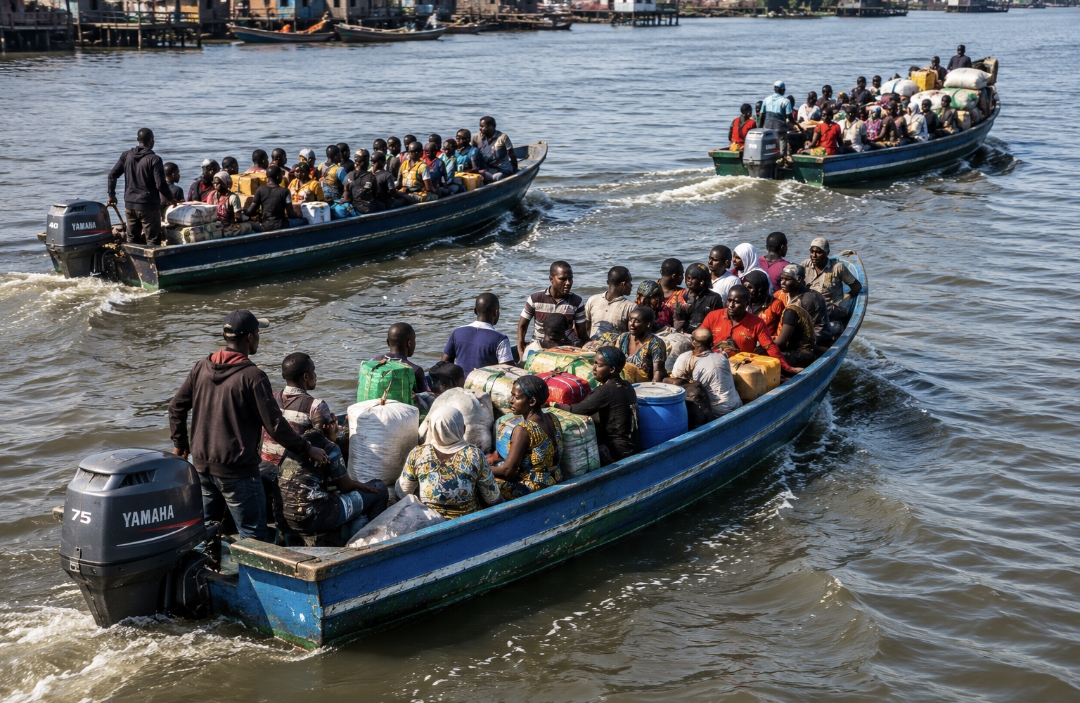
Despite the heavy rains currently battering Lagos with high water levels and flooding , findings by Shipping Position Daily reveals that many commuters, including market women and children, continue to rely on open wooden and fibre boats popularly referred to as “open coffin” on routes linking Badagry, Ebute Ero, Marina and several riverine communities across the state.
Our findings revealed that passenger traffic on Lagos waterways has generally declined as commuters increasingly opt for road transportation during the peak rainy season. However, open boats remain a critical means of movement for residents and traders operating within Lagos’ riverine corridors.
A visit by our correspondent last week to Liverpool, Marina and Ebute Ero jetties showed scores of market women and children boarding open boats in large numbers despite intermittent downpours and unstable weather conditions.
Many of the passengers were seen carrying baskets, sacks and other wares as they boarded the boats. While some of the vessels departed Liverpool for riverine communities and fishing settlements, others operated between Marina, Ebute Ero and adjoining waterfront locations. At the Ebute Ero Jetty, market women were observed boarding larger open boats heading toward Badagry and the Seme border axis with their goods.
To shield passengers from the rains, operators were seen deploying large make-shift tarpaulin sheets to cover the boats before departure. In many cases, passengers sat beneath the improvised covers while boat handlers remained exposed to the elements to maintain visibility during navigation.
But, Chairman of the Governing Board of the National Inland Waterways Authority (NIWA), Barrister Mukhtar Shehu Shagari during a press briefing as part of a facility tour of NIWA projects and facilities in Lagos last week, unveiled plans to rehabilitate dilapidated infrastructure across NIWA offices nationwide, replace ageing and unsafe boats, strengthen enforcement against unregulated jetties to unlock the economic potential of Nigeria’s inland waterways.
Speaking with Shipping Position Daily last week, Public Relations Officer of the Waterfront Boat Owners and Transporters Association of Nigeria (WABOTAN), Chief Raymond Gold, attributed the decline in patronage to seasonal weather conditions and growing commuter concerns over flooding across the state.
He explained that passengers who choose water transportation during the rainy season generally prefer covered boats, noting that standard water transit vessels offer greater comfort and protection from the rain.
“Ordinarily, patronage is always on the lower side during the rainy period, particularly at the peak of it that we are experiencing now. With the flooding, everybody is very careful. Many people prefer to travel by road as against by water. We have always advocated for standards. For long-distance trips, the best option is a covered boat so that passengers do not get drenched while on the water,” he stated.
According to him, routes such as CMS-Marina to Ikorodu are largely served by modern covered ferries operated by LAGFERRY and a few private operators, making open boats less attractive on those corridors.
Gold, however, acknowledged that open boats remain operational on several routes where commuters have limited alternatives. “People would rather board a covered boat, than an open boat. The LAGFERRY service is also subsidized, making it cheaper and more attractive to commuters,” he added.
“What usually happens is that once the rain starts, operators use tarpaulin covers to protect passengers. Most times, the driver remains uncovered so that he can see clearly and navigate safely,” he explained.
Meanwhile, a chieftain of the Maritime Workers Union of Nigeria (MWUN), Liverpool Unit, Mr. Friday Essien, said the rainy season has taken a toll on operators, particularly those serving the Badagry corridor. “The open boats we have at Liverpool usually go to Badagry or Ojo, but unfortunately they are no longer operating there. The business has crashed,” he lamented.
Essien noted that smaller fibre boats continue to serve creeks, fishing settlements and riverine communities around Liverpool, while larger open roof boats powered by 200-horsepower engines still operate between Liverpool, CMS and Ebute Ero.
According to him, some of the larger boats departing from Ebute Ero also transport passengers and traders to Badagry and Seme, where demand remains largely driven by commercial activities and cross-border trade.
On safety concerns associated with rising water levels, Chairman of the Ikorodu Chapter of the Association of Tourist Boat Operators and Water Transporters of Nigeria (ATBOWATON), Mr. Olusoji Mojofodun, maintained that operators in Ikorodu continue to adhere to safety standards.
“I don’t think the high level of the water should affect our operations. All our operations are safe, and all our boats are covered. There are no open boats in our area,” he said.