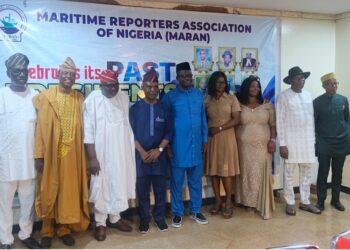
In this interview, a researcher and Master Mariner, Captain (Dr) Abdulrasheed Onakoya discusses the multi-faceted challenges confronting Nigerian seafarers, He identifies the challenges to include poor welfare, limited opportunities to training standards and government support, while proposing sustainable mitigation strategies to reposition the nation’s maritime workforce for global competitiveness. He also touched on these vital areas at the recent Quarterly Meeting and Paper Presentation of the Nigerian Association of Master Mariners (NAMM) in Lagos.

“The data we gathered showed widespread violations of regulations and rights”
“Very few shipping companies recruit Nigerian seafarers”
What inspired your focus on the welfare and protection of Nigerian seafarers?
When we talk about Nigerian seafarers, people often see the profession as an easy-going one. But those of us who have spent time at sea understand how demanding it is and the impact it has on our national economy. Seafarers are young professionals who ensure the safety of human life at sea and enforce international policies and regulations that guide our rights and waters. It’s a high-risk profession that requires qualified, firm, and robust personnel who can withstand the challenges of life at sea and changing climates; locally and internationally.
Unfortunately, the few seafarers we have continue to face welfare issues, violation of rights, non-compliance with international laws by shipping companies, and career progression challenges. My paper addressed these issues in three folds. First, why Nigerian seafarers are not getting the required attention they deserve. Secondly, why some shipping companies treat them unfairly and also the mitigation strategies government has introduced, and why they are not yielding the expected results.
What kind of data or findings informed your paper?
The data we gathered showed widespread violations of regulations and rights. We found that many Nigerian seafarers are underpaid, face salary delays, and suffer contractual breaches by some ship owners. Our objective is to identify and analyze these challenges, understand why international and local regulations are not being fully enforced, and find ways to make ship owners comply with fair labour practices.
Could you highlight the main challenges which Nigerian seafarers face, as identified in your research?
Yes, there are several. The first is unemployment. We discovered that very few shipping companies recruit Nigerian seafarers. Because of the high number of job seekers and limited vacancies, ship owners often exploit them, offering unfair pay and poor working conditions. The second challenge is that only a handful of British or foreign shipping companies take Nigerian seafarers on board. Many prefer foreign workers over Nigerians, which raises the question of why our seafarers are not being encouraged or given equal opportunities. Thirdly, economic challenges also affect smaller shipping companies. We need to ask whether the government is doing enough to create an enabling environment for these companies to thrive and recruit more Nigerian seafarers. Finally, there are gaps in training and certification. We found major disparities between Nigerian maritime certificates and their foreign counterparts. For instance, Nigeria is still not on the IMO White List, which affects our global recognition. This raises concerns about the quality of our maritime education, the robustness of our certification processes, and the issue of corruption in obtaining certificates.
That’s quite concerning. What is the link between certification and welfare issues?
It’s a direct link. Some ship owners complain that when Nigerian seafarers present certificates, their onboard performance doesn’t match expectations. That puts a question mark on the validity and authenticity of our certification process. Consequently, ship owners may use this as justification to underpay or mistreat Nigerian seafarers, claiming low competence. This unfairly lowers their wages compared to international standards and perpetuates welfare inequality.
You’ve touched on training and certification. How does Nigeria’s maritime education compare with the International Maritime Organization (IMO) standards?
That’s another area of major concern. We asked ourselves whether the quality of training received by our cadets and graduates actually matches the standard set by the IMO. Are we equipping them with the right skills to compete internationally? In many cases, the answer is no. The institutions responsible for training our cadets face challenges such as inadequate funding, lack of modern equipment, and limited access to sea-time opportunities. These constraints make it difficult to deliver training that aligns with international benchmarks. So, my paper also delved deeply into those institutional challenges, and how they affect the employability and marketability of Nigerian seafarers both locally and globally.
How do you think the issue of unemployment and underemployment among seafarers can be addressed?
First, we must close the training and certification gap. Our maritime institutions need to align with global standards to make our graduates competitive. Second, we must strengthen labour unions to protect seafarers’ rights. Unions must be empowered to confront unfair practices and ensure seafarers are treated according to international conventions. Third, the government and relevant agencies should create incentives for local shipping companies to hire Nigerian seafarers, and ensure regulations such as the Maritime Labour Convention (MLC 2006) are properly enforced.
You mentioned MLC 2006. How effective has it been in protecting Nigerian seafarers?
The MLC 2006 provides for seafarers’ welfare, health, and safety. However, enforcement remains weak in Nigeria. The question is: how well are government agencies ensuring compliance? Our findings show a gap in enforcement. Without strict monitoring, some ship owners ignore the provisions of the convention. That is something we must address urgently if we want to protect our seafarers effectively.
What are the roles of government and the enabling environment in this?
That’s a key component. We assessed the extent to which government policies and the overall enabling environment support maritime education and seafarer welfare. For instance, what incentives exist for indigenous shipping companies to invest more in human capacity development? Are there tax breaks, subsidies, or policy frameworks that encourage local participation in seafaring? Unfortunately, we found that the current environment is not sufficiently supportive. Many local shipping firms are struggling to survive the harsh economic realities in the maritime space, which limits their ability to prioritize seafarers’ welfare and training.
Labour unions are often seen as defenders of workers’ rights. How do they fit into this conversation?
That’s a very important dimension. The paper also examines the role of labour unions in protecting the few seafarers we have. We asked: what are the existing unions doing to advocate for their members? What challenges do they face? Our findings suggest that many of these unions lack the capacity, resources, and institutional backing to effectively protect seafarers’ rights. Therefore, we must explore ways to empower and strengthen these labour unions so they can speak more forcefully on behalf of Nigerian seafarers. By doing so, we can not only improve conditions for those already at sea, but also inspire a new generation of young Nigerians to take up maritime careers with confidence.
What are some social consequences of these welfare challenges?
When seafarers become frustrated, due to unemployment, lack of support, and poor working conditions, some unfortunately turn to illegal activities within our waterways. This has wider implications for national security and the reputation of our maritime sector. Therefore, addressing seafarers’ welfare is not just a labour issue; it’s a national development and security issue.
Finally, what key message would you like to leave with stakeholders in the maritime sector?
My key message is that the sustainability of Nigeria’s maritime future depends on how we treat our seafarers today. We must create a system that values welfare, upholds international standards, and rewards professionalism. First, government must review and strengthen maritime labour laws to align with global best practices. Second, our maritime training institutions must improve their curricula to meet international certification standards and help Nigeria regain its place on the IMO White List. Third, we must enforce the MLC 2006 provisions on welfare and ensure compliance by all shipping companies. Fourth, labor unions should be reformed and empowered to defend the rights of seafarers effectively. Ultimately, we must create an enabling environment where seafaring becomes attractive again, where young Nigerians can build meaningful careers at sea without fear of exploitation or neglect.
By aligning training, certification, labor protection, and industry incentives, we can transform Nigeria from a marginal player into a globally-recognized maritime power, one that produces seafarers who are respected, competitive, and are proud of their profession.