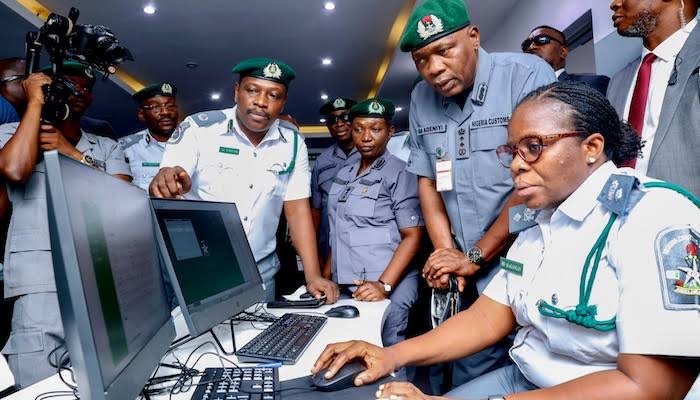
Prior to the introduction of the novel Unified Customs Management System (UCMS) popularly called B’Odogwu, the Nigeria Customs Service had undergone years of transformation. Those who are old enough will remember the ear of Long Room, when everything about Customs clearing process was analogue.
The first attempt towards computerization started with the Automated System for Customs Data (ASYCUDA), which was later upgraded to ASYCUDA++. Since then the service has toyed with different approaches, such as Nigeria Integrated Customs Information System (NICIS) I and II, to upgrade its services; it even used consultants to offer different tech-driven supports.
Arguably the most daring and indigenous of all its efforts is the B’Odogwu, which replaced the NICIS II.
The B’Odogwu, is a bold leap-forward from the holistic Customs Modernisation Project, which has its overall aim as, engendering the establishment of a digital/paperless customs administration. To a large extent, this has been done.
Prior to the advent of B’Odogwu, importers and agents have long complained about server downtimes which often delayed the clearing process and documentation at the nation’s seaports, and leading to costly demurrage.
This lapses are expected to be corrected by B’Odogwu. We were told that the repeated failures of foreign technology providers prompted the need for an in-house solution. Customs also admitted that previous foreign systems (ASYCUDA, NICIS) actually failed Nigeria.
The Comptroller General of Customs; Adewale Adeniyi had noted that previous foreign service providers, despite multiple contract extensions, failed to meet their obligations, ultimately leaving the NCS without a reliable system.
Justifying the adoption of indigenous B’Odogwu, he lamented that the serial failures led to the expiration of the Nigeria Integrated Customs Information System (NICIS) in December 2022 without a viable handover or continuity plan. As a result, the NCS decided to prioritize the development of its indigenous platform, moving away from reliance on foreign systems.
Hence, the new ‘B’Odogwu’ software is designed to improve the Customs’ ability to streamline end-to-end business processes, offering stakeholders customized integration capabilities that support more efficient decision-making and enhance the ease of doing business.
Adeniyi explained that the platform complements ongoing efforts to integrate advanced technologies, including artificial intelligence and mixed reality, into customs operations.
Yes, B’Odogwu, is a home-grown cutting-edge technology created to address the glitches experienced during customs documentation by freight forwarders.
The NCS says that it incorporates sophisticated digital tools, including electronic cargo tracking, automated risk management and non-intrusive scanners, ensuring a more secure and efficient trade environment for port users. This was why the initiative was seen as a reflection of Nigeria’s ambition to set a new standard in Customs’ administration.
The platform, which has been operational and has been successfully implemented at several locations, after the rollout of the system’s pilot phase at the Port & Terminal Multi-Services Limited (PTML) in October 2024.
Yes, it is already boosting revenue as evident by the figures coming from the commands where it has been rolled out.
However, as it is with all good things, we are concerned with sustainability of B’Odogwu, Can it sustain the tempo of revenue haul, through enforcement of compliance and legitimacy, preventing the upload of invalid documents. Can it also maintain its objective of creating a more transparent trade environment, making it easier to track and manage transactions? These were the promises given by the NCS.
Maiwada also said the new initiative has boosted trade facilitation. “The new system is designed to facilitate trade by streamlining processes, reducing bureaucratic bottlenecks and providing stakeholders with more efficient and intelligent business decisions,” he stated, adding that it is part of broader efforts by the NCS to modernise its operations, eliminate inefficiencies and align with international best practices.
Expectedly, all those who have been privileged to either operate the new B’Odogwu system, including Controllers of Commands to the Managing Director of Trade Modernisation Project Limited, Dr. Jummai Zainab Umar-Ajijola, have given thumbs up to the new platform. Notably, Dr Umar-Ajijola declared that its successful deployment has enhanced trade competitiveness, saying that it has fully-digitalise Customs processes.
The Nigeria Customs Service must place premium on training and retraining of its personnel. There have been glitches, bank integration issues and lack of knowledge among stakeholders since the technology came into force.
We are equally aware that, at the initial stage, some Authorised Dealer Banks (ADBs) were hesitant to integrate into the system, causing bottlenecks in processing payments and raising Form ‘M’ which led to delays and difficulties for importers and clearing agents. But we are also aware that these are being taken care of as they rear their heads as challenges.
As sweet as the B’Odogwu story appears, we are apprehensive about the reality of the ‘Nigerianess’, which painfully may rear its head as officers of the Nigeria Customs Service at the various command who are the ‘on-ground officers’ operate the system.
Similarly, stakeholders, including clearing agents, importers, and shipping companies that have shouted non-inclusivity at the onset of the platform have now been fully integrated into the system, through detailed stakeholders’ engagement and training.
The Nigeria Customs Service has to do everything to ensure that B’Odogwu succeeds. Anything short of this will be disastrous. The legacy of the system must outlive the present crop of management.