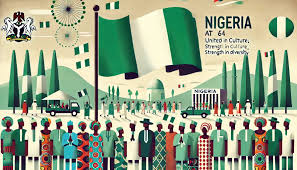
Nigeria is now 63 years old as a sovereign nation. The landmark was celebrated last week. The independence anniversary celebration offers a good opportunity to again appraise the state of the maritime sector, especially now that the nation is 64 years old.
Once again, the occasion offered an opportunity to appraise the country, from different perspectives. But, as a maritime industry newspaper, our focus will be on how Nigeria has fared as a maritime nation since 1960.
At independence the then-leaders of Nigeria envisioned a vibrant maritime sector; no wonder concerted efforts were made to put the early maritime agencies on a sound footing. It is therefore reasonable to think that Nigeria, being a 64-year-old sovereign nation, must also have a maritime sector that has, at least come of age.
In the beginning, the agencies gave a good account of themselves, they were indeed the pivot on which the nation’s economy stood and blossomed. The efficiency with which these agencies functioned was a confirmation of the fact that their creation was not by accident and that their emergence was drawn from a genuine desire to engender sustainable state-owned enterprises.
But what has become of these institutions? While some were either plundered or out rightly ‘killed’ by subsequent governments (military and civilian), others have been caught in the web of unstable policies have ceased to be.
A lot of these agencies that were created in the immediate post-independence era or later, are all dead or have ceased being government-owned. Some have been offered as political patronages to associates of political leaders. Agencies like the Nigerian National Shipping Line, National Clearing and Forwarding Agency, Nigerdock; all belong to this generation of sold or ‘failed assets’.
A few others that were created post-independence, like – the Nigerian Shippers’ Council, the then-National Maritime Authority (now the Nigerian Maritime Administration and Safety Agency) and the National Inland Waterways Authority are lucky to still be in exisitence.
Given the potentials of Nigeria and her vast aquatic endowments, and backed with a good national shipping policy and adequate implementation of relevant legislations and domestication of all relevant international conventions, Nigeria ought to be a giant among maritime nations.
Despite the challenges, Nigeria has indeed grown as a maritime nation from what she was on October 1, 1960, to what she is today, so also have the challenges grown.
In 1960, our ‘maritime worries’ did not include the mass of unemployed manpower which now dot the nation’s maritime landscape.
In 1960, Nigeria did not have to worry about how the nation’s imports were being freighted into the country, neither were our leaders disturbed about other imbalances occasioned by our import-dependency. Our share of international trade was freighted by the NNSL. Nigeria was simply happy to be counted among independent nations with her own Customs Service and Port Authority!
With developments and nation-building, came the challenges of running these institutions to meet the growing needs of a sovereign nation and the peculiar needs of her people.
Some people have argued that the 1995 decision to liquidate the NNSL was the best; given the failure of its managers and the abuse that the national carrier was subjected to by government officials and political leaders.
A lot of maritime industry stakeholders are reluctant to agree that the failure of NNSL should be blamed for the mass of unemployment that is plaguing the nation’s maritime sector today. But we ask: Where are the national lines of sister nations like: Ghana, Gambia, Cote d’ Ivoire, Cameroun and a host of other African nations which, at independence in the 1960s, also floated national shipping lines. They all did it for national pride. Sadly, the national lines could not be turned into commercial successes for too long. They are all dead!
If government had not liquidated the NNSL in 1995, it would have been privatized in the same way that Nigerdock which was doing extremely well, was sold under questionable circumstances. Had it not been liquidated, it is most unlikely that our NNSL will be able to stand shoulder- to- shoulder with its counterpart in (for example, Philippines and Singapore) which today is a pride to that country and the whole of Asia.
Even though we join others to lament the decay and failure of the maritime sector and its failure to meet the yearnings of Nigerians (especially since the late 1980s), we are also convinced that the greatest opportunity for a better maritime sector is provided in the policy of private sector participation; a policy which has so far seen the nation’s seaports transformed and become more efficiently-operated.
We also agree with those who have argued that the death of NNSL has caused the nation’s maritime industry more woes than any other thing. If we still have the national line, our fleet would have soared since independence, and our army of trained seafarers would be employed.
Sadly, the efforts of the Federal Government to revitalize the nation’s fleet has hit the rock. There was a time that the Federal Government embarked on an expedition in the form of a Memorandum of Understanding with a Singaporean shipping firm; PIL to float a national fleet. So much money was wasted in an effort that was ill-conceived and doomed to fail.
The Cabotage Vessel Financing Fund (CVFF), which was created to aid participation in shipping, still remains untouchable almost 20 years after it started accumulation. If the funds have been disbursed as expected, it would have at least aided acquisition of some category of vessels by Nigerian ship owners.
Nigeria can still rework her ways back as a ship-owing nation, which will guarantee employment for seafarers and also guarantee sea time for hundreds of young seafarers who currently have no hope of sailing. It requires good policies, good administrators and adequate funding to change this narrative.
Perhaps, the creation of the Marine and Blue Economy Ministry by the current administration was meant to rejig and rekindle hope in the nation’s maritime industry. But there is still a long way to go. The ministry is barely one year old and there is nothing to show that the journey has begun at all.
Notwithstanding the challenges, the maritime sector’s hand is still prominently visible in all facets of the nation’s economy; be it, manufacturing, oil and gas, finance, energy and so on.
The stunted growth of the Nigerian maritime sector is only a reflection of the slow pace or the near comatose nature of the nation’s economy and unfortunately a reflection of the nation’s economic standing at 64.
Nigeria can still rework her ways back as a ship-owing nation, which will guarantee employment for seafarers and also guarantee sea time for hundreds of young seafarers who currently have no hope of sailing.
At 64, Nigeria’s maritime sector is not a failure. Of course, the maritime sector can not be more successful than the collectivity called Nigeria and her economy.