Nigeria lost its ranking as a ship-owning nation in 1995, when the then-Federal Government ordered the liquidation of the nation’s national carrier; the Nigerian National Shipping Line (NNSL).
From then, Nigeria went from a nation of almost 29 ships to a nation that can no longer boast of owning a ship that is trading on international waters. Yes, Nigeria no longer has a ship flying her flag in waters outside her waters!
In 2011, that is, after a long period of inactivity, the then-Minister of Transport; Alhaji Ibrahim Bio gave a hint that the Federal Government had given approval to the Nigerian Maritime Administration and Safely Agency (NIMASA) to float a new national carrier; albeit, in partnership with the private sector.
In 2014, the then-Director General of NIMASA; Dr Patrick Akpobolokemi openly declared that the national carrier would be re-floated in six months.
The NIMASA boss had even gone ahead to disclose that government would achieve this by evolving a Public Private Partnership (PPP) initiative in order to avoid the pitfalls that led to the liquidation of the Nigerian National Shipping Line.
He had told participants at the function that, the then-President; Goodluck Jonathan had tasked NIMASA to ensure that the national carrier is brought back during his regime.
The minister and the NIMASA DG, both left office without achieving the objective of refloating the national carrier in 2015.
For those who have also asked questions about the current status of Nigeria as a maritime nation, the answer should start from the foray which Nigeria made into shipping and ship ownership with the birth and the subsequent death of NNSL, the creation of an interventionist policy called ‘Ship Acquisition and Ship Building Fund’ (SASBF) and the abuses which the scheme was subjected to, and its subsequent scrapping.
The SASBF, which was created to uplift Nigeria to a ship-owning nation, sadly only succeeded in creating ship owners, who either had no ships or failed to repay the loans that were given them. Only one or two beneficiaries (out of about 15) repaid the loans that they took under the SASBF.
The birth of a successor company to NNSL; in the name of Nigerian Unity Line (NUL) and its eventual death will offer a good thesis for scholars on how and why government businesses fail in Nigeria.
While the defunct NNSL (at a time) had a fleet that was in excess of 29 bulk carriers, beneficiaries of the SASBF could only account for one or two vessels that could not stand the test of time. None of the few ships that were bought with the SASBF sailed for up to three years.
And since the death of NNSL and failure of SASBF, the challenge has been about how Nigeria could get back on track as a ship-owning nation. While some may argue that government’s direct participation in shipping through tonnage ownership is no longer in vogue, especially as most African nations have done away with the idea, it is also arguable that government can not completely divest from this core sector of the nation’s economy.
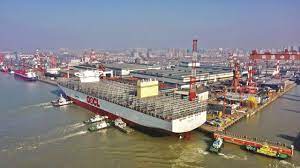
We are often told that Nigeria has more than 1000 ships in her registry, but we dare ask: how many of them are actually owned by Nigerians and what is the tonnage capacity of each of the ships? From findings, majority of what Nigeria currently has in her registry are coastal vessels and supply boats.
Nigeria has descended from her previous height as a key player in global shipping to a nation with a near-empty ship registry.
Yes, there have been some feeble attempts on the part of NIMASA to galvanize the finance sector, especially the banks to embrace ship financing. Very few banks have shown interest in funding ship acquisition. Majority of the banks prefer to fund acquisition of service boats in the oil and gas sector. Acquisition of container ships and bulk carriers is understandably out of it. Not until the Cabotage Act was enacted, there was little or no interest on the part of the financial institutions to be a part of efforts that were aimed at boosting indigenous fleet.
Although, it has been some years since the Cabotage Act came into effect, it has not enhanced ship acquisition, neither has it enhanced the fortunes of indigenous ship owners. We had thought that since one of the core functions of NIMASA is improvement of Nigeria’s participation in sea borne trade, it would have begun to fashion out a workable and sustainable way to boost our indigenous fleet, even if it is centered on acquisition of Cabotage vessels.
We recall that a few years ago, the lot fell on the Implementation Committee for the new National Fleet. The body that was created by the Federal Government was an all-encompassing one made-up of stakeholders from both private and public sectors. It was headed by the then-Executive Secretary of the Nigerian Shippers’ Council; Mr Hassan Bello. After him, his successor; Mr Emmanuel Jime took over the leadership of the committee. Sadly, even though the committee struggled to conclude its assignment, and submitted its report, it was never implemented.
Ministers after minister, the dream remained what it is. This was the case until the incumbent Minister of Marine and Blue Economy; Mr Adegbpyega Oyetola came on board.
Twice, the minster had given hint that government was considering a national fleet through a public-private-partnership arrangement. He says that such a plan would be achieved in the interest of the maritime industry and the country.
Oyetola said that the aim is to secure a substantial share of the estimated $10 billion annual ship charter market within the country. He reassured stakeholders that the revival would not hinder local players’ growth, but provide opportunities for them to enhance value through ship construction, maintenance, and repairs, aligning with the Cabotage Act granting Nigerians exclusive control over locally generated seaborne trade.
Only recently, he met with some ship owners, where he again threw the carrot of national fleet at them.
While we have nothing against the minister’s intention, we are however not too enthusiastic about it. We dare state that this is a familiar route, and until we see concrete moves that are aimed at achieving this, our skepticism remains heightened.
If indeed the Minster is desirous of making Nigeria a ship owning nation once again, the best way to start is to call for the report of the Hassan Bello committee. In that report, he will find all that he needs to know about the Strength, Weakness, Opportunities and Threat of the nation’s aspiration.
Finally, the technocrats will always advise that a national fleet is a necessity. Yes, the advantages are enormous, but we advise that, if indeed Nigerian is desirous of a national fleet, it must be an entirely private sector-driven venture. But, how will the private sector muster the funds, especially in an economy that is distressed as ours.
We still insist that the PPP arrangement that was envisioned by the Hassan Bello committee is the best option that Nigeria has at the moment. The private sector only needs to be encouraged and assured that there would be no policy shift, even if there is change of power between political parties in years to come. This is important because private sector investments must be recouped.