
How far can the project go?
How far the project will go in deepening maritime security depends on several factors.
The first is whether mistakes of the past are avoided. These have included:
.an overtly militarised response to threat,
.negligence of the driving or enabling factors of criminality,
.dearth of accountability mechanisms in response initiatives, and
.poor appreciation of the dynamics of the wider criminal space.
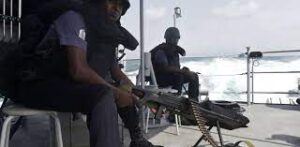
Already, the project’s largely military-centric approach has been criticised. This means that the intricate drivers of maritime insecurity, especially piracy, are ignored. These include socio-economic, environmental and governance factors that enable piracy to fester.
Much of the problem stems from state corruption, declining job opportunities, hollow maritime security forces, and weak law enforcement. Opportunistic foreign, corporate or individual interests that emerge afterwards only help to expand and perpetuate criminality.
A related factor is the inter-agency rivalry which has undermined multi-agency interventions during successive administrations. The multi-agency nature of the new project holds great promise. But in it lies a peril common to Nigeria’s approach to security. Rivalry and mistrust manifest among Nigeria’s agencies. This results in weak coordination, limited intelligence sharing and sub-optimal performance.
There are also concerns over robust internal mechanisms for ensuring transparency and accountability. These are paramount to the project’s success. Projects such as this have in the past served as avenues for vested interests to divert or misappropriate public funds. Politicians, government officials and corporate firms have been involved.
The Olusegun Obasanjo administration was accused of spending between $300 million and $400 million on equipment for fighting maritime insecurity with nothing to show for it.
Similarly, the Goodluck Jonathan administration used the public-private partnership model. It committed resources towards acquisition of assets to fight maritime insecurity. But it was not sustainable.
These concerns are fundamental given that Nigeria’s finance minister, Zainab Ahmed, recently disclosed that Nigeria will borrow $1.76 billion from the domestic markets to fund the fight against insecurity. Thus, lack of transparency may mean that revenue generated through the project may not be used judiciously.
Poor maintenance culture as seen in the aviation, energy, health and transportation sectors may also mean that the recently acquired assets will grind to a halt sooner than expected. These include:
.land assets (a new intelligence centre, 16 armoured vehicles for coastal patrol and 600 specially trained troops);
.sea assets (two special mission vessels and 17 fast interceptor boats);
.air assets (two special mission aircraft for surveillance, three special mission helicopters and four unmanned aerial vehicles).
Read Also: Nigeria’s Ambitious New Maritime Security Project Must Avoid Old Traps
Another factor is the project’s interface with other regional initiatives to counter the vested interests that sustain piracy. Ransom payment has made piracy extremely lucrative. This has entrenched a network of interests of both foreign and local state and non-state actors. Some global shipping companies and foreign actors are using cash and bypassing local authorities in the region to negotiate directly with pirates.
While it costs a pirate gang between $5,000 and $10,000 to mount an operation at sea, ransoms paid for kidnapped crew typically range from $18,000 per person to as much as $500,000.
Without the government’s commitment in addressing these factors, the project will only be an addition to maritime security initiatives in the troubled region.
Concluded
Culled from Conversation Africa
Kindly like us on Facebook













Discussion about this post