The Federal Ministry of Marine and Blue Economy says several long-standing challenges that hindered the growth of Nigeria’s maritime sector were addressed in 2025 through policy and institutional reforms.
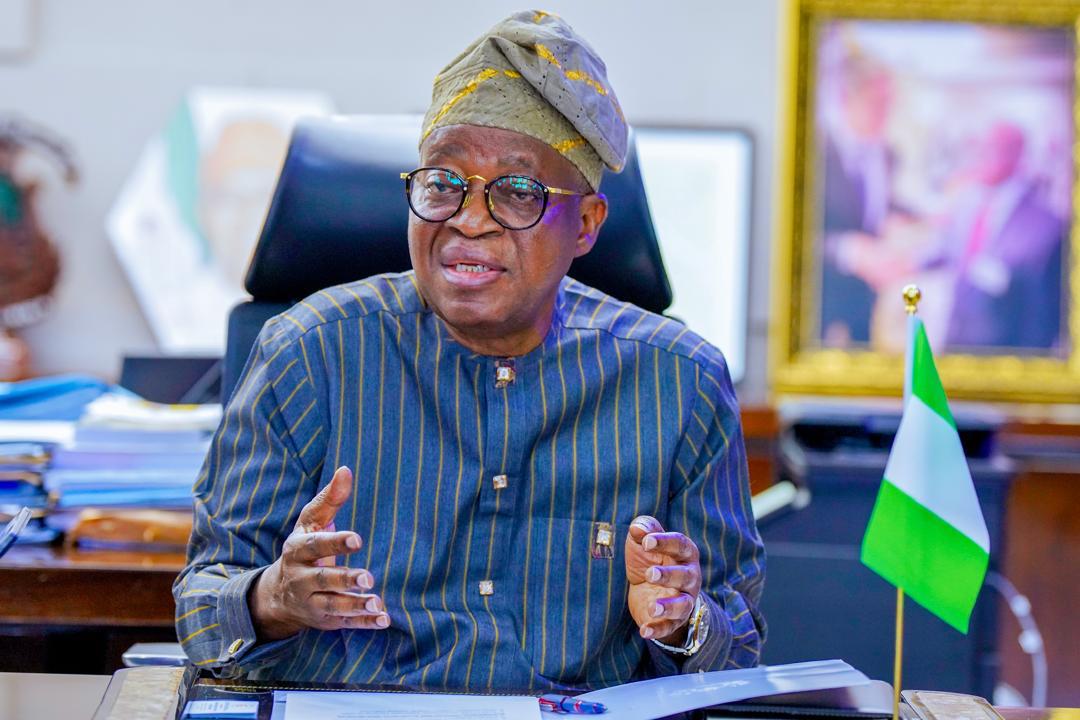
The Minister of Marine and Blue Economy, Dr Adegboyega Oyetola, was credited with the developments in a statement issued on Tuesday by his Special Adviser, Dr Bolaji Akinola, who said the interventions marked a turning point for the sector.
According to the statement, the reforms carried out since Oyetola assumed office in August 2023, particularly in 2025, helped remove structural constraints that limited performance in the maritime and blue economy space, while improving confidence among local and international stakeholders.
One of the key developments highlighted was the resolution of the Apapa port corridor gridlock, which had disrupted port operations for over 20 years. The ministry said sustained policy coordination, operational controls and infrastructure optimisation led to improved traffic flow in Apapa and its environs by early 2024. The improvement reportedly reduced cargo dwell time, lowered logistics costs and enhanced operational efficiency at the Lagos ports.
The ministry also cited Nigeria’s return to the International Maritime Organisation (IMO) Council in 2025 after a 14-year absence as a major outcome. The development followed a competitive election process and, according to the statement, restored Nigeria’s participation in global maritime decision-making and strengthened its position within the African maritime space.
Another issue referenced was the approval for the comprehensive upgrade and modernisation of Nigeria’s ports, said to be the first of such approvals in more than 50 years. The ministry said the decision was aimed at addressing obsolete port infrastructure, improving competitiveness and aligning Nigerian ports with global operational standards.
In addition, compliance certificates were issued for the Bakassi Deep Sea Port and the Ondo Deep Sea Port to the governments of Cross River and Ondo States. The ministry said the approvals removed key regulatory hurdles and would enable faster investment and construction activities, with the potential to expand national port capacity and improve regional trade links.
The statement further noted the establishment of the Regional Maritime Development Bank (RMDB) in 2025, ending a 16-year delay in setting up a regional financing institution for the maritime sector. The bank is expected to provide long-term funding for shipping, port development and related maritime services.
On indigenous shipping, the ministry disclosed that approval was granted for the Nigerian Maritime Administration and Safety Agency (NIMASA) to begin the disbursement of the Cabotage Vessel Financing Fund (CVFF), which had remained unused for more than two decades. The move is expected to support local shipowners in vessel acquisition and capacity expansion.
Policy-wise, the ministry said Nigeria’s first National Policy on Marine and Blue Economy was approved by the Federal Executive Council in May 2025. The policy provides a framework covering shipping, ports, fisheries, aquaculture, marine tourism, offshore energy and environmental sustainability, with the aim of improving coordination across government agencies and providing clarity for investors.
On maritime security, the statement said the continued deployment of assets under the Deep Blue Project helped sustain zero reported piracy incidents in Nigerian waters, contributing to improved safety and investor confidence in the maritime domain.
The ministry also reported an increase of about 300,000 metric tonnes in fish production in 2025, described as the first significant rise in over a decade. The increase was linked to efforts to reduce fish import dependence, improve food security and stimulate employment in the fisheries and aquaculture subsector.
Akinola said while reforms began shortly after Oyetola assumed office, 2025 stood out as a year of notable policy actions and outcomes. He added that the Minister remains focused on supporting indigenous shipowners, boosting fish production and consolidating gains recorded so far.
The statement concluded that with several long-standing challenges addressed, the marine and blue economy sector is positioned for further growth in the coming years.