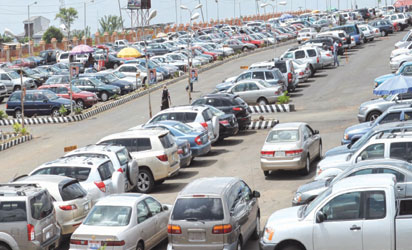
For decades, foreign-used vehicles (popularly called “Tokunbo”) that are shipped into Nigeria through Apapa, Tin Can and other Nigerian ports, were the lifeblood of the nation’s auto economy. They were the bridge between aspiration and affordability, allowing millions of families and businesses access to mobility while providing steady revenue for government, jobs for port workers, clearing agents, transporters, technicians and dealers.
From available records, the business of vehicle importation into Nigeria wasn’t very pronounced until the late 1970s when Nigerians started developing tastes for exotic cars, which had to be imported.
Our investigations at the two biggest vehicle handling terminals in Lagos; that is, PTML Terminal and Five Star Logistics Terminal, as well as Africa’s biggest automobile market; Berger Auto Market in Apapa have revealed that 70% of the vehicles coming into the violate government’s automotive policy.
Even though the federal government had raised the age limit of vehicles to be imported into the country from 10 years to 15 years, investigations also revealed older vehicles are imported through the nation’s seaports.
Confirming the influx of over-aged vehicles, top officials of terminals that handle such vehicles have confirmed that used vehicles terminal are often flooded with damaged, ‘accidented’ and relatively low grade vehicles. They added that there have been more of this grade of vehicles since the auto policy came into being.
Sadly too, they confirmed that importers now bring in low grade, salvaged vehicles, and these are equally older models rather than newer models. He said, relatively, majority of the vehicles being imported were manufactured before 2008.
This is the boom that the tokunbo vehicle importation market had enjoyed for many years. That era is now under threat. The tokunbo trade is shrinking at an alarming pace, and in its place, the Nigerian-used car market is surging, feeding on the desperation of prospective car owners who have been priced out of foreign used vehicles owing to soaring costs. What we are witnessing is not just a market adjustment, but a structural shift with far-reaching consequences.
The numbers tell the story. Data from the National Bureau of Statistics show that the value of passenger-car imports rose to ₦1.47 trillion in 2023, before sliding 14.3 percent to ₦1.26 trillion in 2024. The volatility masks a deeper volume collapse, with mid-2024 alone recording an 83 percent year-on-year crash in the import bill for used cars. By August 2025, the Nigeria Customs Service reintroduced a 4 percent Free-on-Board levy on imported vehicles while tightening the Vehicle Identification Number (VIN) valuation regime. These policies, layered on top of existing duties and levies, pushed the landing cost of tokunbo vehicles further out of the reach of ordinary Nigerians.
Vehicles whose landing and clearing cost was between N4million and N5million, now attract double or even triple that figure. Consumers have responded in the only rational way available: they are selling their existing vehicles and buying Nigerian-used cars, which are cheaper, involve no clearing uncertainty, and fit better within battered household incomes.
The consequences of this turn are troubling. First, the government itself is bleeding revenue. Every tokunbo that fails to come through the ports represents lost customs duty, shipping line income, terminal handling charges and haulage jobs. The informal Nigerian-used trade that has replaced it does not provide the same returns to the public purse. The ports themselves are quieter, clearing agents face dwindling work, and ancillary businesses that depend on vehicle throughput are struggling. The knock-on effect on employment is significant but underreported.
Second, there are safety and quality implications. Imported used cars, however imperfect, at least arrive with verifiable VIN histories, odometer records and are subject to age restrictions that screen out the oldest and most dangerous vehicles. Nigerian-used cars on the other hand circulate in a largely unregulated market, often with unknown accident histories, improvised repairs, and dubious roadworthiness. Policies designed to keep substandard imports off Nigerian roads may have the paradoxical effect of flooding those same roads with locally recycled vehicles that are even more dangerous. Without a robust inspection and roadworthiness regime, this is a step backwards in safety and environmental standards.
Third, there is the failure of industrial policy. The justification for high tariffs and levies was to protect and encourage local auto assembly. Yet after years of sacrifice by consumers, affordable locally assembled cars remain scarce. The Nigerian buyer who cannot afford a tokunbo and cannot find a reasonably priced locally made car has no choice but to turn to the second-hand domestic market. What was supposed to be a bridge to industrialization has instead become a tax on mobility. Meanwhile, neighbouring countries like Benin continue to serve as re-export hubs for the very same used vehicles Nigeria claims to be discouraging, with much of the trade simply leaking informally across the border.
This is why government must rethink its tokunbo policy urgently. What is needed is not more levies and sudden changes that choke demand, but a measured framework that balances the realities of consumer purchasing power with long-term industrial ambition. A transparent, predictable charge system that importers and buyers can plan around would be a start. Levy reliefs or credits tied to the importation of younger, cleaner vehicles would ensure that Nigerians are not forced into buying death traps, while also aligning with safety and environmental goals. VIN valuation should be retained but made more transparent and appealable to build trust. And rather than rely on tariffs alone to grow local assembly, government must demand enforceable commitments from assemblers to produce affordable models within set price bands, supported by incentives for genuine local content and volume-based procurement from public institutions.
Equally, the Nigerian-used market must not remain a lawless refuge. If that is where Nigerians will continue to buy, then roadworthiness inspections, emissions checks, and transparent odometer disclosures must be made mandatory for every resale. A scrappage programme funded from the levies already being collected would help clear end-of-life vehicles from the roads and channel parts into regulated remanufacture.
The path to a sustainable auto industry is not to strangle tokunbo with ever-rising costs while offering no affordable alternatives. The data already prove that imports are collapsing—₦1.26 trillion in 2024, down from ₦1.47 trillion a year earlier, and an 83 percent crash in the first half of 2024 alone. Layering new levies on a shrinking market will not deliver factories; it will only drive trade further underground and leave Nigerians clinging to unsafe local second-hand cars. Government must stop treating tokunbo as the enemy and instead govern it as a bridge—regulated, safer, cleaner and affordable enough to keep families mobile and the auto economy alive while local assembly slowly takes root.
The time to rethink is now. To delay further is to risk collapsing a vital industry, endangering lives on our roads, and eroding confidence in industrial policies that should have lifted the nation but have instead burdened its people.