By Ajay Menon
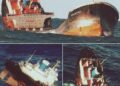
Do you have any idea on why ships sink? These massive superstructures weigh thousands of tons, can span hundreds of meters in length, and those responsible for moving goods worth billions of dollars, having an average lifespan of ten to fifteen years.
When building ships of massive dimensions, the risks involved also increase proportionately. The ship construction process can be fraught with a disaster waiting to happen, while the actual sailing on the high seas poses a major threat to the stability of the ships.
All manners of safety arrangements are undertaken by all shipping companies that run thousands of ships plying the oceans. But for an industry of such massive proportions, accidents do tend to happen due to avoidable causes, unpredictable natural elements or from rampant piracy.
In this article, we will closely examine 10 major reasons why ships sink.
- Flooding
Flooding is the most common reason why ships sink. The scientific explanation behind how ships float is that the weight of a vessel is supported by the water it displaces when floating.
Mathematically,
Weight of the Ship =Volume of Water Displaced × Density of Water
The water that is displaced by the ship equals the volume of the ship that is submerged, and we can rewrite the equation as,
Weight of the Ship =Submerged Volume of the Ship ×Density of Water
When water is able to enter the vessel through openings in the hull or superstructure, the regions filled with water are no longer hydrostatically considered to be part of the ship. However, the weight of the vessel remains constant.
This creates an imbalance, where the weight of the ship is now larger than that of the displaced water. As a result, the vessel continually sinks lower in the water until it is completely submerged. Due to mounting water pressure, holds, walls and bulkheads may eventually rupture, which will lead to the vessel rapidly sinking.
- Grounding and Collision
The ships are propelled by massive marine engines driving the propeller while the direction is controlled by the rudder. There have been many cases reported of grounding, which is bottom of the ship scrapping on the ground or on rocks near to the shore. However, the ship can sink after grounding in heavy or bad weather which will first damage the ship’s hull and heavy swell will take the ship to deeper water making it sink.
Also, ships are large structures that take time to respond to manoeuvring inputs from the bridge. On average, it may take a ship hundreds of meters to come to a complete stop, and time to turn effectively.
Given these circumstances, there is always a chance for a vessel to collide with other ships, tugs, ancillary vessels or floating structures such as port wharves if proper precautions are not taken.
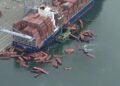
Once a collision occurs, the hull of the vessel may rupture, leading to imminent flooding as discussed previously. In addition, there is a high chance that equipment such as the rudders or propellers may be damaged by the collision.
A collision can also lead to loss of cargo which can destabilize the ship leading to loss of stability which is explained in the next section.
- Loss of Stability
All floating bodies have a metacentric height, that is defined as the vertical distance between the metacentre (M) and the vertical centre of gravity (G).
For ships, the vessel will remain relatively stable as long as this quantity remains positive. In the event it becomes negative, the vessel can capsize with the smallest of forces.
The metacentric height (GM) is directly related to a quantity known as the period of roll. This refers to the time that an oscillating body will take to come back to the original position of stability.
Loss of Stability
Vessels with very large values of GM will instantly reach an upright position, which can cause damage to the equipment and machinery owing to the large forces exerted.
On the other hand, very low values of GM will have extremely high periods of roll. In this case, the vessel has a high chance of taking on water through the deck. Thus, if the GM moves out of the safe region due to various conditions, there is a chance of the vessel sinking.
- Poor Weather Conditions
Bad weather is exceedingly common for ships sinking, and contributes to nearly 75% of all other types of accidents. Due to the large unobstructed open space found in the ocean, wind speeds can reach the regions associated with typhoons or hurricanes. This can create massive waves that are able to capsize vessels.
Vessels can sink due to a few main reasons- wind and other forces forcing the ship to lean at dangerous angles to the port or starboard sides, waves on the deck adding weight to the vessel and forcing it lower into the water, or waves crashing into the side of the vessel and causing flooding.
All these reasons force the vessel to take on water, which eventually leads to it becoming unstable and susceptible to sinking by the smallest of disturbances.
- Negligence and Human Error
Fatigue, negligence and simple mistakes all contribute to a number of disasters at sea. These occur when ships are under-manned, have crews that are fatigued or are not properly managed.
As a result, simple avoidable errors are prone to occur. For instance, obstacles that float can get entangled in the rudder and propellers or can damage the hull.
Negligence and Human Error
If not spotted in time, the vessel can collide with them. In addition, if engine room measurements and adjustments are incorrectly made, there is a chance of the ship sinking due to a lack of thrust.
It is important that shipping and passenger lines take efforts to keep the crew well-rested and ensure that the vessel is adequately manned at all times.
Sometimes, a wrong judgement regarding technical aspects can lead to the stability of the vessel being compromised.
*To be concluded next week