According to the General Agreement on Tariffs and Trade (GATT), a free-trade area is an agreement among a group of two or more customs territories in which the duties and other restrictive regulations of commerce are eliminated on key provisions of the treaty.
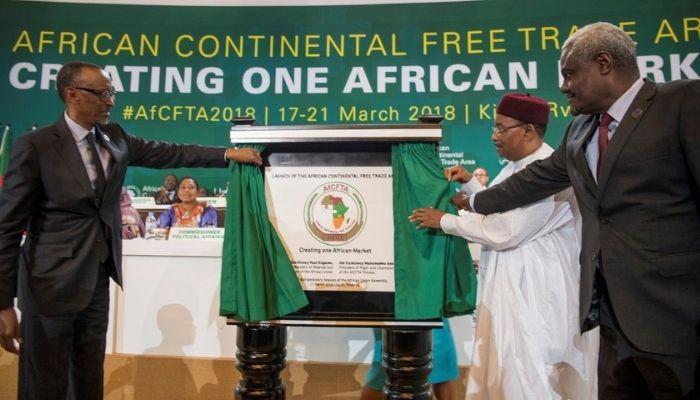
After so much prevarication, Nigeria in July 2024 eventually joined the league of nations that have commenced trading on the African Continental Free Trade Area (AfCFTA).
At an elaborate ceremony in Apapa, Lagos, the Federal Government expectedly seized the opportunity to reaffirm its dedication to ensuring that Nigerian businesses, both small and large, will benefit from the $50 billion African Continental Free Trade Area (AfCFTA) portfolio.
Prior to July, Nigeria had failed many deadlines to begin the trading, apparently due to tardy internal processes and conflict of interests.
Apart from commencement of trading, it also took Nigeria many years to accede to the agreement in July, 2019. So, Nigeria actually started the GTI exactly four years after signing on to the AfCFTA, and about two years after the first set of countries commenced trading.
More than 10 countries representing the five regions of the continent, namely: Cameroon, Egypt, Ghana, Kenya, Mauritius, Rwanda, Tanzania and Tunisia, among others have successfully commenced participation in the AfCFTA’s Guided Trade Initiative (GTI).
According to research by the African Development Bank in 2014, only 16% of international trade by African countries takes place between African countries.
The above narrative is expected to change, as the African Continental Free Trade Area is expected to cover all 55 countries of over 1.2 billion people and a Gross Domestic Product (GDP) in excess of USD 2.5 trillion. The scope of the Agreement covers trade in goods, services, investment, intellectual property rights and competition policy.
The AU therefore estimates that implementing AfCFTA will lead to around a 60% boost in intra-African trade.
We observe that since last year, there have been feeble attempts at stamping our footprints on the AfCFTA landscape. That it took Nigeria this long to commence trading is a confirmation of the fact that, Nigeria and her officials have been sound-biting for too long. Nigeria created a designated agency-the National Action Committee (NAC) which until recently, has been less than effective. For these years, despite being given the opportunities, the NAC failed to galvanise Nigeria’s participation in AfCFTA.
For years, NAC and the supervisory federal ministry had been telling Nigerians how much the continental market is worth, and how we are losing by not participating in the 3.4 trillion-dollar economic bloc.
At a point, the Manufacturers Association of Nigeria (MAN), also cried out about Nigeria’s slow pace. That was the position of the CEO of Centre for the Promotion of Private Enterprise (CPPE); Dr Muda Yusuf who also cried out that Nigerian stakeholders, especially business people had not been adequately informed about the protocols and what goods they can export with free duty to our African countries.
We recall that after the Guided Trade Initiative was launched in July last year, 10 Nigerian companies were announced as having started exporting made-in-Nigeria products to five countries across East, Central, and North African sub-regions.
The companies that pioneered the initiative were said to have included: Dangote Group which exported clinkers to Cameroon, Flour Mills of Nigeria (FMN) native starch to Algeria, Tolaram wrappers to Egypt, Le Look Nigeria Limited bags to Kenya, and Secure ID Limited smart cards to Cameroon.
Others are: Hwani Industry Nigeria Limited which shipped Nigerian-made water closet sanitary sets to Kenya, Avila Naturalle black soap and shea butter to Kenya, Craft Methods Limited alcoholic bitters to Uganda, and Ruchim Limited SIM and bank cards to Kenya.
While, we can not outrightly contradict the above claims, information from official sources does not back these claims.
Perhaps, giving credence to our fears, the Nigeria Customs Service said in November 2024 (four months after the flag-off in Apapa) that it has facilitated Nigeria’s first shipment to Kenya, with Lucky Fibres, a subsidiary of the Tolaram Group as the company. The Service spoke through its National Public Relations Officer; Abdullahi Maiwada,
Also, corroborating the Customs statement, a Senior Trade Expert and Lead of Trade Enablement at the Nigeria AfCFTA Coordination Office, Olusegun Olutayo, added that the shipment from Nigeria to Kenya by Lucky Fibres, specifically to the port of Mombasa, demonstrates the collaborative spirit of AfCFTA.
Since July 2024, little or nothing has been heard about the pioneer companies that were celebrated in Apapa in 2024.
We hold the NAC accountable for the fact that Nigeria took so long to join, because of non-ratification of some of the six mandatory protocols that were needed for all participating countries under the terms and conditions. We still hold the agency responsible for the slow pace in actual trading.
This newspaper had cautioned last year after the flag-off, that it was not yet uhuru for Nigeria. While it is great to have taken- off, sustaining the tempo is more important. Nigeria needs an enabling environment that supports businesses, fosters innovation, and enhances competitiveness. In actual fact, we don’t have that at the moment.
We are happy that President Bola Tinubu has assured that the federal government will offer a conducive environment for Nigeria to beneficially participate in AfCFTA. He should walk the talk by effectively supporting the manufacturing sector to thrive. We are yet to see the effect of that promise
Yes, the president has emphasized that making AfCFTA work is a compelling necessity for Nigeria, requiring significant commitment and determination. He should back that up by removing the prevailing bottlenecks that are militating against competitive pricing of Nigeria-manufactured goods.
Nigerian manufacturers can not compete in the continental market if energy and general cost of production (including capital) is as high as they are at the moment.
Finally, we ask: What do these countries (Rwanda, Cameroun, Egypt, Ghana, Kenya, Mauritius and Tanzania) and others that have been selected to start trading under the continental trade framework have that Nigeria did not have, that it took us years to join the league.
Perhaps, the answer is that, these countries are well-prepared in terms of in-country policies, they have a well-structured trading system, and they have a more functional system.