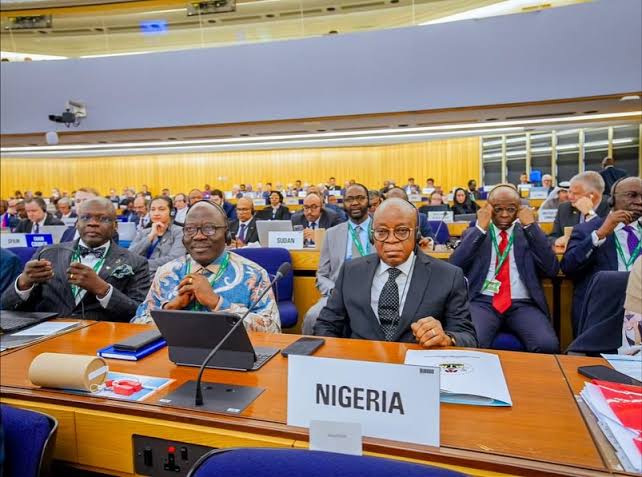
Nigeria has been a member of the International Maritime Organisation for decades. However, in 2007, she made her first successful move for a seat in Category ‘C’ of the IMO Council. In 2011, exactly four years after securing the seat and after serving two terms, Nigeria failed to secure re-election into the council. Since then, Nigeria has lost out in subsequent quests to be re-elected back into the Council.
It is quite understandable therefore, that Nigeria is celebrating the November 28, 2025 victory. Yes, Nigeria deserves to win, not only because we campaigned seriously for it. But significantly because we have since grown from where we were in the last election cycles. We may not have the most superb credentials, but our maritime standing has grown, so has our ‘maritime diplomacy’ matured.
The backslap, the smiles of victory and the celebration dinner which was hosted last Monday by the Minister of Marine and Blue Economy; Dr Adegboyega Oyetola is worth it.
Now that the celebration is over, Nigeria must confront the harder question beneath the jubilation after its re-election into Category C of the IMO Council: What does this victory truly mean for a maritime sector that is still grappling with structural weaknesses that cost the country the same seat 14 years ago?
While the diplomatic achievement is commendable, it does not in itself signify progress. Securing a seat at the IMO is symbolic, but sustaining it requires measurable change—change that the sector has struggled to demonstrate. Beyond the applause in London lies the urgent need for Nigeria to address deep-seated gaps in regulation, operational efficiency, fleet development, and global compliance.
A major unresolved issue is Nigeria’s standing on the IMO “White List,” which affirms countries whose maritime training and certification processes meet international standards. Though Nigeria has made attempts at compliance, persistent concerns over training integrity, outdated facilities, and inconsistent regulatory oversight, continue to undermine global confidence in Nigerian seafarers. Without addressing these shortcomings, maritime manpower development—one of the chief pillars of global competitiveness remains compromised.
Closely tied to this is the challenge of internationally-recognised certification. Sadly, Nigeria continues to struggle with global acceptance of its Certificates of Competency (CoCs), limiting opportunities for its seafarers and weakening the nation’s reputation as a credible maritime labour source. Being on the IMO Council offers an opportunity to advocate, but advocacy must be backed by real institutional reform, not rhetoric.
Equally urgent is the need to grow Nigeria’s tonnage and enhance its status as a ship-owning nation. No country can be deemed a serious maritime power, without vessels flying its flag. Yet Nigeria remains largely absent from the global shipowners league, relying almost entirely on foreign tonnage to move its cargoes. Indigenous shipping development continues to be stifled by lack of financing, high operational costs, weak Cabotage enforcement, and poor regulatory support. If Nigeria does not build or acquire ships, its influence at the IMO will remain inconsequential.
Flag administration also requires a complete overhaul. Nigeria’s flag registry, which should be a credible platform for vessel registration, still faces issues of compliance, competitiveness, and global trust. Countries with whom Nigeria will be seating at the IMO table maintain strong, transparent, and reputable flag administrations that attract international tonnage. For Nigeria, improving vessel registration processes, enforcing compliance, and building a credible safety record are non-negotiable steps toward becoming a respected maritime nation.
The victory at the IMO should therefore be viewed as a wake-up call, rather than an achievement in itself. It offers Nigeria a second chance—an opportunity to rebuild relevance, redefine priorities, and demonstrate seriousness to the global maritime community. But this can only happen if the country commits to genuine reforms across training institutions, regulatory agencies, enforcement architecture, port systems, and shipping development.
Celebration alone cannot sustain Nigeria at the IMO table. Only results can.
If the nation must remain relevant beyond this two-year tenure, it must urgently transform the structures that define its maritime identity. The world will not be swayed by speeches or diplomatic visits; it will judge Nigeria by the strength of its institutions, the credibility of its certifications, the safety of its waters, the efficiency of its ports, and the presence of its ships on global trade routes.
Nigeria has returned to the Council. Remaining there—meaningfully and credibly, depends entirely on the reforms it chooses to pursue from this moment.