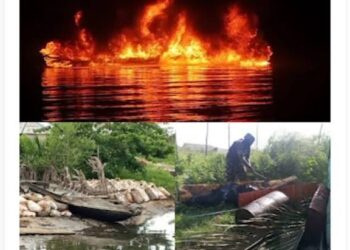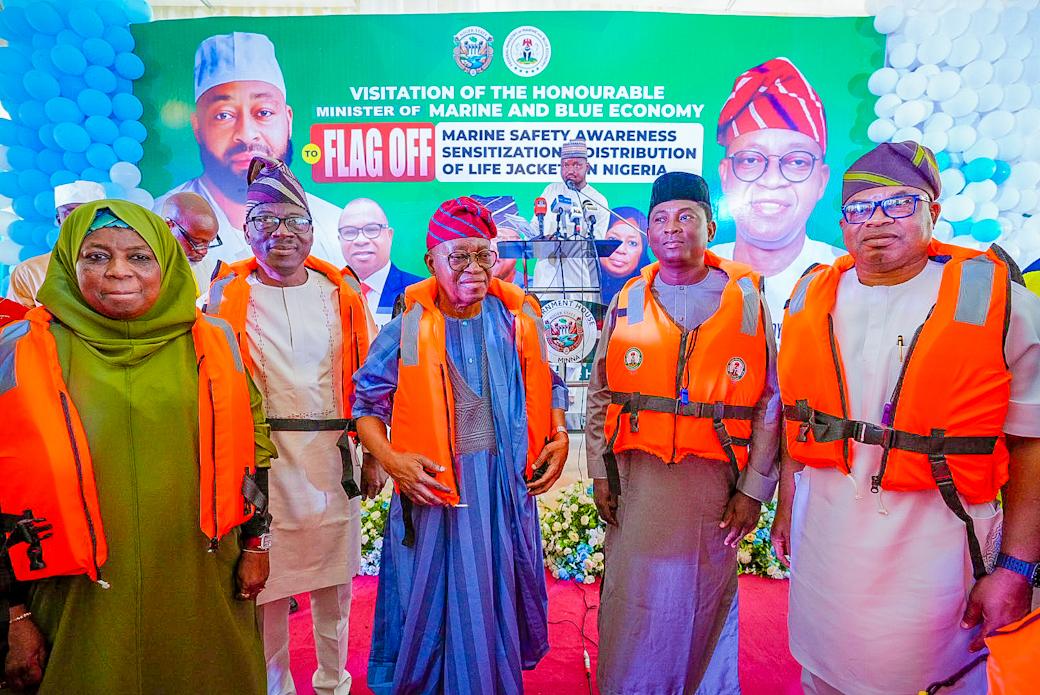
The spate of boat mishaps across Nigeria, particularly in the northern states, has become a recurring national tragedy. In Sokoto alone, more than three fatal accidents have been recorded this year, with dozens of lives lost in each. From Kebbi to Niger, Kwara to Anambra, the death toll from capsized wooden boats has grown steadily, leaving behind heartbroken families and communities in perpetual mourning.
Nigeria has more than 10,000km of navigable inland waterways. This comprises of rivers, creeks, lagoons, lakes and intra-coastal waters. The nation’s main rivers are Rivers Niger and Benue. Both rivers form a confluence at Lokoja, in Kogi State. Several brown waters across about 28 states flows in both Niger and Benue rivers.
Available facts indicate that River Niger is the longest river in West Africa and eleventh longest in the world. The river and its main tributary (which is River Benue), the delta creeks as well as the lagoons bordering the coast, form the principal navigable waterways in Nigeria.
It is also instructive that these principal navigable waterways are the major transportation routes linking Apapa, Tin Can, Warri, Port Harcourt, Onne and Calabar seaports and the numerous river ports and jetties.
Through the lagoon and the creeks, a water transportation route is established between the hinterland and urban centres of Nigeria on River Niger. This goes as far as Niamey in the Republic of Niger and Garua in Cameroon on River Benue.
This beautiful interconnectivity helps the riverine community to link-up with themselves and the larger society. However, this has brought more pains than pleasure, ruins than boom. Accidents on Nigerian waterways have become a norm.
And just as this page was being penned, news of yet another fatal mishap happened in Niger state, taking the lives of 29 persons, with several still unaccounted for.
Perhaps reading from a familiar script, the Director General of the Niger State Emergency Management Agency (NSEMA), Abdullahi Baba Arah, said the accident occurred on Monday. Again, preliminary findings showed that the mishap was caused by overloading and a collision with a submerged tree stump.
Sadly again, it was disclosed that none of the passengers wore life jackets, despite repeated sensitization and government directives on water safety in the state.
These incidents expose the fragility and vulnerability of Nigeria’s inland water transport system. At the center of this crisis is the Nigerian Inland Waterways Authority (NIWA), the statutory regulator of water transportation.
The National Inland Waterways Authority was established by Decree No. 13 of 1997 (now an Act) and charged with a clear mandate to manage Nigeria’s vast inland waterway resources.
The law vests in NIWA the power of exclusive management, direction and control on the Nigerian inland waterways. This power is exercised on Nigeria’s 3000km of navigable waterways from the Nigeria/Niger and Nigeria/Cameroon borders to the Atlantic Ocean.
Sadly, for too long, NIWA has struggled with inadequate enforcement capability, weak oversight, and limited presence in the vast riverine terrains which it is tasked to monitor.
Yes, the agency cannot absolve itself of blame. However, to point fingers only at NIWA is to ignore a critical truth – state governments, under whose jurisdictions these tragedies occur, have failed to provide the complementary support needed to make water transport safe.
Lagos presents a sharp contrast. While not completely accident-free, its waters are among the safest in Nigeria; thanks largely to consistent investment by the state through the Lagos State Waterways Authority (LASWA). Although a court judgment affirms NIWA’s primacy as the regulator of inland waterways, Lagos’ experience shows that where state governments support regulation with infrastructure, awareness campaigns, and emergency response capacity, tragedies are minimized.
The difference is glaring, the results are glaring. In Lagos, commuters are more likely to see patrol boats, access life jackets, or encounter public enlightenment on water safety. In Sokoto, Niger or Kebbi, by contrast, passengers often board dilapidated wooden canoes—without safety gear—on waters with no visible presence of authority and clear navigation markings and aids. The result has been catastrophic.
The Minister of Marine and Blue Economy; Mr Adegboyega Oyetola recently called for the phasing-out of wooden boats in favour of safer, fiber-reinforced alternatives. The directive is timely: nearly every major mishap this year has involved old, unsafe wooden crafts. Yet the minister’s words must be matched with action. Who will provide affordable alternatives for local boat operators? Who will monitor compliance in remote riverine communities? NIWA’s current skeletal structure, often reduced to a single area office per state, is insufficient. The Authority must urgently establish zonal offices across the states, staffed and equipped to enforce safety standards.
But NIWA cannot do it alone. State governments must play their parts too—not as regulators, but as partners. They can invest in jetties and terminals to encourage safer boarding. They can support the distribution of life jackets. More importantly, they must fund enlightenment campaigns to discourage overloading and unsafe night voyages; these must be enforced. They can provide emergency response units that complement NIWA’s oversight. These are practical interventions that do not conflict with NIWA’s statutory authority, but can save lives.
Beyond that, state governments must work with NIWA to domesticate and enforce safety policies at the community level. If a state like Lagos can demonstrate that collaboration and investment reduce accidents, other states have no excuse for indifference.
Perhaps, the Federal Government (through the National Assembly) should tinker with the exclusivity which NIWA currently enjoys with regards to navigating the nation’s waterways.
The truth is stark: every boat mishap represents not just a regulatory failure, but a governance failure. The deaths in Sokoto, Kebbi, Niger and other states were not inevitable; they were preventable. For as long as NIWA remains under-resourced and state governments remain disengaged and nonchalant, Nigeria’s rivers will continue to claim lives.
The time for condolences and empty promises is over. NIWA must deepen its presence and enforce the minister’s directive on safer boats. State governments must support with infrastructure, awareness, and rescue capacity. Together, they can transform Nigeria’s waterways from death traps into channels of safe commerce and connectivity.
Water transport should be a blessing, not a recurring curse. To achieve that, both NIWA and the states must act—decisively, collaboratively, and without delay.