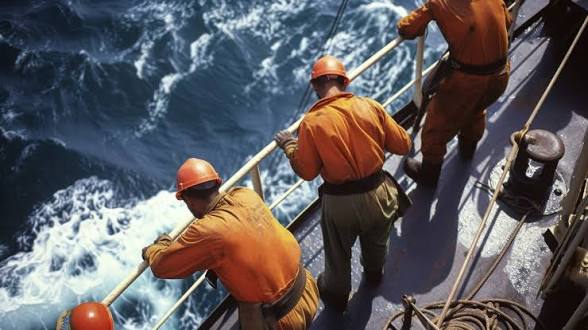
A new survey by the World Maritime University (WMU) found that U.S. seafarers face heavier workloads, higher stress, poorer mental well-being, and a greater likelihood of leaving the profession than their global counterparts.
The Officers’ Union of International Seamen (OUIS) commissioned the World Maritime University (WMU) to conduct the Work & Health Balance at Sea (WHEAB) project to examine some dimensions of seafarers’ working lives. Building on exploratory interviews, a survey was designed and administered. The current report presents findings on work patterns (onboard and home periods), working hours, work-related stress, safety management system, shore leave, mental well-being, and career intention.
The survey gathered responses from 4,372 seafarers, mainly from India (n=1,098; 25.1%), the Philippines (n=690; 15.8%), the United States (U.S.) (n=501; 11.5%), and other worldwide regions (n=2,083; 47.6%). The overrepresentation of U.S. seafarers, especially at higher ranks, was intentional, as this group was the primary target.
Long working hours and high stress levels
The findings point to persistently long working hours, limited opportunities for rest and shore leave, and high levels of work-related stress. Around one third of respondents were assessed as experiencing severe or potentially dangerous stress levels, while mental well-being scores indicate that a significant proportion of seafarers may be at risk of mental health problems. U.S. seafarers, a specific focus of the study, reported particularly heavy workloads, extended work hours, and administrative and inspection pressure despite shorter contract lengths.
Extremely low retention levels
The report also raises concerns about the future sustainability of the maritime workforce. Nearly half of all respondents indicated an intention to leave seafaring within the next five years, with poor mental health and dissatisfaction with working conditions emerging as key drivers.
According to the authors, these trends pose serious risks to safety, operational resilience and long-term recruitment and retention across the global shipping industry.
This timely study shows that, however much the working world ashore may change, seafarers are still confronted with major challenges in achieving a healthy and socially sustainable work/life balance
… said Nick Bramley, OUIS Executive Director, adding that from the numerous statements by working seafarers, it becomes evident that a major change is required if the industry is to not only retain those experienced seafarers in whose training so much time has been invested, but also to recruit the next generation.
Key findings for U.S. seafarers compared to the total sample are summarized below:
Work pattern
U.S. seafarers averaged 3.7 months per contract and expressed a preference for shorter onboard periods (2.8 months). For comparison, the global average is 5.7 months onboard period, with a preferred period of 4.5 months.
On average, U.S. seafarers spent about 6.5 months at sea per year, but would appreciate a 13% reduction in their annual sea time. On the other hand, the world average was reported at 7.3 months at sea per year.
Working hours
U.S. seafarers reported the longest weekly hours (79 hours per week), with 94.8% having no weekly day off. The global average was 71.3 hours per week, with 86.2% of seafarers having no day off per week.
About half of U.S. seafarers (52.9%) admitted adjusting work/rest records to cover the violation. In the overall sample, 64.0% of seafarers reported adjusting their records, demonstrating a stark stability over the last two decades.
On a yearly basis, seafarers reported working more or far more than their shore counterparts. U.S. seafarers reported working an average 2,225 hours per year, which is similar to other seafarers (2,275 hours) but 26.1% higher than the average U.S. shore workers (1,765 hours per year).
In addition, the latest Seafarers’ Happiness Index by Mission to Seafarers showed that responses on workload reveal a workforce under increasing pressure. While some report manageable levels, many paint a darker picture of excessive demands, inadequate rest, and unsustainable work patterns.
U.S. seafarers reported marginally higher stress levels than other groups. Worryingly, one-third of U.S. seafarers exhibited stress levels considered severe and potentially dangerous (33.9%), close to the global average of 32.8%.
U.S. seafarers identified ship inspections as the primary stressor, followed by onboard administrative duties, company communication, and port-related activities. This order of stressors was quasi-similar for all seafarers.
Safety Management System (SMS)
U.S. seafarers reported the most negative experiences across all measured SMS dimensions compared to other groups.
79.0% of U.S. respondents declared their SMS as too long, compared to 66.0% of the total sample.
Two-thirds (66.3%) of U.S. seafarers found SMS procedures generic and not ship-specific; similarly, 60.6% of global seafarers confirmed this.
71.0% of U.S. seafarers reported that their SMS did not reflect shipboard realities, considerably higher than the global average (45.1%).
Furthermore, 68.6% of U.S. seafarers considered SMS difficult and paperwork excessively time-consuming, compared to 59.3% globally.
About half (51.6%) of U.S. seafarers had submitted feedback to improve SMS; among them, 64.9% reported that their input was not taken seriously. Globally, 48.2% reported that their input was not considered.
Shore leave
While shore leave access seemed comparatively better for U.S. seafarers than for seafarers overall, it remained severely restricted in both groups, with 68.5% vs. 76.9% reporting that they “never” or “rarely” go ashore.
Workload and insufficient port time remained the top barriers across the U.S. and other groups.
In the 2025 SEAFiT Crew Survey, covering 1.7K ships and 22K seafarers worldwide, shore leave challenges were explored in a dedicated section, revealing very low satisfaction levels, below 50%.
Mental well-being
The WHO-5 questionnaire revealed that nearly half (48.2%) of U.S. seafarers reported poor mental well-being, well above the average (37.2%) and the general population.
Career intention
Worryingly, nearly half of the whole sample expressed the intention to quit seafaring within the next five years by exhibiting various stages of preparation.
Less than half of U.S. seafarers (40.2%) intended to stay in a sea career over the next five years, slightly lower than the overall sample (45.2%).
Notably, poor mental health was common reported by U.S. seafarers planning to quit (65.3%) compared to those intending to stay (34.9%).
Overall, the findings reveal a severe crisis across the seafaring workforce, with U.S. seafarers appearing particularly affected by significant occupational challenges.
While U.S. seafarers benefit from shorter contracts, this advantage is hampered by excessive workloads, demanding administrative burdens, extended work hours, high work stress, and severely limited shore leave.
The combined effects of inspection pressure, administrative burden, and challenging communication with companies dangerously elevate unsustainable stress levels among seafarers, particularly U.S. seafarers.
The impacts of such high stress are confirmed by widespread reports of poor mental well-being, potentially leading to mental health troubles.
Work-related factors and dissatisfaction with well-being trigger an alarming response among seafarers, with nearly half intending to exit the industry in the near future.
Addressing job stress and pressure is critical to safeguarding seafarers’ health and well-being and to ensuring the sustainability of the maritime workforce.
Without serious, immediate consideration for seafarers’ welfare, the shipping industry as a whole, and the U.S. maritime sector in particular, may face a recruitment crisis and the loss of vital operational know-how.
Meaningful improvement requires targeted, evidence-based policy-making and a genuine commitment to further integrating human-factors science within the maritime regulatory framework