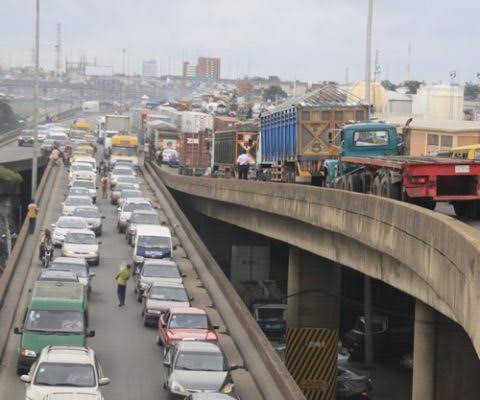
The Marine Bridge in Apapa was constructed in phases between 1965 and 1975, making it around 50 to 60 years old. It was constructed largely to help reduce severe traffic congestion in Lagos.
No doubt, since its construction, it has served as a vital transportation artery for moving imports and exports to and from Lagos ports.
However, due to the volume of cargoes that pass through it, especially by articulated vehicles, and years of intense use, this has led to a number of repairs and rehabilitation, with one of the most significant closures occurring in August 2016.
The first major closure of the Marine Bridge was in August 2016, following a fire that damaged the structure.
The then-Minister of Works ordered the immediate closure, and emergency repairs began the next day. Prior to this, there had been various forms of traffic diversions and maintenance, but this 2016 event marked the start of a period of more significant and recurring repair closures.
Since the 2016 repairs which lasted for six months, the exercise has become an almost annual ritual. For instance, it was closed for four months in 2017, six months in 2018, five months in 2020, and three months in 2021. In 2022, it was partially closed for three months (January 7 to April 2) for emergency repairs. In 2023, lane diversions lasted for about three months in February, followed by a 41-day closure from November to December. In 2024, another three-month rehabilitation was ordered from December through February 2025.
And recently again,, the Lagos State Commissioner for Transportation, Mr. Oluwaseun Osiyemi, announced another closure of the bridge for 15 days — from Saturday, October 11, to Saturday, October 25, 2025 — to allow for urgent maintenance by the Federal Ministry of Works.
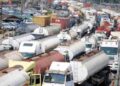
We quite appreciate that the bridge has become an indispensable route into and out of Apapa. The bridge carries hundreds of articulated trucks laden with dry and wet cargo, including petroleum products, daily.
There is no doubt that the bridge is old, but there are salient issues to be addressed in the quest for a solution: Can the structure withstand periodic repairs, without endangering the lives of people? Can motorist and other stakeholders continue to take the risk of its continued usage? Also, can everyone including motorists and Lagosians generally bear the pains of traffic diversion, giving the geography of the location of the bridge?
Officials of Lagos state government have confirmed that there are manifest defects which affect the section from the foot of the bridge at Lawani Oguntayo Road (by UBA, in-bound Apapa/Costain), as well as the stretch between Ijora Badia and Lilypond Access Ramp (in-bound Apapa).
When our correspondent visited the bridge abiut two weeks ago, that is in the midst of the latest repairs, he reported that the bridge’s condition had severely deteriorated, with several sections have broken rails, deep potholes, and un-motorable portions that pose grave risks to container-laden trucks and other motorists.
Even without any major reconstruction, the maintenance repairs worsened traffic gridlock, as truckers and other motorists were forced to use alternative routes, making movement in and out of the port corridor extremely hectic.
The fact that the bridge is very strategic to operations at Lagos seaports, especially Apapa port – the nation’s largest seaport, makes it imperative that a well-thought-out action plan that will take cognizance of the importance of the bridge and the consequences of its closure for a permanent solution, is highly desirable.
The incessant closure affects movement of trucks in and out of the port. These trucks remain the primary means of cargo evacuation from the seaports, hence when there is no free flow of traffic, cargoes are held up in the port and when this happens, it impacts negatively on economic activities in the country.
Reconstructing the bridge will come at a huge price, especially the traffic bedlam that will come up. The greater danger in this is the attendant cargo backlogs at the port, which will inevitably lead to port congestion and vessel queue. Port congestion will also mean that importers and agents will have to pay more to clear their cargoes from the port, the cost of which will eventually be borne by the masses.
These are the challenges that the closure of the bridge will throw up as it has always done. But, the truth is – there is no alternative to total reconstruction of this bridge.
This will come with pains and inconveniences, but it is inevitable, especially in the face of the current state of the almost 60 years old bridge. Keeping the facility as it is presently is, is akin to postponing the evil day.