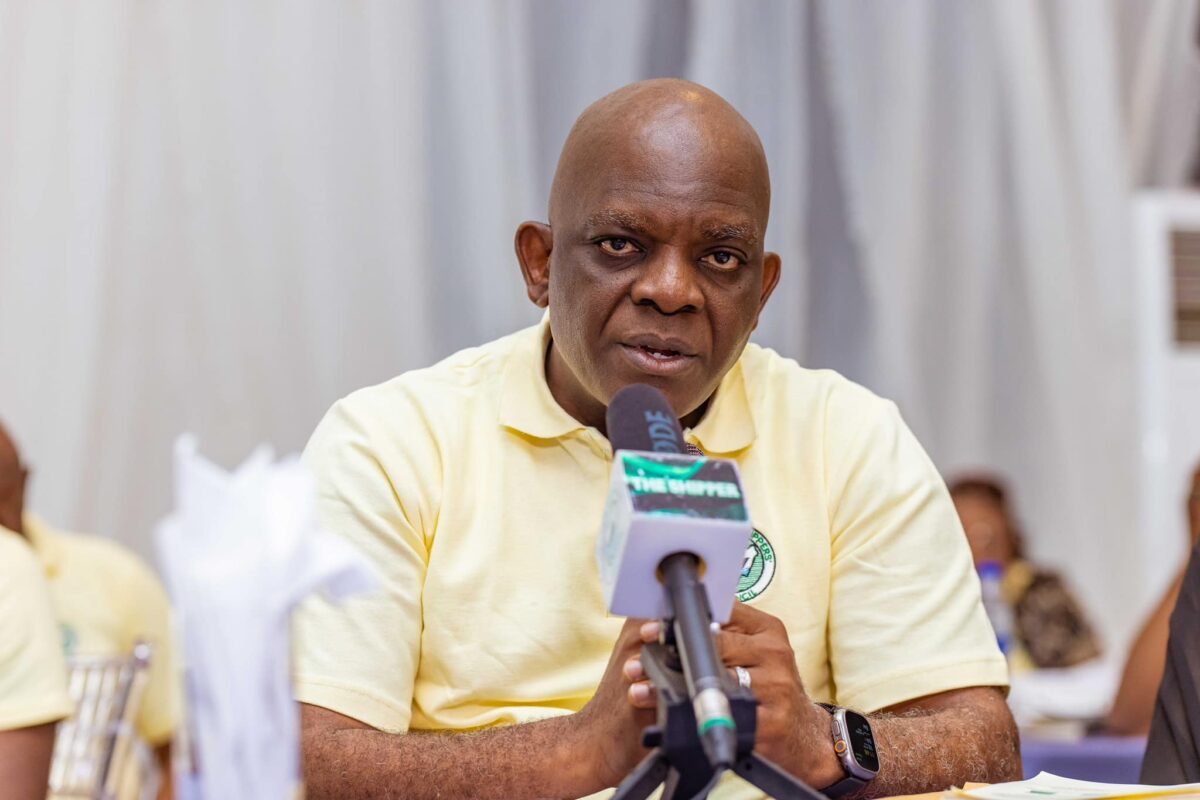
Mr Akutah Pius Ukeyima, MON is the Executive Secretary/Chief Executive Officer of the Nigerian Shippers’ Council. In this media interaction which held last week at the commencement of the Council’s management retreat in Ibadan, he speaks about the imminent transformation of the Council and issue connected to it. It was attended by Joshua Yousouph
Could you please start by sharing what brings us all together for this significant management retreat?
Thank you for having me. With profound honor, I welcome you to this transformative management retreat. Today, we embark on a pivotal journey to define the future of the Nigerian Shippers’ Council (NSC) as it transitions into the Nigerian Port Economic Regulatory Agency (NPERA). This retreat marks a critical step in shaping a comprehensive 5-year strategic plan for 2025–2029, designed to advance the maritime sector through enhanced efficiency, adaptability, and innovation.
What would you say are the significant achievements of the Nigerian Shippers’ Council in the past year?
The Nigerian Shippers’ Council has a proud legacy of resilience and impact. We have been protecting shippers’ interests, fostering fair trade practices, and driving competitiveness within our ports. Over the past year, we’ve recorded remarkable achievements, including signing the Minimum Standards of Conditions of Service for Workers in the shipping industry, launching the Operational Manual for Inland Dry Ports, and hosting the 17th International Maritime Seminar for Judges. We also rolled out the Online Registration Portal for regulated port service providers and users, and developed the E-Regulatory Process Portal (ERPP) and the Confirmation of Reasonableness of Demurrage, Freight Rate, and Charter Party Fees (CRD) portal. Through robust complaints handling mechanisms, we have recovered billions of naira. Additionally, we introduced a Leadership Development Programme aimed at strengthening institutional capacity through succession planning.
Looking ahead, how does the Nigerian Shippers’ Council plan to drive further change, particularly with the transition to NPERA?
The transition to NPERA is a crucial next step. As we look to the future, we are strategically anchoring our 2025 budget on the 1% freight stabilization fee, which will commence collection upon Presidential assent to the NPERA Bill. This move is essential to positioning the council for greater regulatory effectiveness. Additionally, we are focusing on four key strategic priorities during this retreat: strengthening stakeholder engagement, promoting transparency and fairness through predictable regulatory policies, enhancing operational efficiency for a seamless transition to NPERA, and driving sustainability by aligning economic growth with environmental responsibility.
You mentioned the 1% freight stabilization fee. Can you elaborate on how this will function and its impact on stakeholders?
The 1% freight stabilization fee is designed to be collected once freight fees are paid to the shipping companies. Importantly, it’s not an additional cost to stakeholders; rather, it’s a stabilization fee that will ensure the sustainability of the council’s operations. This fee aligns with existing provisions in the law and supports the transition to NPERA. The implementation of this fee will help enhance the financial stability of the council and ensure that we are better positioned to regulate and oversee the maritime sector.
In your speech, you mentioned that the budget of the council is tied to the 1% interest compensation. Does this mean that without the passage of the bill, the council will not be able to spend any money this year?
The Nigerian Shippers Council Act, CAP N133, laws of the Federation, 2004; essentially the 1978 law that established the Nigerian Shippers Council provides for the implementation of the 1% freight fee as a funding source for the council. Over the years, this provision has not been implemented, which has made it difficult for the Nigerian Shippers Council to adequately fund its activities. We believe that you cannot selectively implement parts of the law while ignoring others. Since this provision remains a valid part of Nigerian law, we have decided it must be implemented. The argument that implementing the 1% freight fee adds to the cost of doing business in the sector is not accurate. We conducted a cost-benefit analysis, and the benefits of implementing the 1% freight fee far outweigh any costs. So, in the 2025 budget, we have included this as a source of income for the council. This will help position the council better, especially as it transitions into the Nigerian Port Economic Regulatory Agency. Stronger regulations will support the president’s economic policies, drive trade facilitation, and grow the economy as we saw in 2024.
What is the current state of the NPERA Bill, and what is the expected timeline for its implementation?
The NPERA Bill has passed through both chambers of the National Assembly- the House of Representatives and the Senate, and is currently awaiting Presidential assent. However, the lawmaking process doesn’t end there. The bill is undergoing a phase known as “cleaning,” where final revisions are made before it can be formally enacted. We are optimistic that once the President assents to the bill, we can proceed with its full implementation and the transition to NPERA.
Without the President’s assent, can the government proceed with implementing this law?
The new law will effectively set a new course for the sector, promoting the efficiency we’ve all been yearning for. But yes, the president’s assent is necessary for implementation.
Now, shifting focus to the International Cargo Tracking Note, there have been concerns about its delayed implementation. Can you provide reassurance regarding its progress?
I understand the concerns regarding the prolonged delay in implementing the ICTN. However, let me assure you that these delays were primarily due to previous contractual obligations that didn’t work out as planned. The good news is that we are making steady progress now. The Honorable Minister of Marine and Blue Economy is working closely with all relevant stakeholders to ensure that all outstanding issues are resolved, and the implementation of the ICTN will be seamless. Stakeholders are actually eager to see this come to fruition, because of the security it promises for cargo entering the country. Nigeria is not the only country implementing the ICTN—other countries have already adopted it, and we are aligning ourselves with these global standards. We anticipate that the ICTN will be implemented by the second quarter of this year.
Concerning the ICTN, stakeholders have raised concerns about fears of added costs. Can you address these issues?
I don’t believe there’s any fear from stakeholders about costs associated with the ICTN. On the contrary, stakeholders are eager for its implementation because it ensures the security of cargo entering the country. Nigeria is lagging behind other countries in implementing the ICTN.
What is the council’s budget for 2025?
Our budget is based on three streams of revenue. First is the 2% of 7% port development levy, which we receive quarterly. This has been grossly inadequate to run the council’s activities. Secondly, the International Cargo Tracking Note (ICTN), which has been championed by the Honorable Minister of Marine and Global Economy; His Excellency Adegboyega Oyetola. Stakeholders are eager for the ICTN’s implementation because of the economic value it will bring to the country in terms of revenue generation and also the security of cargo that comes into the country. So, all of these factors, these reasons, necessitate all of the efforts that the Minister is doing to ensure the implementation of that International Cargo Tracking Note. Also, the 1% freight fee which I mentioned earlier. These three streams will provide the council with better financial standing in 2025, provided the budget is approved by the National Assembly. We are preparing for budget defence early next month.
What are your expectations for this strategic management retreat, and how do you hope it will influence the future of the Nigerian Shippers’ Council?
This retreat is not just a planning session; it’s a collaborative platform for crafting actionable solutions. We have clearly defined roles for each Directorate, and everyone’s expertise, creativity, and dedication will be vital in laying the foundation for a competitive, inclusive, and sustainable maritime sector. The focus of this retreat is on preparing for the smooth transition to NPERA, ensuring operational efficiency, and strengthening collaboration among stakeholders. This is a defining moment for the Nigerian Shippers’ Council, and I believe that by uniting our efforts, we can create a future that is grounded in innovation, excellence, and progress.