In its 2020 report on Greenhouse Gas Emission, the International Maritime Organisation (IMO) estimated that total shipping emitted 1,056 million tonnes of CO2 in 2018, accounting for about 2.89% of the total global anthropogenic CO2 emissions for that year, and that under a voyage-based allocation method, the share of international shipping represented 740 million tonnes of CO2 in 2018.
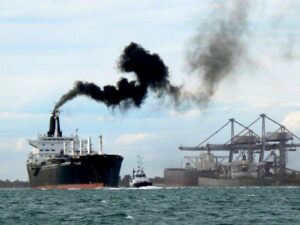
According to a range of plausible long-term economic and energy business-as-usual scenarios, emissions could represent 90-130% of 2008 emissions by 2050.
In this regard, IMO has been actively engaged in a global approach to further enhance ship’s energy efficiency and develop measures to reduce GHG emissions from ships, as well as provide technical cooperation and capacity-building activities.
This is evident in the number of across-the-globe engagement with stakeholders, including ship owners, shipping operators, port operators, regulatory agencies and many others.
To push this further, the IMO has enacted two regulations on energy efficiency for ships, which comprises of Energy Efficiency Design Index (EEDI), which requires new ships to comply with minimum mandatory energy efficiency performance levels, increasing over time through different phases, and Ship Energy Efficiency Plan (SEEMP), which establishes a mechanism for shipowners to improve the energy efficiency of both new and existing ships using operational measures such as weather routing, trim and draught optimization, speed optimization, just-in-time arrival in ports, etc.
Ahead of the 2050 deadline, attention is now shifting to sea transportation and the Federal Government of Nigeria has also assured that it would ensure that shipping in Nigeria works towards the target.
The assurance has come from the Minister of Transportation, Muazu Sambo, while other relevant agencies and stakeholders are also singing the same song.
There is no doubt that, Greenhouse Gas (GHG) emission is the number one contributor to global warming. It is however not just a product of in-land transportation, industries and other anthropogenic effect, but also the maritime and shipping industries.
Transport sector emissions have grown faster than those of other sectors over the past 50 years and emits around 23 per cent of the energy-related Carbon dioxide (C02) that contributes to global warming.
Experts say that, the transport sector currently produces 14 per cent of total anthropogenic GHG emissions, adding that emission levels are expected to reach 40 per cent by 2030 and 60 per cent by 2050, generated primarily from fossil fuels burned for road, rail, air and marine transportation.
Specifically, an expert and the Group Managing Director, Organizational Development & Management Experts Consulting (ODMEC); Mrs Anthonia Ekpa said, nearly three-quarters of the total transport GHG emissions stems from road transport, followed by aviation (13.9 per cent), maritime transport (13.3per cent) with railways and other transport modes (inland waterway transport, pipelines) amounting to one per cent.
According to other experts, many countries, including Nigeria, are still struggling with managing carbon blueprints resulting from transport and logistics-related activities.
They also noted that transport and logistics activities ranked higher among the largest contributing factors to greenhouse gas emission.
Back home in Nigeria, the fears are obvious; that Nigeria, like most developing nations faces the challenge of decarbonisation and green shipping.
Available data shows that, although Nigeria does not produce nearly as much greenhouse gas pollution as the United States and China, it produces the 3rd highest amount of GHG in Africa; just behind South Africa.
Of course, Nigeria is not lacking in discussions and awareness creation about green shipping and greenhouse gas emission.
In Nigeria too, shipping and port activities contribute significantly to emission. While efficient ports are vital to the economic development of their surrounding areas, the related ship traffic, the handling of the goods in the ports and the hinterland distribution can cause a number of negative environmental impacts.
With six ports located in Lagos, Calabar, Onne, Port Harcourt and Delta, the nation also contributes to GHG emissions. If we include the Lekki Deep Sea Port which is now completed and ready for business, this makes the number of seaports to be seven.
Contributing to these emissions is the high number of factories and high pollutant-emitters located within and in the environment of Nigerian ports. Road traffic to and from the ports area cause additional environmental problems.
As Nigeria’s GHG emissions continue to rise, the government has made multiple outings to help slow the rising rates, but is absence of substantial policy intervention.
As far back as 2017 the country made a climate pledge to reduce GHG emissions by 20% by 2030, assuring that she would expand a roll-out of solar energy production. However, GHG emissions from fossil fuels have continued to increase.
And recently, the Federal Government assured that it will ensure that carbon emissions reach zero level by 2050. The Minister of Transportation, Muazu Sambo said in Lagos that Nigeria was duty-bound to contribute to global efforts to ensure a safe environment in all sectors, including shipping.
Also, the Director General, Nigerian Maritime Administration and Safety Agency (NIMASA), Dr. Bashir Jamoh, assured that Nigeria had planned to cut its greenhouse gas emission intensity by 20per cent by 2030 and a further 45per cent on receiving climate finance, technology transfer and capacity building.
He also added that the nation needs to establish a National Technical Committee on Green House Gas emission reduction and decarbonisation.
We also take note of what the Managing Director, Nigerian Ports Authority (NPA); Mohammed Bello Koko said while addressing chief executives of ports and stakeholders from West and Central Africa at the meeting of Port Management Association of West band Central Africa (PMAWCA), which ended in Luanda, Angola recently.
He had said that as a build-up to developing a decarbonized port system, the NPA is working towards a fully-automated port system, where vehicular and human interface will be reduced.
We recall that he had earlier raised the alarm about the high cost implication of decarbonisation and greener shipping and the implication on ports in Africa. He consequently called for localized solutions to decarbonisation and green shipping.
From his submission, two things stood out: The cost of green shipping and decarbonisation is high and will be a burden on African ports, Nigeria inclusive. His second point us the need for a localized solution to efforts to decarbonize.
Read Also: How do you think Nigeria can meet the IMO decarbonisation deadline of 2050?
We take a serious note of the above and we align with that position. Nigeria lacks concrete policies regarding decreasing their GHG emissions or mitigating climate change effects.
Analysts posit that, Nigeria has abundant sources of renewable energy but lacks adequate government backing to harness these resources for electricity power. Nigerian shortcomings regarding climate governance is an issue of follow-through.
We agree that bringing environmental efficiency and digitisation to the maritime industry is a duty everyone owed the habitat. It is the same with Nigeria
Nigeria’s shipping industry needs people and policies to implement shipping’s decarbonisation journey.
Yes, alternative fuels and green technologies can help meet emission reduction targets. But, it requires determination on the part of the government and heads of relevant agencies to see this through.
Shipping is global and the world will not wait for those who are not ready. As much as localizing solutions is okay, it can not be done in isolation from the global community.
To solve the problem of funding, Nigeria should seek funding from the available purse at the World Bank.
In conclusion, the quest for decarbonisation can not be achieved without carrying the seafarers along. Seafarers are at the hearth of it, and they must have appropriate training for a smooth transition to a greener future.
shippingposition
Kindly like us on Facebook/twitter